 Yucel F. Sahan
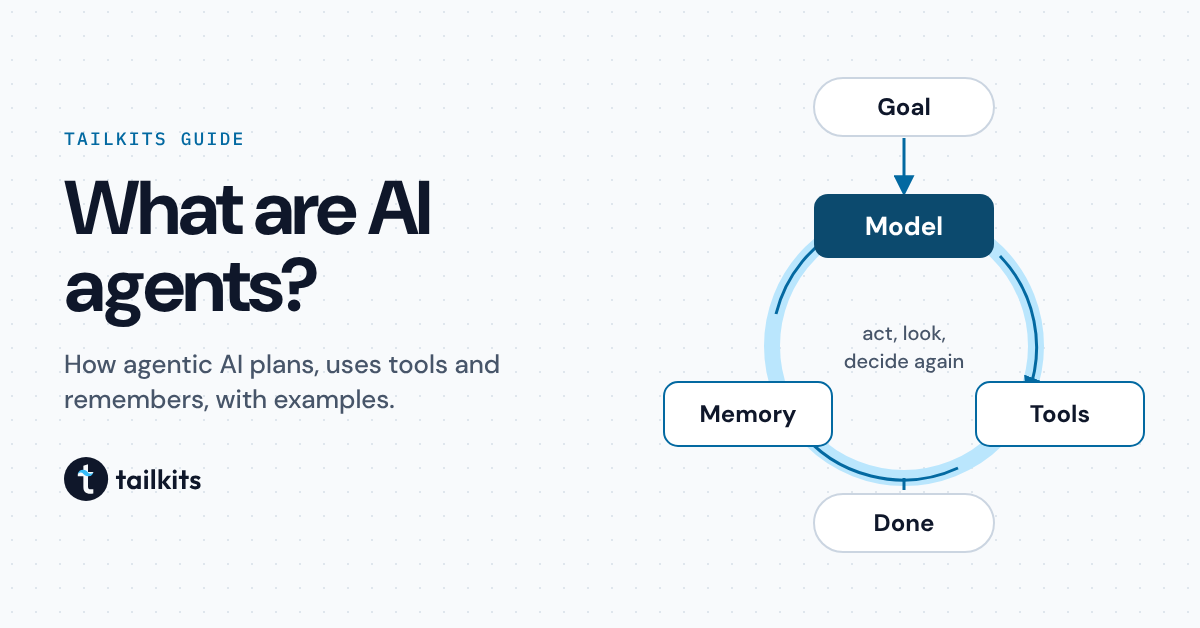
An AI agent is a program that takes a goal, works out the steps itself and uses tools, such as a browser, your files or your apps, to carry them out. A chatbot answers your message and stops. An agent keeps going until the job is done, it gets stuck, or it needs your approval.
This guide explains how agents work, how agentic AI differs from AI agents, the kinds of agents you can use today with real examples, and what it takes to build one.
What is an AI agent?
Ask a chatbot to set up a call with three people next week and it writes you a polite email. Ask an agent and it reads the calendars it can access, finds a free slot, sends the invitations and tells you when everyone has accepted. The language model inside can be the same. The difference is what surrounds it: tools it can call, a memory of what it has done, and a loop that lets it act, look at the result and decide what to do next.
That loop is why agents are useful and why they need care. An agent that can send email can send the wrong email, and it does not ask first unless it was built to.
How an AI agent works
Almost every agent, from a weekend project to a product from an AI lab, is built from the same four parts.
A model. A large language model reads the goal and the results so far and decides the next step. Stronger models plan longer tasks and take fewer wrong turns, and each step costs more.
Tools. Functions the model can call: search the web, open a page, read or write a file, run a command, call an API. Many agents now get their tools from MCP servers, a standard way to plug a service into any agent.
Memory. The conversation so far, notes the agent keeps between sessions and documents it can look up. Without memory an agent repeats itself; with too much it gets slow and expensive.
A loop with limits. The agent acts, looks at the result and repeats until it decides it is done, reaches a step or budget limit, or stops to ask you.
Stripped down, the core of an agent is a short loop:
goal = "Find three venues in Lisbon for 40 people in May and email me a comparison"
history = [goal]
steps = 0
while steps < 30:
    step = model.decide(history, tools)    # a tool call or a final answer
    if step.is_final_answer:
        break
    result = run_tool(step.tool, step.arguments)    # search, browse, send email...
    history.append((step, result))
    steps += 1
Everything around that loop, from retries, approvals and saved state to logs and spending limits, is what separates a demo from an agent you can trust with your accounts.
Agentic AI vs AI agents
The two terms are often used for the same thing. A useful way to tell them apart:
Agentic AI is the approach: AI systems that pursue a goal with some independence, plan, use tools and try another way when something fails. It describes a property, so a product can be more or less agentic.
An AI agent is one program built that way, with a job, a model, tools and limits. Hermes Agent, the AI Agent node in n8n and Claude are AI agents.
Agents are also easy to confuse with chatbots and with workflow automation:
| Chatbot | Workflow automation | AI agent | |
|---|---|---|---|
| Who decides the steps | You, one message at a time | You, in advance | The model, as it goes |
| Uses tools | Rarely | Yes, the ones you wired in | Yes, and it picks which |
| When something unexpected happens | It asks you | It fails or follows a branch you drew | It tries another way |
| Best for | Answers and drafts | Processes that never change | Tasks whose steps change each time |
Many products mix them. n8n is workflow automation with an AI Agent node, so you can put an agent inside a fixed process and keep the steps that must not change outside it.
Types of AI agents, with examples
As of November 2026, the agents people use fall into five groups. Each example links to its Tailkits review.
Personal agents you host yourself
Hermes Agent and OpenClaw are free and open source, work with any model and talk to you in chat apps such as WhatsApp and Telegram. They are the most capable kind and the riskiest: by default their tools run on the machine you install them on, so run them in a container or a virtual machine, and read a skill before you install it.
Agents from the AI labs
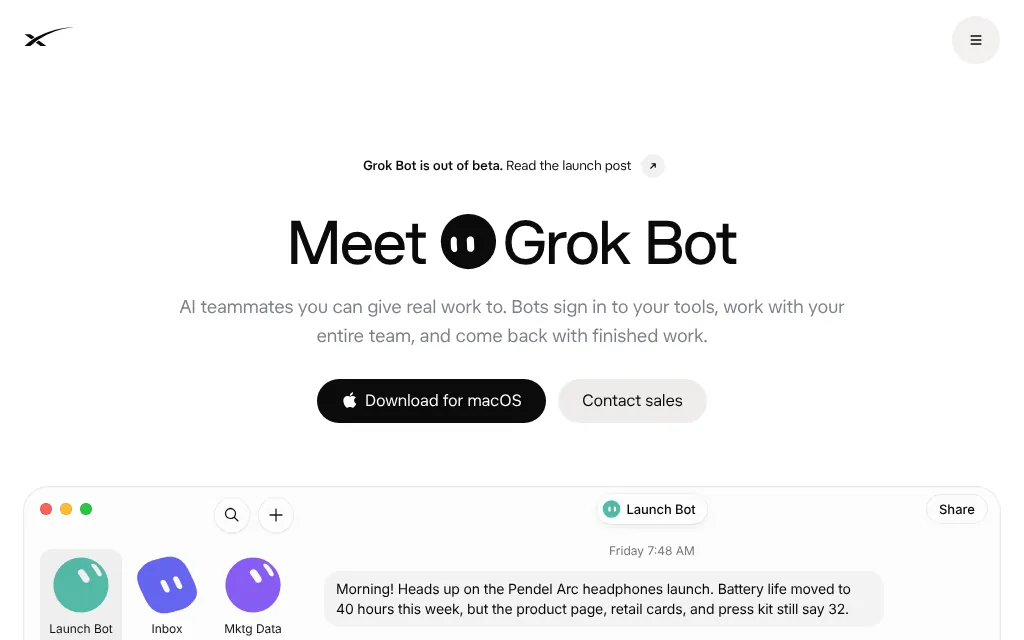
Claude comes with every paid Claude plan, from $20 a month, and works in folders on your computer, with scheduled tasks in the cloud. Grok Bot, with The X Subscription from $30 a month, and OpenAI dots, with ChatGPT Pro from $100 a month, have their own cloud computer and keep working between chats.
Hosted agents
Manus needs nothing installed: you describe a task and it comes back with research, slides, a website or a video. It gives 300 free credits a day, but it does not publish what a task costs in credits.
AI agent builders
To make agents for your own team with little or no code: n8n adds an AI Agent node and a no-code agent builder to its workflow automation and is free to self-host under a fair-code license. Dify builds an agent from a chat and gives each one its own sandbox. Lindy is hosted only and learns routines you write in plain English.
Agent frameworks
To build an agent into your own product: LangGraph runs agents as graphs with saved state, and CrewAI organizes them into crews by role and goal, both in Python. Mastra is the TypeScript option, with a local Studio for testing.
Coding agents, which edit your repository and open pull requests, are a group of their own: see AI coding tools.
How to build an AI agent
Start with one job. "Sort support email and draft replies" works; "be my assistant" does not. A narrow job tells you which tools the agent needs and how to tell when it is done.
Pick a builder or a framework. If the agent works inside your team's tools, a builder such as n8n or Dify is faster. If it is part of your product, use a framework such as LangGraph, CrewAI or Mastra.
Give it only the tools the job needs. Every tool is something the agent can get wrong. Start with tools that only read; add the ones that send, pay or delete later.
Write the instructions like a brief. State the goal, what good output looks like, what it must never do and when to stop and ask.
Ask for approval before anything you cannot undo. Sending email, spending money, deleting files and posting in public should wait for a person to say yes, at least until you have watched the agent work.
Log every step and set a budget. Keep the model's decisions and the tool results so you can see why it did something, and cap the steps and spend per task.
What to check before you give an agent access
Instructions hidden in content. An agent that reads web pages, email or documents can be told what to do by them. This is called prompt injection, and no agent is immune to it, so limit what the agent can reach.
Where its tools run. An agent that runs commands on your computer can do anything you can. Give it a container, a virtual machine or a separate account.
Skills and plugins from others. Community skills are instructions and code written by strangers. Read one before you install it.
Your data. Check where conversations and files are stored and whether they are used to train the vendor's models.
Cost. A loop that goes wrong can run up model or credit bills. Set a limit per task.
Where to find AI agents
Tailkits lists the best AI agents, agent builders and frameworks, each with a review that names its price, where it runs and what to watch for. Start with one agent and one job, watch it work for a week, then give it more.
FAQ
What is an AI agent in simple terms?
A program that is given a goal and works toward it on its own: it decides the steps, uses tools such as a browser or your apps, checks the results and keeps going until the task is done or it needs your help.
What is the difference between agentic AI and AI agents?
Agentic AI is the approach: AI that pursues a goal with some independence, plans and uses tools. An AI agent is one program built that way, such as Hermes Agent, OpenClaw or the AI Agent node in n8n.
Is ChatGPT an AI agent?
Plain ChatGPT answers one message at a time. OpenAI's always-on agent is dots, included with ChatGPT Pro from $100 a month: it has its own cloud computer and keeps working between chats.
Are there free AI agents?
Hermes Agent and OpenClaw are free and open source, and n8n is free to self-host; you pay for the model you connect them to and the machine they run on. Manus is hosted and gives 300 free credits a day.
Do I need to code to build an AI agent?
No. n8n, Dify and Lindy build agents without code. To build an agent into your own product, LangGraph and CrewAI are Python frameworks and Mastra is a TypeScript one.