
Self-hostable workflow automation with AI Agent nodes and an agent builder
Manus
Hosted AI agent that turns prompts into research, slides, sites and videos
FreemiumAgents
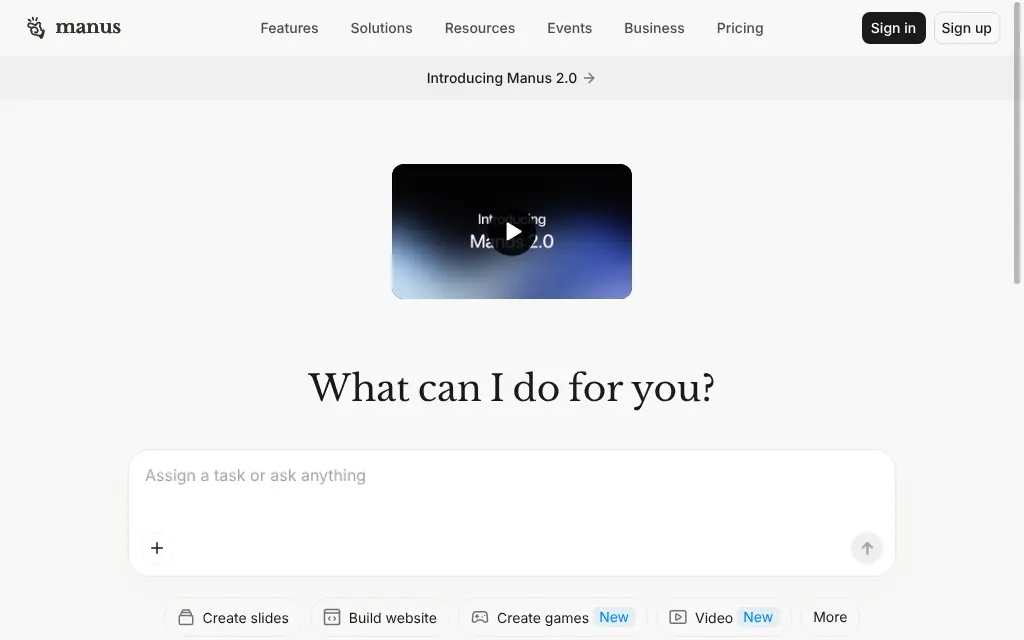
manus.imExplore the product
AT A GLANCE
Details about Manus
Short verdict: Manus is a hosted general AI agent: you describe a task in the web, desktop or mobile app (or in Telegram, Slack or email), and it works in its own cloud computer to return research, slides, websites, videos or games. Nothing to install or secure, a free plan with 300 credits a day, and Manus 2.0 (28 September 2026) added event-triggered automations, a video editor and rentable Cloud Computers. The weak spot is cost predictability: everything is billed in credits, Manus publishes no per-task price, and unused subscription credits expire each month. It suits people who want finished deliverables without running a server; developers who want an open, self-hosted agent should look at Hermes Agent or OpenClaw.
How we reviewed it: We did not create a Manus account or run a task, so output quality and real credit use are not tested here. On 12 November 2026 we read manus.im (home, pricing, features, models, team plan, updates and the Manus 2.0 announcement), the Manus help center articles on plans and credits, and news coverage of the company's ownership. Prices are as listed that day in US dollars.
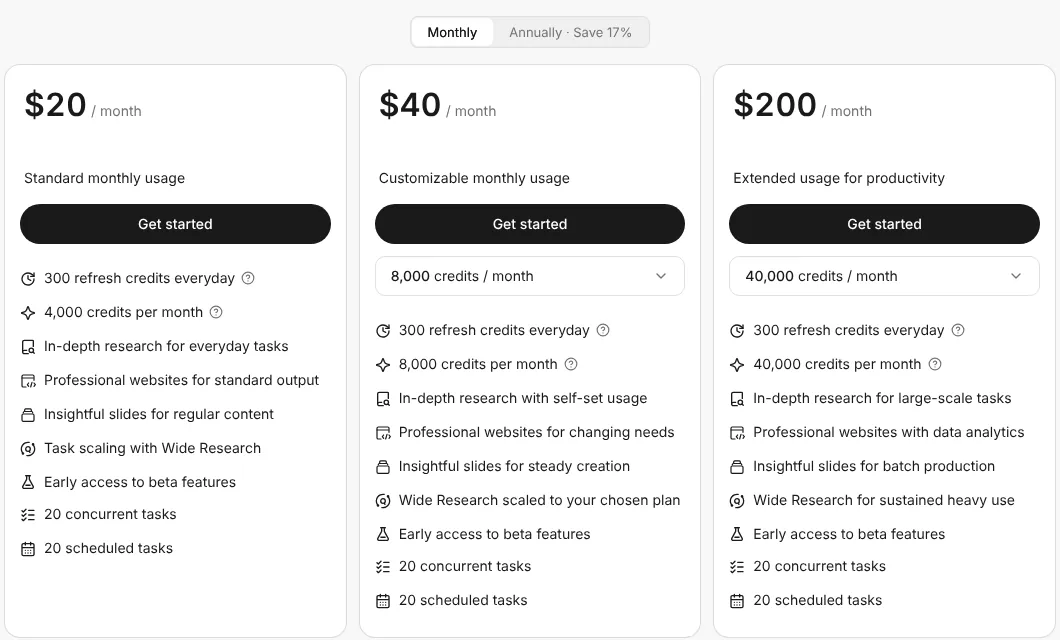
What Manus costs
| Plan | Price, 12 November 2026 | What you get, per Manus |
|---|---|---|
| Free | $0 | 300 credits a day that do not accumulate, capped at 1,500 a month and usable only with Manus 2.0 lite; 1 task at a time, 2 scheduled automations |
| Paid (entry) | $20 a month | 4,000 credits a month plus 300 a day; 20 concurrent and 20 scheduled tasks; Wide Research |
| Paid (adjustable) | From $40 a month | 8,000 credits a month, with larger credit levels in a selector |
| Paid (top) | $200 a month | 40,000 credits a month |
| Team | $20 per seat a month ($200 a year) | 4,000 credits per seat, pooled across the team; admin dashboard, audit logs, free guest users; SSO free from 30 seats, otherwise a $150 flat add-on |
Annual billing saves 17%. Subscription credits do not roll over; add-on credits do while you keep a paid plan.
Who owns Manus now
Manus is made by Butterfly Effect, a company founded in China and headquartered in Singapore. Meta agreed to buy it in December 2025 for about $2 billion, but China's National Development and Reform Commission ordered the deal withdrawn on 27 April 2026, and Meta reportedly began unwinding it in June (TechCrunch). Manus returned to independent operation and, on 8 October 2026, Butterfly Effect announced a round of more than $500 million led by Boyu Capital and IDG Capital, with Tencent, HSG and ZhenFund participating (TNGlobal). The product kept shipping throughout. If you read older coverage that calls Manus a Meta company, it is out of date.
What we found
A cloud computer that does the work
Each task runs in a sandboxed virtual computer with internet access and a persistent file system, so Manus can browse, run code and build files without touching your machine. Manus 2.0 introduced Cascade, its new agent harness, which Manus says used 23.2% fewer tokens and cost 32% less in one tested configuration. Wide Research fans a task out to many parallel subagents. The desktop app (since March 2026) can also work on your own files and apps through My Computer and Computer Use, but only in sessions you connect and authorize.
From chat to automations
Scheduled tasks became Automations in Manus 2.0: a new email, a calendar event, a Slack message or a Notion update can start a task. You can reach Manus in Telegram (since February 2026), Slack and by email ("Mail Manus"), and connect Gmail, Google Drive, Notion, GitHub, HubSpot, Zapier's 8,000+ apps and custom MCP servers. For always-on bots and multiplayer games you can buy a Cloud Computer, a dedicated machine that keeps running.
Media models are part of the bill
Manus picks models per task, or you choose: its models page lists video (Seedance 2.5, Veo 3.1), image (Nano Banana Pro, GPT Image 2.5), audio (Lyria 3.5, ElevenLabs) and 3D (Tripo). Since 29 September 2026, Manus Flex lets you plug in your own API key from a supported provider. Manus Studio's Video Editor keeps generated clips, music and text as separate timeline pieces you can edit by hand.
Credits are hard to budget
Manus's help center says credit use depends on a task's size and complexity and gives no per-task figures, so the $20 plan's 4,000 credits could be many quick answers or a handful of long builds. The free plan's 300 daily credits are meant "for quickly answering simple questions" and stop refreshing after 1,500 in a month. Check the usage shown after each task during your first week before choosing a plan.
Security and data
Manus states SOC 2 Type II and ISO 27001 certification and links a trust center. For teams it promises that it never allows model training on their data and adds SSO, SIEM integration and audit logs; the help center lists the training opt-out among Team plan features, so check the privacy settings on an individual plan. Because Manus is closed source and runs in its cloud, you are trusting the vendor rather than auditing code, and every connector you add (Gmail, Drive, Slack) gives the agent that access during tasks.
Pros and cons
Pros
Nothing to install, patch or sandbox; tasks run in Manus's cloud.
A usable free plan of 300 credits a day.
Finished outputs across research, slides, sites, video and games, with editable video timelines.
Event-triggered automations and many connectors.
Cons
No published credit cost per task; subscription credits expire monthly.
Closed source, cloud only for the agent itself.
Free credits are capped at 1,500 a month and limited to the lite model.
Ownership changed twice in 2026; terms could change again.
How Manus compares
Hermes Agent is open source (MIT) and free to self-host with any model; Nous Research's optional plans from $20 a month add one hosted cloud agent. Choose it for control over models and data, and memory you can read as files.
OpenClaw is free with no hosted tier, runs on your own machine and answers in 20+ chat apps. Choose it if you will run and secure a server yourself and want no subscription at all.
Claude comes with paid Claude plans (Pro from $20 a month) and can keep working in Anthropic's cloud. Choose it if you already pay for Claude and mostly work with documents and files.
See all AI agents.
Who should use Manus
Manus fits marketers, founders and analysts who want an agent to produce research, decks, landing pages or short videos from a prompt, and teams that want shared projects and pooled credits without any infrastructure. Try the free plan first and watch credit use. Skip it if you need predictable per-task costs, an open-source agent you can audit, or to keep data off a third-party cloud.
FAQ
Is Manus free?
Partly. As of 12 November 2026 the free plan gives 300 credits a day for simple tasks, usable only with Manus 2.0 lite and capped at 1,500 credits a month, with one task at a time. Paid plans start at $20 a month for 4,000 credits plus the daily 300.
How much does Manus cost?
Individual plans cost $20 a month (4,000 credits), from $40 (8,000 credits) and $200 (40,000 credits), and annual billing saves 17%. The Team plan is $20 per seat a month or $200 a year, with 4,000 pooled credits per seat. Unused subscription credits do not carry over to the next month.
Who owns Manus?
Butterfly Effect, a Singapore-headquartered company founded in China. Meta's roughly $2 billion acquisition, announced in December 2025, was blocked by Chinese regulators in April 2026 and unwound; Manus operates independently and raised more than $500 million in October 2026 from investors led by Boyu Capital and IDG Capital.
Is Manus open source?
No. Manus is a closed-source hosted service. If you want an open-source agent you can self-host, look at Hermes Agent or OpenClaw, both MIT-licensed.
Can I use my own API key with Manus?
Yes. Manus Flex, launched on 29 September 2026, lets you connect an API key from a supported provider and use it inside Manus.
KEEP EXPLORING
More AI agents Good company for Manus.
Self-hosted open-source AI agent that writes its own skills, in 20+ chat apps
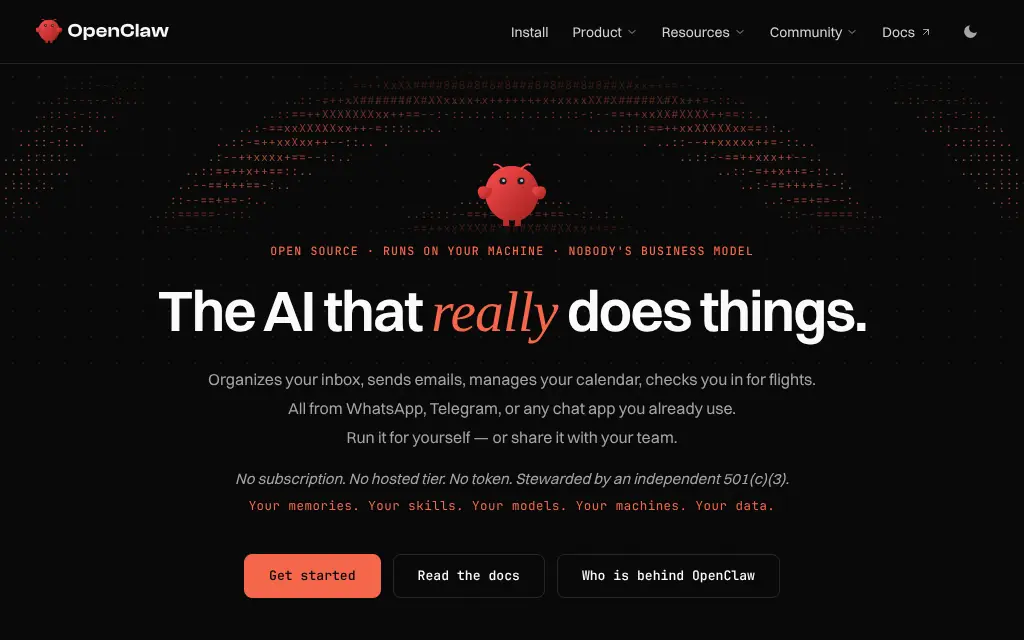
Free, open-source AI assistant for 20+ chat apps and ClawHub skills