
Self-hostable workflow automation with AI Agent nodes and an agent builder
CrewAI
MIT Python framework for multi-agent crews defined by role, goal and task
FreemiumAgents
crewai.comExplore the product
AT A GLANCE
- Website
- crewai.com
- Pricing
- Freemium
- Categories
- Agents
- Listed
- Nov 2026
- Updated
- Nov 2026
Details about CrewAI
Short verdict: CrewAI is an MIT-licensed Python framework for teams of role-playing agents: you give each agent a role, goal and backstory, hand it tasks, and CrewAI writes the prompts and runs the loop. Our one-tool test crew ran with a scripted model and no API key, and the code read almost like a job description. It is also the heaviest framework we installed (950 MB, 137 packages, 2.3 s to import), it sends anonymous telemetry to CrewAI on every run unless you opt out, and it does not yet support Python 3.14. It suits Python teams who want multi-agent workflows quickly and may later buy CrewAI's enterprise platform; developers who want tight control over each step or a small footprint should look at LangGraph.
How we reviewed it: On 12 November 2026 we installed CrewAI 1.15.41 in a fresh Python 3.13 virtual environment on a shared 4-core Linux machine, ran crewai create flow from the official quickstart, and built the same spec we used for LangGraph and Mastra: a weather agent with one get_weather tool and a scripted model that calls the tool and then answers. Every proxy setting pointed at a logger that recorded and refused outbound requests. We did not enter a model or Serper key, sign in to CrewAI AMP or request an Enterprise trial, so platform features and prices come from CrewAI's own pages.
What you get for $0
| Price | Framework free, MIT license. CrewAI AMP, the hosted platform: Basic free with 50 workflow executions a month, Enterprise priced on request. |
|---|---|
| Version | 1.15.41, released 12 November 2026; 1.0 shipped on 20 October 2025. 26 stable releases in the last 90 days, plus nightly dev builds, per PyPI. |
| Python | 3.10 to 3.13; the package metadata excludes 3.14. |
| Models | The crewai create wizard offers 12 providers (OpenAI, Anthropic, Gemini, Groq, Ollama, Bedrock, Azure and others) plus a manual entry; LiteLLM is an optional extra. |
| Built in | Crews (agents and tasks), Flows (stateful event-driven orchestration), memory, MCP, and a separate crewai-tools package. |
| Project health | 590,729 PyPI downloads in the week of 2 to 8 November 2026; 60,797 GitHub stars, the most of the three frameworks we tested. |
What we found
A 950 MB install for a one-agent crew
pip install crewai took 48.9 s with no cache and installed 137 packages, 950 MB, against 89 MB for LangGraph. The required dependencies include two vector databases (ChromaDB and LanceDB), the OpenAI SDK, OpenTelemetry, the MCP SDK, pdfplumber and openpyxl, whether or not you use memory, PDFs or spreadsheets. import crewai took 2.28 s (median of five), against 0.67 s for LangGraph and 0.53 s for Mastra. The project generated by crewai create flow depends on crewai[tools]; crewai install synced it with uv in 20.0 s, giving 153 packages and 972 MB.
The scaffold asks for a provider and a key, and writes notes for coding agents
crewai create flow latest-ai-flow asked for one of 13 provider choices, then a model, then an API key (Enter skips it), saved them to .env, initialized a git repository and offered to run the flow. It made no network requests. Next to the code it wrote AGENTS.md, CLAUDE.md, GEMINI.md and CURSOR.md for coding agents. The generated crew is a three-agent planner, writer and editor configured in YAML, while the docs quickstart tells you to replace it with a single researcher defined in JSONC; following the guide also needs a Serper.dev key for web search, so we stopped there and wrote our own crew.
Our test crew: readable code, a long hidden prompt
CrewAI documents a BaseLLM class for custom models, so we wrote a short subclass that returns two scripted replies. The 39-line script defined the tool with @tool, one agent, one task and a crew, and crew.kickoff() returned "It is sunny and 21 C in Lisbon." after 2 model calls, with the tool result in the second prompt. With function calling turned off in our stub, CrewAI used its text format of Thought, Action and Final Answer: our six-word task became a 1,665-character first prompt. Runs took 44 to 51 ms, except the first run on a new machine, which took 5.1 s and printed a box asking "Share this execution trace with CrewAI? [y/N] (20s timeout)". It also keeps each run's task output in a local SQLite file for crewai replay.
Telemetry is on by default
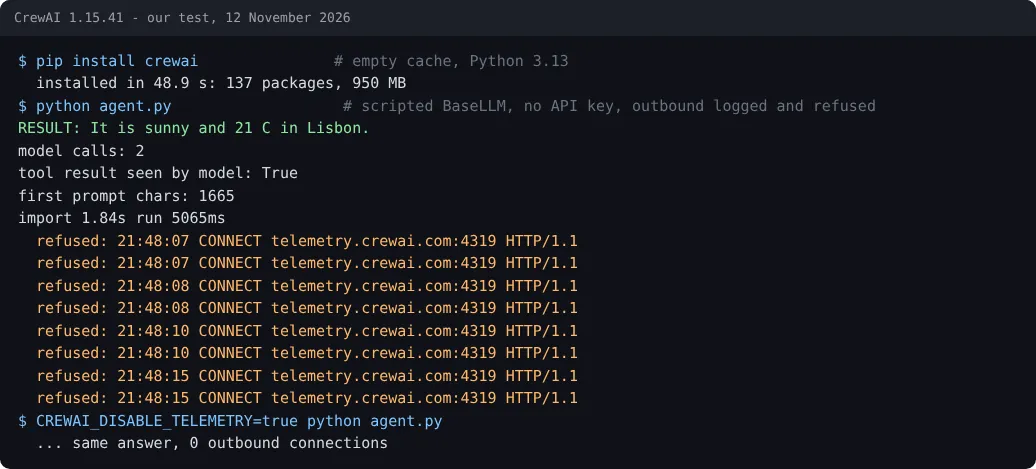
Each run tried to reach telemetry.crewai.com:4319 8 times when blocked; on our first run, before we blocked it, the requests left the machine. Per CrewAI's telemetry page and the source, the spans hold the CrewAI and Python versions, the number of agents and tasks, the process type, agent roles, tool names and model names, but not prompts or outputs unless you turn on share_crew. CREWAI_DISABLE_TELEMETRY=true stopped every request in our test. Agent roles and tool names are your own text, so keep them free of client names.
CrewAI AMP: a free tier with 50 executions, then sales
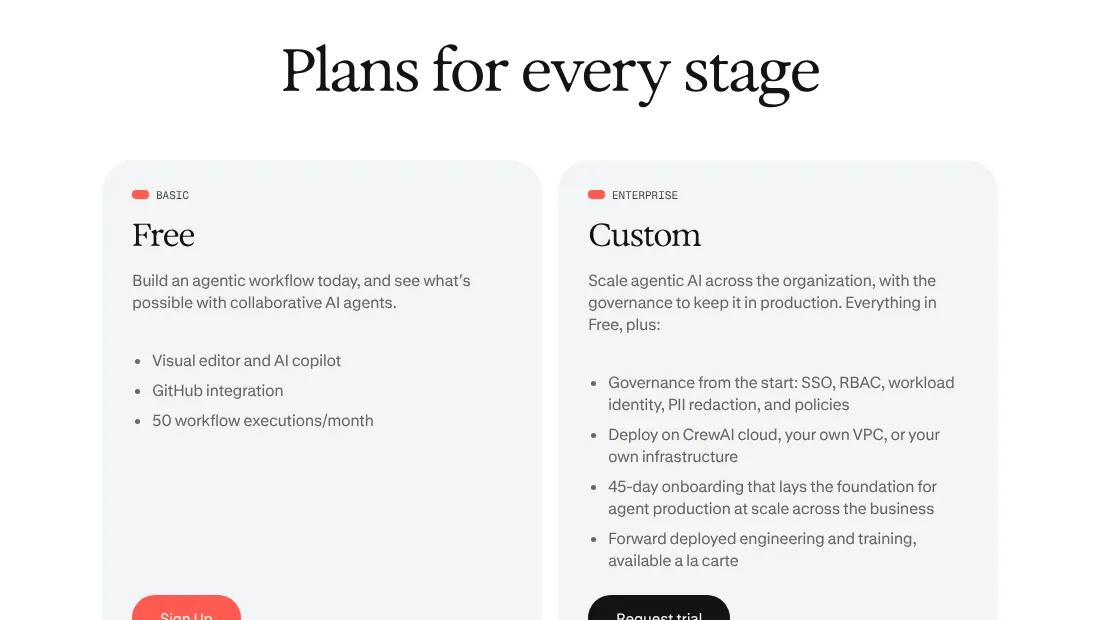
The pricing page on 12 November 2026 lists two plans. Basic is free: the visual Studio editor with an AI copilot, GitHub integration, tracing, guardrails, cron scheduling, 2 automations and 50 workflow executions a month, deployed on CrewAI's cloud. Enterprise is custom: SSO, role-based access, PII redaction, deployment in your VPC or on your own infrastructure, and a "45-day onboarding". There is no self-serve paid plan between them and no public per-execution price. CrewAI says 65% of the Fortune 500 use it; we could not check that.
Output and build
| Measurement | CrewAI | LangGraph | Mastra |
|---|---|---|---|
| Framework install, empty cache | 48.9 s; 137 packages; 950 MB | 8.5 s; 38 packages; 89 MB | 16.3 s; 146 packages; 160 MB |
| Import time (median of 5) | 2.28 s | 0.67 s | 0.53 s |
| Same weather agent, scripted model | 44-51 ms (5.1 s first run); 39 lines | 8-11 ms; 37 lines | 110-127 ms; 41 lines |
| Outbound requests from the agent run | 8 telemetry attempts | 0 | 0 |
Single runs on one machine; the LangGraph and Mastra numbers come from their reviews. With a real model, network latency will dominate the run time.
What you still have to build
Model and tool keys: the quickstart needs a model key and a Serper.dev key before it produces anything.
A serving layer:
crewai runruns a project from the terminal; an API around it is yours to write, or AMP's to host.Prompt tuning: CrewAI's built-in prompt is long and you will want to read what it sends.
A telemetry decision for production, and a Python version below 3.14.
Pros and cons
Pros
Agents, tasks and crews read like plain job descriptions; our crew took 39 lines.
A documented
BaseLLMclass makes keyless testing and custom models straightforward.Crews and stateful Flows in one package, with a scaffold and replay of past runs.
The largest community of the three: 60,797 GitHub stars.
Cons
950 MB and 137 packages for the base install, with two vector databases.
Telemetry on by default, and a trace-sharing prompt on the first run.
Slowest import: 2.28 s.
No Python 3.14 support, and no public price above the free AMP tier.
How CrewAI compares
LangGraph is lower level: you wire the nodes yourself, it installed in a tenth of the space and sent nothing out, and its paid layer, LangSmith, has public per-seat prices. Choose it when you need explicit control and checkpoints. Mastra is the TypeScript choice, with a local Studio and public platform prices from $25 a month. The OpenAI Agents SDK is a lighter Python option centered on handoffs between agents. If the people building agents are not developers, n8n and Dify offer visual editors you can self-host. See all AI agents.
Who should use CrewAI
Python teams that think in roles and hand-offs, want a working multi-agent prototype fast, and may later want an enterprise platform with SSO and on-premises deployment are CrewAI's audience. If install size, cold start in serverless functions, Python 3.14 or default telemetry matter to you, or you need to see and control each step of the loop, LangGraph or Mastra fit better.
FAQ
Is CrewAI free?
The framework is free and MIT-licensed. CrewAI AMP, the hosted platform, has a free Basic plan with 50 workflow executions a month and an Enterprise plan priced on request, as of 12 November 2026.
Does CrewAI send data to CrewAI?
Yes, by default. In our test every run tried to send OpenTelemetry spans to telemetry.crewai.com, which per CrewAI hold versions, agent roles, tool names and model names but not prompts or outputs. Set CREWAI_DISABLE_TELEMETRY=true to stop it.
Does CrewAI depend on LangChain?
No. CrewAI 1.x has its own agent loop and model clients; its required dependencies include the OpenAI SDK, ChromaDB, LanceDB and OpenTelemetry, and LiteLLM is optional.
Which Python versions does CrewAI support?
Python 3.10 to 3.13. Version 1.15.41 excludes Python 3.14 in its package metadata, so install it with an older interpreter.
Can I test CrewAI without an API key?
Yes. Subclass crewai.BaseLLM and return scripted replies from call(). Our test crew ran a tool call and a final answer this way with no key.
KEEP EXPLORING
More AI agents Good company for CrewAI.
Hosted AI agent that turns prompts into research, slides, sites and videos

Self-hosted open-source AI agent that writes its own skills, in 20+ chat apps