
Next.js and Astro single-product store with a model picker and checkout UI
Hirewise
Astro careers site theme with salary bands, team pages and a 3-step apply form
PaidTemplates
lexingtonthemes.comExplore the product
AT A GLANCE
- Website
- lexingtonthemes.com
- Pricing
- Paid
- Categories
- Templates
- Listed
- Jul 2023
- Updated
- Nov 2026
Details about Hirewise
KEY POINTS
- Tailwind CSS v4
Short verdict: Hirewise is now a careers site for one company, not a job board, and it answers the questions candidates ask before applying: every role shows its salary band, the bands come from one table of six levels, and the hiring process, benefits and teams each get a full page. The weak spot is the part that matters most: every Apply button opens the same form, fixed to one role, and the form sends nothing anywhere, CV included. It suits a company hiring across several teams that publishes its pay and has a developer to connect applications to its hiring tool. It is the wrong buy for a multi-company job board or for anyone who needs applications working without development.
How we reviewed it: On 30 October 2026 we used the live Astro demo on a 1440 px desktop screen and a 390 px phone screen. We opened every type of page, applied for a role through all three steps with a test CV, joined the talent pool and sent the contact form while logging every network request, and checked the shader code for motion settings. We cite one Lighthouse 12.8.2 run each for the home page and a role page. We did not buy the theme, so we can't judge the source code or the Sanity and EmDash editions, which have no public demo. Prices, versions and license terms come from Lexington Themes' site on the same day.
Disclosure: Our links to Lexington Themes carry a referral tag.
What you get for $89
| Price | $89 one-time for the Astro edition, $129 for the Sanity or EmDash edition. Lexington Themes Full Access Personal is $99 in the Black Friday 2026 sale ($198 regular) and includes every Lexington Astro theme, so during the sale $10 more buys Hirewise and every other theme. At the $198 regular price it pays off from the third theme. |
|---|---|
| Version | Astro 7.4.1 and Tailwind CSS 4.3.3, per Lexington. First released in June 2023 as a job board, rebuilt from scratch as a careers site on 11 October 2026. |
| Size | 9 static pages plus collections for roles, teams, stories, a blog and legal pages, per Lexington. The demo's sitemap lists 53 URLs: 18 roles, 5 teams, 6 stories, 4 blog posts and 5 style guide pages among them. |
| Stack | Astro and Tailwind CSS, with Lenis for smooth scrolling and a WebGL shader for the dithered backgrounds. The rest is plain JavaScript; the demo loads no Alpine.js. Teams, levels and salary bands live in one file, so one edit updates roles, team pages and the benefits page. |
| Delivery | Access to a private GitHub repository after paying through Polar. Builds to static files for Netlify, Vercel or any static host, and ships with AGENTS.md, Cursor rules and a design skill for AI coding tools. |
| License | Unlimited sites for yourself and for clients, commercial use without attribution. You can't resell the theme as a template, and one seat is one person. License terms |
What we found in the demo
Roles grouped by team, each with its band
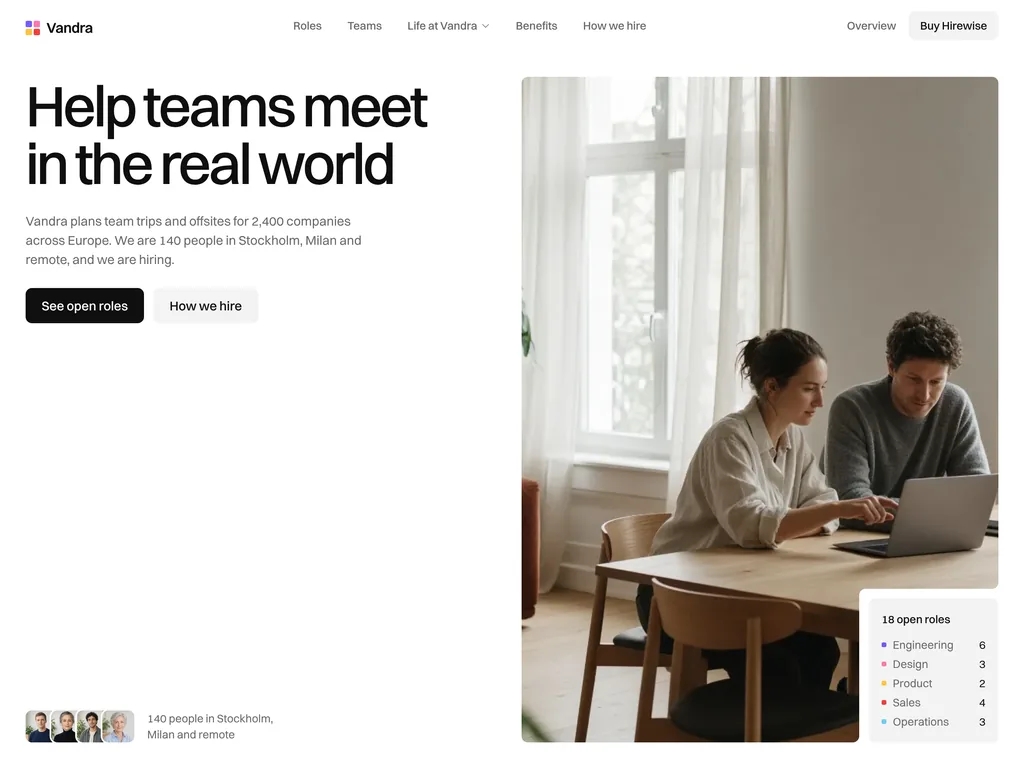
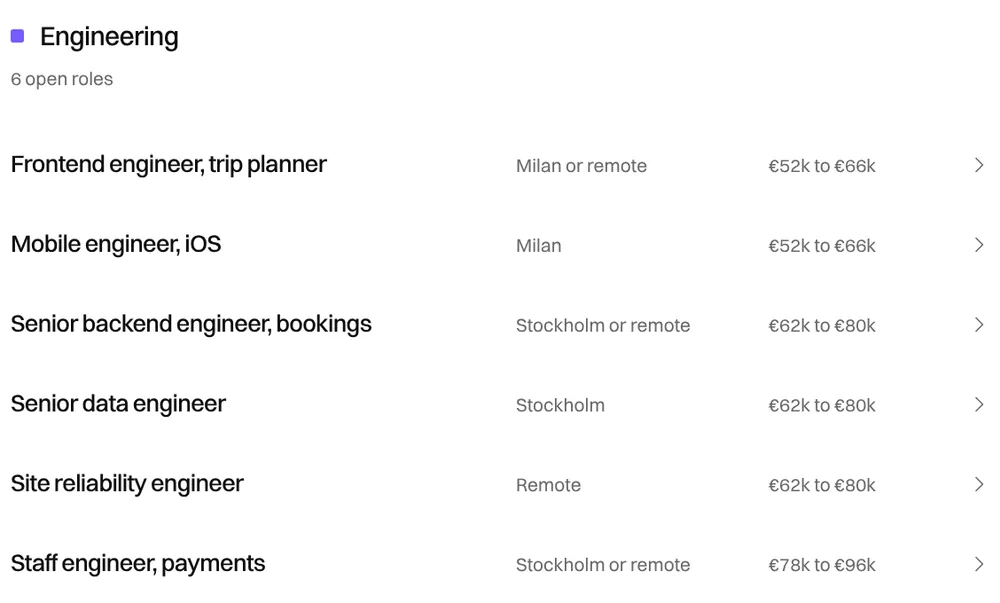
The sample company, Vandra, has 18 open roles in five teams: 6 in engineering, 3 in design, 2 in product, 4 in sales and 3 in operations. The roles page lists them by team, each row with its location and salary band, and the team chips at the top jump to each group. The redesign removed search and filters, which is fine at 18 roles. A role page opens with the team, the level ("L2, Specialist"), the location and the yearly salary, then what you will work on, what you bring, who you work with, a five-step timeline from Day 1 to Day 14, and more roles from the same team.
Salary bands come from one table of levels
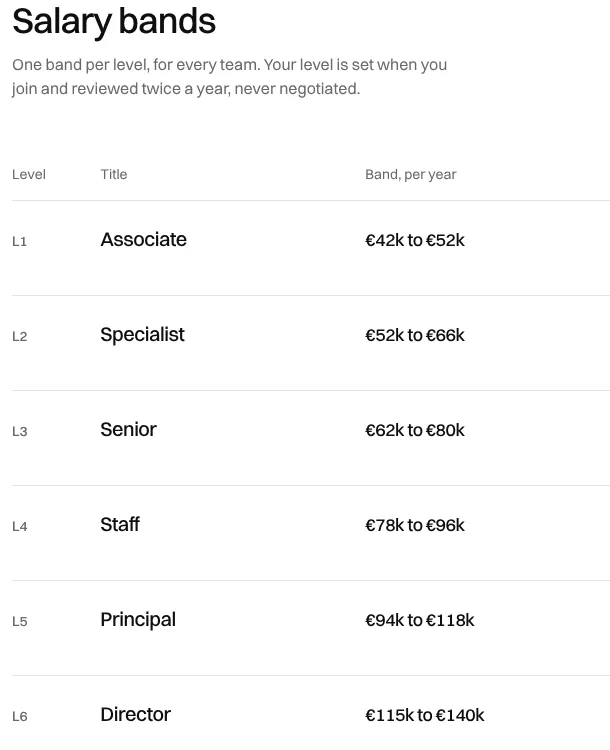
The benefits page lays out six levels, from L1 Associate (€42k to €52k) to L6 Director (€115k to €140k), and all 18 role pages show the band of their level: 2 roles at L1, 8 at L2, 7 at L3 and 1 at L4. The same page lists 15 benefits in five groups and explains the stock options (2,400 for a senior hire, four years of monthly vesting after a one-year cliff, ten years to buy them after leaving). Because the bands sit in one file, per Lexington, a pay review is one edit rather than 18.
The apply form: three steps, one role, no destination
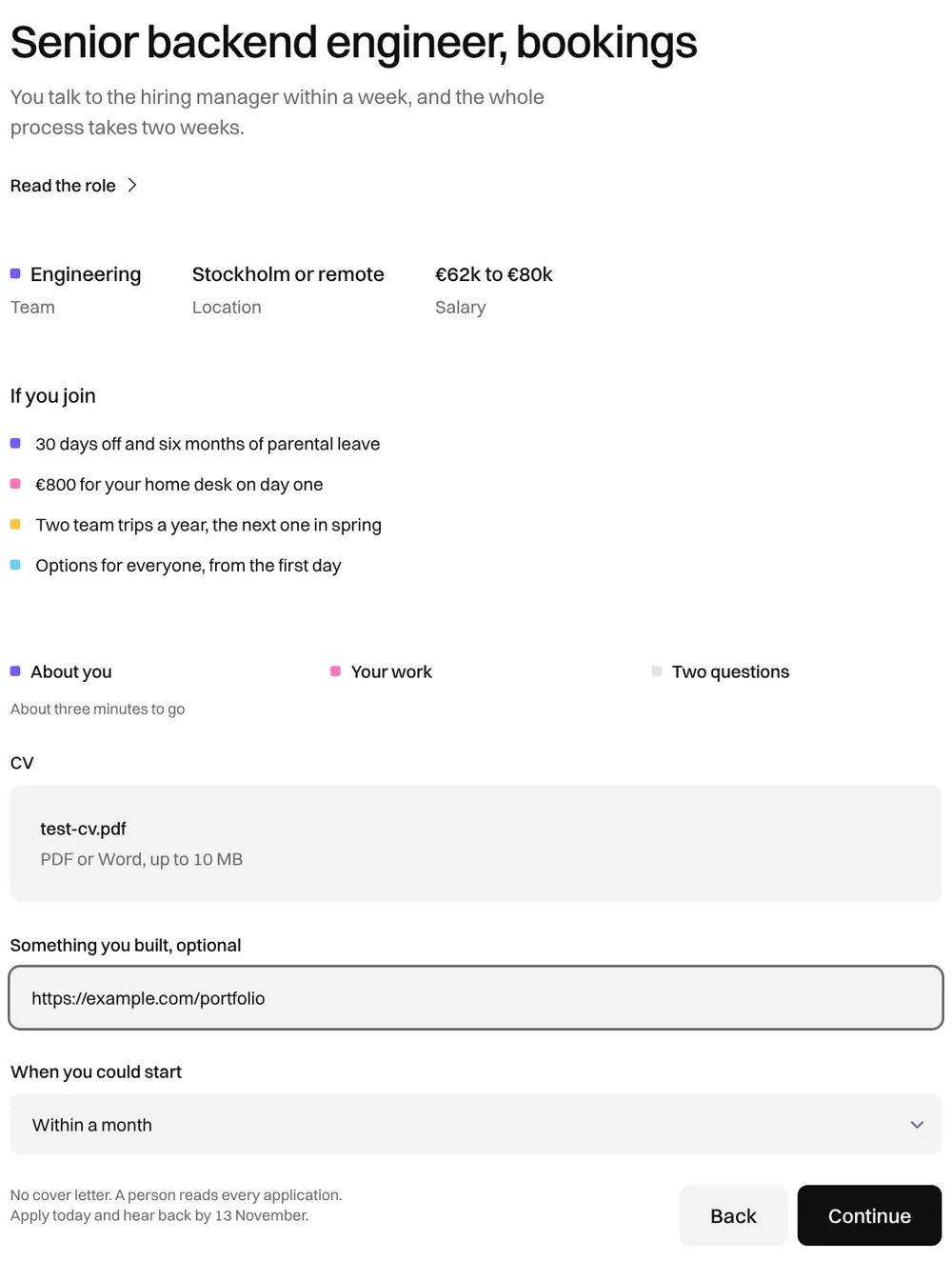
The form has three steps: about you (name, email, city, where you would work), your work (a required CV, "PDF or Word, up to 10 MB", an optional link and a start date) and two questions. Each step checks its required fields before Continue, and the form promises an answer by a date it works out, 14 days ahead. Two problems showed up. First, every "Apply for this role" button links to the same /apply page, which is fixed to "Senior backend engineer, bookings": we clicked Apply on the frontend engineer role and on the trip coordinator role and landed on the backend role both times. Second, sending the form only opened a thank-you page with the answers in the address bar, and the CV arrived there as its file name (cv=test-cv.pdf). The file itself never left the browser.
Talent pool, contact and the thank-you page
The talent pool page asks for a name, an email, any of the five teams and where you would work. Its shorter version on the home and roles pages and the contact form lead to the same thank-you page, again with the answers in the URL and no request sent. The thank-you page lists the next steps with a reply date two working days ahead.
Hiring process, teams and stories
The how-we-hire page explains the five steps with who you meet and how to prepare, then four scoring criteria and five promises, such as a paid work sample and written feedback after a no. Each team page has its own colour and mark, a lead's quote, how the team works, its people and its open roles. Six employee stories, a blog with RSS and an about page with both offices complete the site. At 390 px we found no sideways scrolling on the pages we checked, and the menu opens as a card with the five sections and their counts.
Performance and SEO
One Lighthouse 12.8.2 run per page, 30 October 2026:
| Page | Performance | Accessibility | Best practices | SEO |
|---|---|---|---|---|
| Home, mobile | 86 | 100 | 96 | 100 |
| Home, desktop | 100 | 100 | 96 | 100 |
| Role page, mobile | 87 | 100 | 96 | 100 |
| Role page, desktop | 99 | 100 | 96 | 100 |
Neither page had any blocking time. On both, the first text appeared at 3.0 s on mobile because the Switzer font loads through a render-blocking stylesheet from Fontshare, so self-hosting the font is the first fix. The dithered WebGL shader only animates while it is on screen and draws one still frame for visitors who ask for reduced motion. Lexington lists 98 for performance without naming the page or device.
Every page we checked has the title "Your Page Title", the description "A detailed description of your page content." and the canonical URL https://yourwebsite.com/current-page, and the sitemap lists its 53 URLs on yourwebsite.com. Lighthouse only checks that these tags exist, so the SEO score of 100 means little here. The demo outputs no structured data, so role pages carry no JobPosting markup, which is what Google reads to list jobs in its job search. Each role page already shows the fields it needs: title, salary band, location, team and level.
What you still have to build
One apply form per role. Pass the role to the apply page, or point each role's button at its posting in your applicant tracking system.
Somewhere for applications to go. A form backend or your hiring tool's API that accepts the CV as a file upload. The forms use GET today, which puts names and emails in URLs and can't carry a file.
Talent pool and contact. An email list that stores team preferences, and a handler for the contact form.
SEO. Your domain for the sitemap and canonical URLs, a title and description per page, JobPosting markup on role pages, and a name for the RSS feed, which is titled "Lexington Themes".
Your own company. Replace Vandra's people, stories, offices, benefits and bands. The sample copy disagrees with itself in places: the home page offers €50 a month for sport, the benefits page €500 a year for wellbeing.
Pros and cons
Pros
Pay transparency is built into the data: bands per level feed every role, team page and the benefits table.
The pages candidates read before applying are written and designed: a day-by-day hiring process, benefits with equity explained, teams with their people.
The three-step apply form validates each step and has a CV field, ready to connect.
100 for accessibility on the home and role pages, and no sideways scrolling on a phone.
Cons
Every Apply button opens the same form, fixed to one role.
No form sends anything, and the CV upload never leaves the browser.
No JobPosting markup, and placeholder SEO tags on every page.
No search or filters on the roles page, which will matter past a few dozen roles.
How Hirewise compares
Carriera ($89), also from Lexington, is a dark job board for many companies, with a salary on every listing, filters, a salary guide and pages for employers who post jobs, per Lexington. Pick it if you run a board rather than hire for one company.
Cruip JobBoard ($49 one-time) comes as HTML, Next.js and Vue code with a Figma file and four pages: a job list with filters, a job post, a create-a-job form and a sign-in page. Pick it if you want a filterable list of openings in React or Vue and don't need team, benefits and hiring-process pages.
See all templates for more options.
Who should buy Hirewise
Buy it if you are hiring for your own company across several teams, publish salary bands or plan to, and want a branded careers site in front of the applicant tracking system you already use, with a developer to connect the apply form to it. Look elsewhere if you run a job board for other companies, or if you need applications collected the day the site goes live without any development.
FAQ
Where do Hirewise applications go?
Nowhere yet. The apply form only opens a thank-you page with the answers in the URL, and the CV is reduced to its file name. Connect the form to your applicant tracking system or a form backend that accepts file uploads.
Does each role get its own apply form?
Not in the demo. Every Apply for this role button opens the same /apply page, which is fixed to the Senior backend engineer role. Pass the role to the form, or link each role to its posting in your hiring tool.
Is Hirewise still a job board template?
No. Since the 11 October 2026 redesign it is a careers site for one company; the companies, candidates, pricing, sign-in and job submission pages were removed. For a board with many companies, Lexington's Carriera is the closer fit.
Should I buy Hirewise alone or Lexington Full Access?
Hirewise alone costs $89 one-time. Full Access Personal costs $99 in the Black Friday 2026 sale ($198 regular) and includes every Lexington Astro theme, including Hirewise and Carriera, so during the sale $10 more buys the whole catalog. At the $198 regular price it pays off from the third theme.
Can I use Hirewise for client projects?
Yes. Lexington's license allows unlimited sites for yourself and for clients, with no attribution. You can't resell or redistribute the theme as a template, and each seat is one named person.
New templates like Hirewise, in your inbox
The best developer tools, templates and UI components added to Tailkits, each reviewed by an editor. Free, unsubscribe in one click.
27 new in the last 30 days323 products reviewed so farSee what you get
KEEP EXPLORING
More templates Good company for Hirewise.
Do you make Hirewise? Get a badge for your site
An optional "Featured on Tailkits" badge that links to this page. Pick light or dark and paste the code into your site, for example in the footer.