
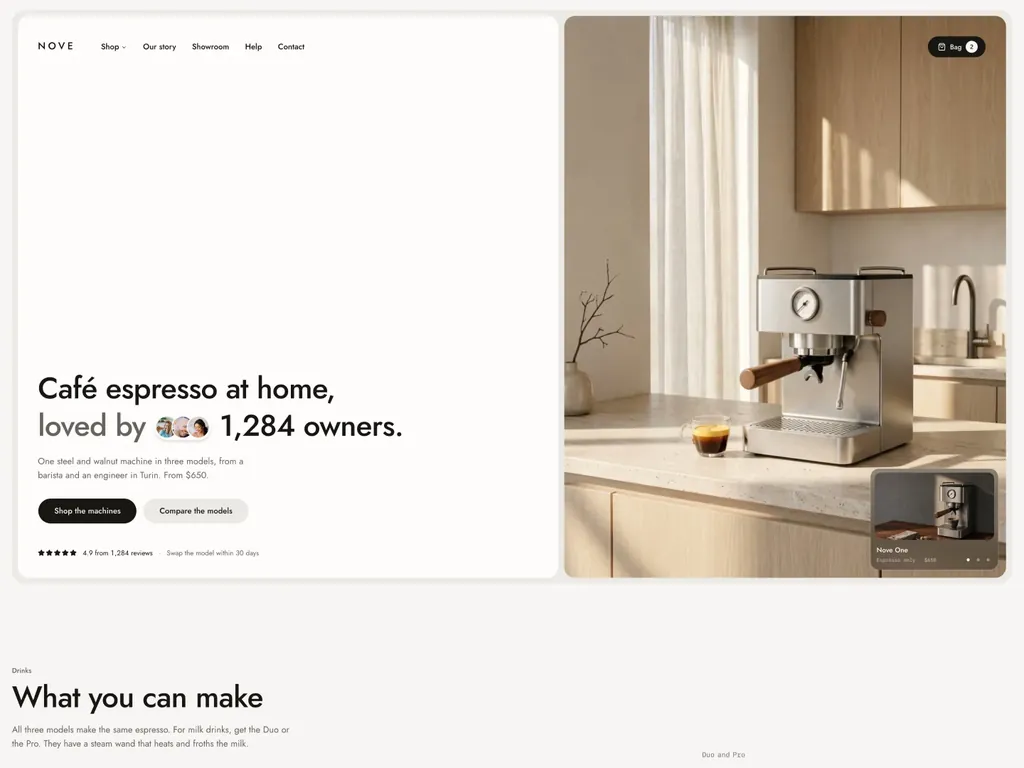
Next.js and Astro single-product store with a model picker and checkout UI
Halden
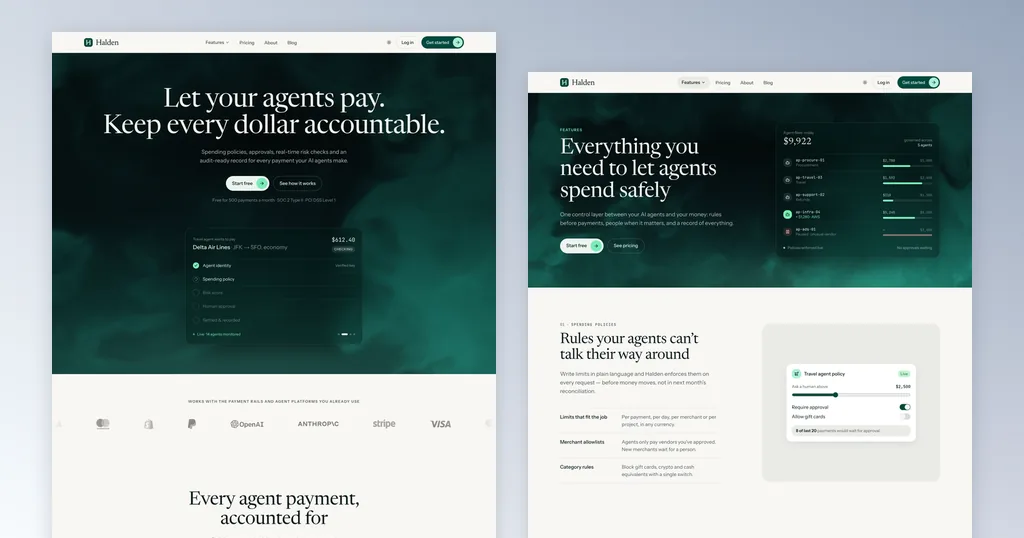
Editorial Next.js template for security, compliance and AI, with a WebGL hero
cruip.comExplore the product
AT A GLANCE
Details about Halden
KEY POINTS
- Tailwind CSS v4
- Figma file
- MDX support
Short verdict: Halden swaps the usual dark SaaS look for warm paper, pine green and a Newsreader serif, and builds its product screens in code. Its WebGL hero is well behaved, pausing off screen and for reduced motion, but our Lighthouse run, on a machine without a graphics card, scored the home page 53 on mobile. Every form is a front end only, and the sample site carries certifications and brand logos you must replace. It suits a security, compliance or AI infrastructure startup with a developer; skip it if you need product, solution or docs pages.
How we reviewed it: On 24 November 2026 we used the live Next.js demo on a desktop and a 390 px phone screen, opening all 16 routes and the 404 page. We switched the theme and billing period, played every product panel, filtered the blog and submitted each form with a [email protected] address while logging requests and blocking any that left the demo. We counted the shader's frames in three states and ran Lighthouse 12.8.2 on the home and pricing pages. We did not buy Halden, so we could not check its source code, Figma file or other editions. Prices and terms come from cruip.com on the same day.
Disclosure: Our links to Cruip carry a referral tag.
What you get for $49
| Price | $49 one-time, per Cruip. Also in Cruip's Modern Bundle with 12 other Modern templates: $149, or $74.50 in its Black Friday sale (no end date given). |
|---|---|
| Editions | Cruip's sidebar lists HTML (with Alpine.js), Next.js, Vue and Astro downloads, but its "What's included" text names only Next.js 16, React 19, Tailwind CSS 4 and shadcn/ui. Only the Next.js demo is online; the Astro, HTML and Vue demo addresses return 404. |
| Version | No version number, release date or changelog entry. Halden was not on cruip.com when we reviewed the Cruip bundle on 23 October 2026. The demo runs Next.js 16.4.6. |
| Size | 10 pages, per Cruip. We counted 16 routes: home, features, pricing, about, contact, sign up, log in, the blog with five posts, and privacy, terms and cookie pages. |
| Stack | Seen in the demo: Next.js, React 19, Tailwind CSS v4, shadcn/ui components, next-themes for light and dark, and a hand-written WebGL shader with no 3D library. Fonts are Newsreader, Instrument Sans and JetBrains Mono. The MDX blog and the Figma file ("solely as a visual reference", says Cruip's FAQ) are Cruip's statements. |
| License | Unlimited end products for you or your clients. No reselling, redistribution or use in site builders, and no team license. One year of support; refunds only if a product is defective or will not download. Terms |
What we found in the demo
A WebGL hero that pauses when it should
The hero's drifting pine-and-mint light is a short fragment shader in raw WebGL, no three.js, that reacts to the pointer. It draws below screen resolution, runs only while visible, and paints one still frame for visitors who prefer reduced motion. Our counts agreed: frames ran continuously with the hero in view and stopped once we scrolled 2,500 px down. Reduced motion also stopped the logo marquee, spinning rosettes and testimonial autoplay; only the hero's payment console still changes, every 6 seconds. The shader returns on the features, about and pricing pages, and beside sign-up and log-in on desktop.
Product screens built in code
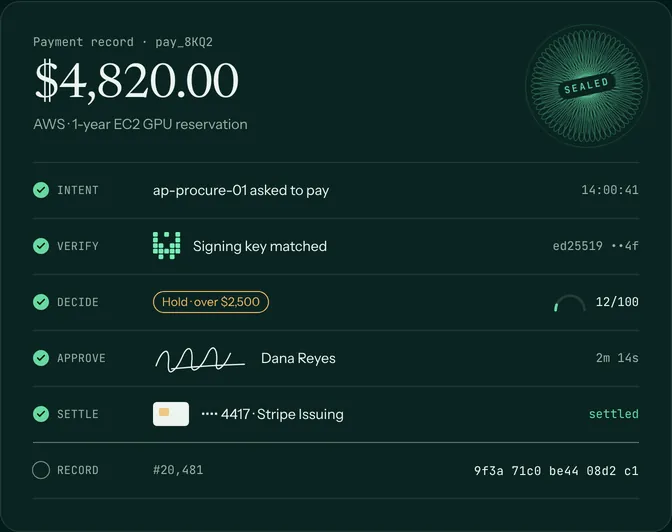
The hero console replays four sample payments, including $12,900 of gift cards blocked by policy. Approve and Decline on the approval card change its status, the six "How it works" steps fill in a payment record with a signature and a guilloché "Sealed" stamp, and the audit trail has five tabs, though its "Export evidence" button does nothing. As you scroll, the home page's paper background blends into dark pine for "How it works" and into mint for the audit trail.
Light and dark modes
The header's sun icon switches between light and dark, and the choice is stored in localStorage under theme, so it survives reloads and page changes. A first visit always opens in light, even when the operating system is set to dark: the demo's theme script defaults to light, and the toggle has no "system" option.
Pricing: one discount that does not add up
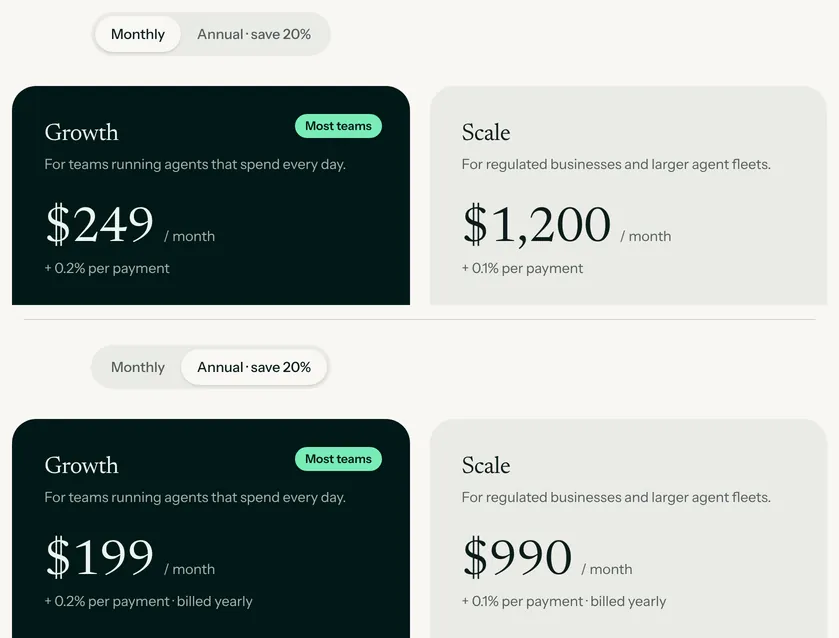
The pricing page opens on annual billing. Sandbox is free for 500 agent payments a month; Growth costs $249 a month plus 0.2% per payment, or $199 billed yearly; Scale costs $1,200 plus 0.1%, or $990. The switch says "save 20%", which is true for Growth but not for Scale, where the saving is 17.5%: fix the label or make Scale $960. The comparison table has 17 rows in four groups, with check and dash icons labeled for screen readers, and the six-question FAQ keeps one answer open at a time.
Forms that send nothing
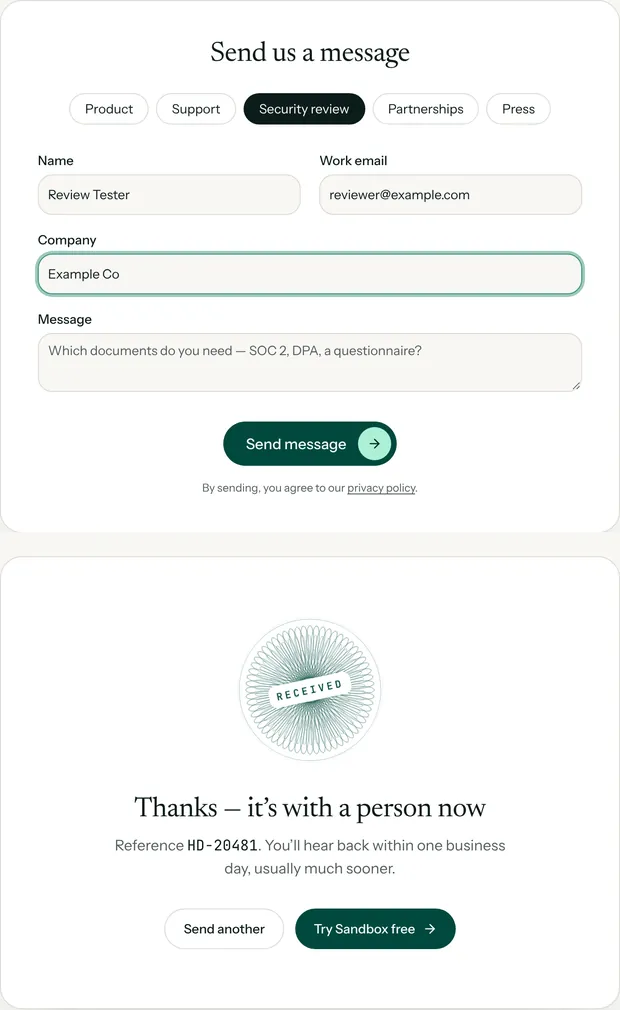
"Topic routing" on the contact page means five topic buttons that change the message box's placeholder; the topic goes nowhere. The browser's own validation requires name, email and message. On submit a "Received" stamp shows reference HD-20481, a number fixed in the code, and our network log showed nothing sent. Sign-up and log-in need only an email, accepted reviewer@example without a domain ending and claimed a secure link was on its way. The Google and GitHub buttons show the same message, and the newsletter's "You're on the list" is just as empty.
Content pages and mobile
The blog has five short posts, and its "generated covers" are one guilloché rosette SVG in three color treatments. The category tabs keep the featured post above the grid, so each tab adds a single post. The about page has the founders' story, eight portraits in a carousel, four values and three open roles that link to the contact page, and the legal pages get a sticky contents list. At 390 px none of the 17 pages we opened scrolled sideways, but Escape does not close the full-screen menu, and sign-up and log-in drop the shader panel.
Performance and SEO
Lighthouse 12.8.2, one run per page on 24 November 2026:
| Page | Performance | Accessibility | Best practices | SEO |
|---|---|---|---|---|
| Home, mobile | 53 | 81 | 100 | 100 |
| Home, desktop | 60 | 81 | 100 | 100 |
| Pricing, mobile | 87 | 100 | 100 | 100 |
| Pricing, desktop | 100 | 100 | 100 | 100 |
The home page score comes from the shader, not from page weight. Our test machine has no graphics card, so the browser drew the hero in software, keeping the main thread 90 to 100% busy while it was on screen against about 10% after scrolling past. Lighthouse logged 151 seconds of main-thread work on mobile, only 2 of them script evaluation, and 99,780 ms of total blocking time (8,770 ms on desktop), while the pricing page, whose shader stays paused below the fold, scored 87 and 100. Lab audits that run without a GPU will show the same; devices with one, which we could not test, should do better.
The home page weighs 548 KiB on mobile and 930 KiB on desktop, where Lighthouse estimates 292 KiB of savings from properly sized photos. Accessibility loses points for two markup mistakes, role="tab" buttons inside an <ol role="tablist"> and a <dl role="tabpanel">, plus green badges at 2.75:1 contrast. No page has structured data, and the sitemap, robots.txt and share image point to the placeholder domain halden.example.
What you still have to build
Forms and sign-in. Connect the contact form, newsletter, sign-up and log-in.
Compliance claims. SOC 2 Type II, PCI DSS Level 1, ISO 27001 and GDPR badges on every page, EU AI Act, PSD2, SOX and DORA cards, and a blog post announcing "our first SOC 2 Type II report". Keep only what you can prove.
Brand logos. Stripe, Visa, Mastercard, Shopify, PayPal, OpenAI and Anthropic appear as platforms Halden "works with": not customers, but still integrations you may not have.
People, figures and addresses. Six testimonials with portraits, eight team portraits, figures such as "320+ companies governing agents", real street addresses in Brooklyn and Amsterdam, and "© 2026 Cruip.com" in the footer.
Pros and cons
Pros
A look of its own: paper, pine and mint, a serif display face and tones that change as you scroll.
Payment record, audit trail, approval card and console built in code, ready to adapt instead of commissioning screenshots.
Motion that pauses off screen and stops for visitors who prefer reduced motion.
A complete pricing page with a billing switch, a comparison table and an FAQ, scored 100 for accessibility.
Cons
Lighthouse scored the home page 53 on mobile and 60 on desktop.
No form sends anything, yet every one shows a success message.
Certifications, brand logos, testimonials and figures to rewrite before launch.
Ten pages, with no per-product, solution, docs, changelog or job pages.
Only the Next.js edition can be seen before buying, and Cruip does not refund.
How Halden compares
Clause, also $49 from Cruip, targets legal and compliance software with a navy palette and its own shader hero, and has twice the pages, per Cruip, including product, solution and per-role careers pages. Its home page scored 68 on mobile and 97 on desktop in the same Lighthouse run. Choose it if you sell several products to enterprise buyers.
Relay ($49, Cruip) is dark and developer-first, with the docs, changelog, status and security pages Halden lacks, and a public Astro demo next to the Next.js one. Choose it if your buyers are engineers.
Spaziobianco by Lexington Themes is closest in style, with serif headings on warm paper and a dithered shader, for fintech and API products. It is Astro only and cost $89 on 24 November 2026, or $99 for every Lexington theme in its sale. Choose it for Astro and for its developer and status pages.
Cruip's Modern Bundle includes Halden, Clause and Relay and, at $74.50 in the sale, costs less than two single templates. See all SaaS templates for more options.
Who should buy Halden
Buy Halden if you are launching a security, compliance, fintech or AI infrastructure product, want a site that feels careful rather than loud, and can connect the forms and rewrite every certification and figure. It fits a young company with one product and a self-serve plan. Look elsewhere if you need many product pages, documentation, or an Astro, Vue or HTML edition you can check before paying.
FAQ
Does Halden's contact form actually send messages?
No. In the demo the contact, sign-up, log-in and newsletter forms only switch to a success screen, and our network log showed nothing sent. You connect them to your own email service, CRM or sign-in provider.
Will the WebGL hero slow my site down?
In lab tests, yes. Our Lighthouse run, on a machine without a graphics card, scored the home page 53 on mobile, against 87 for the pricing page, whose shader stays paused below the fold. Devices with a GPU, which we could not test, should do better, so check it on the phones your buyers use.
Can I get Halden for Astro, Vue or plain HTML?
Possibly, but we could not confirm it. Cruip's page lists all four downloads while its description names only Next.js, and only the Next.js demo is online. Ask Cruip before buying, since it does not refund.
Can I keep the SOC 2 and PCI DSS badges?
Only if your company holds those certifications. The demo shows SOC 2 Type II, PCI DSS Level 1, ISO 27001 and GDPR badges on every page and a blog post about a SOC 2 report, so rewrite or remove them otherwise.
Can I build client sites with Halden?
Yes. Cruip's license covers unlimited end products for you or your clients, but not reselling the template, using it in a site builder or sharing your access, and there is no team license.
New templates like Halden, in your inbox
The best developer tools, templates and UI components added to Tailkits, each reviewed by an editor. Free, unsubscribe in one click.
26 new in the last 30 days322 products reviewed so farSee what you get
KEEP EXPLORING
More templates Good company for Halden.
Do you make Halden? Get a badge for your site
An optional "Featured on Tailkits" badge that links to this page. Pick light or dark and paste the code into your site, for example in the footer.