Dark landing page template with hand-drawn art
Cruip
Flux, Cadence, Relay and Artifact: Tailwind templates for Next.js and Astro
cruip.comExplore the product
AT A GLANCE
Details about Cruip
KEY POINTS
- MDX support
- Figma file
- Tailwind CSS v4
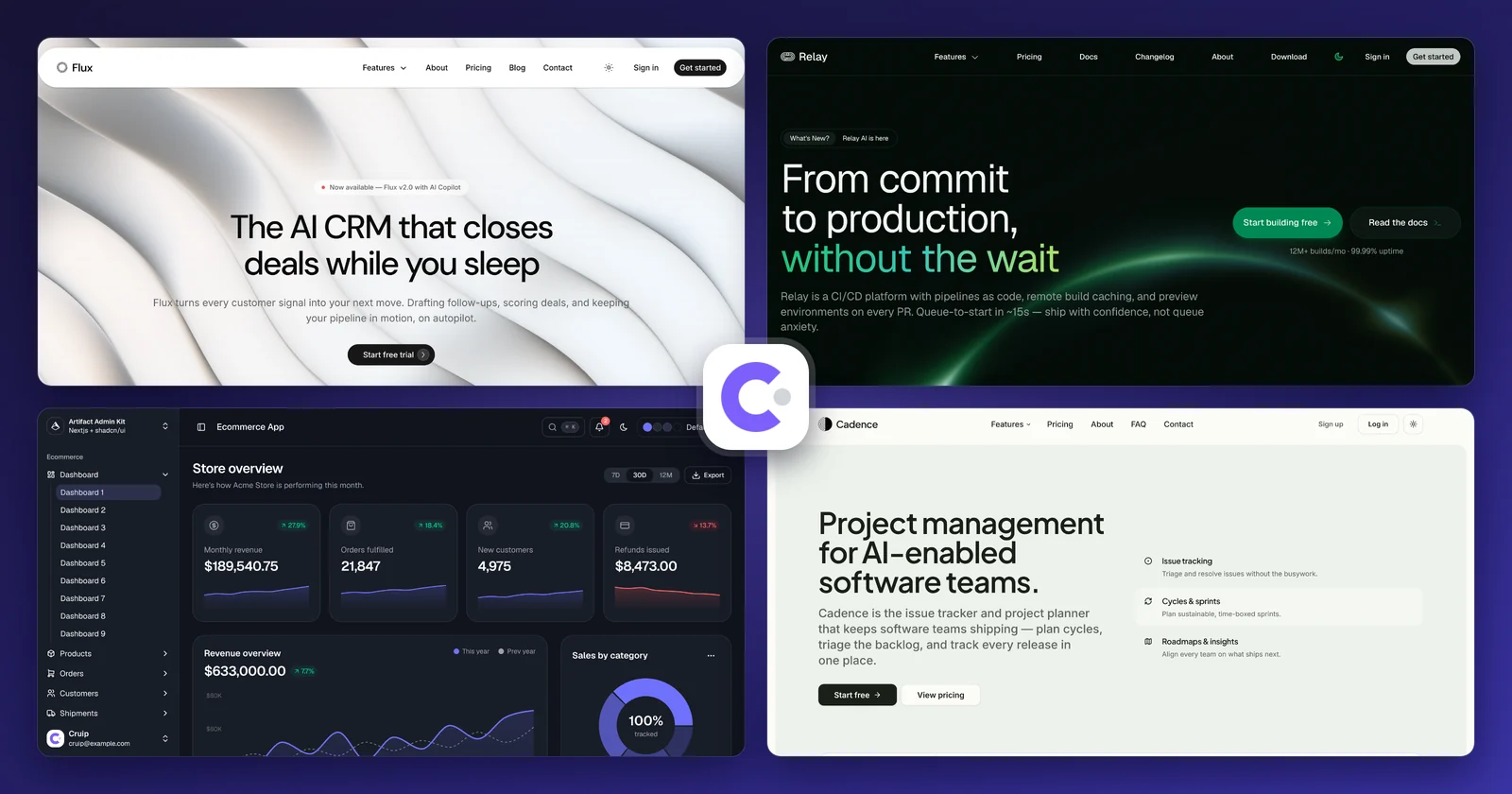
Short verdict: Cruip sells its Tailwind CSS templates in two one-time bundles, and the newer Modern Bundle ($149) is the one to look at: Flux, Cadence and Relay for Next.js and Astro, plus Artifact, a 103-screen Next.js and shadcn/ui admin kit. The designs are polished, Relay's documentation search works and all 88 of Artifact's URLs load. Everything stops at the front end, though: no form we submitted was connected to anything, Cadence's "fully validated" contact form accepts an empty submission, and Cadence's home page weighs 13.7 MB. Buy it if you want two or more of these designs and will wire up forms, sign-in and data yourself. Skip it if you need those working on day one, or a dashboard outside Next.js.
How we reviewed it: On 23 October 2026 we used the four Next.js demos Cruip links, on a desktop and on a 390 px phone screen. We crawled every page, submitted the forms while logging network requests, tried each template's interactive parts and ran Lighthouse 12.8.2 on two pages of each. We also checked the Astro builds of Flux, Cadence and Relay that are deployed next to the Next.js demos, though Cruip doesn't link them. We did not buy a bundle, so we could not read the source code, the Figma files or the 20 Classic templates. Prices and terms come from cruip.com on the same day.
Disclosure: Our links to Cruip carry a referral tag.
What $79 or $149 gets you
| Modern Bundle | $149 one-time for Flux, Cadence, Relay and Artifact, with lifetime updates for those four. New templates join this bundle: monthly, says the bundle card, or every two to three months, says Cruip's FAQ. |
|---|---|
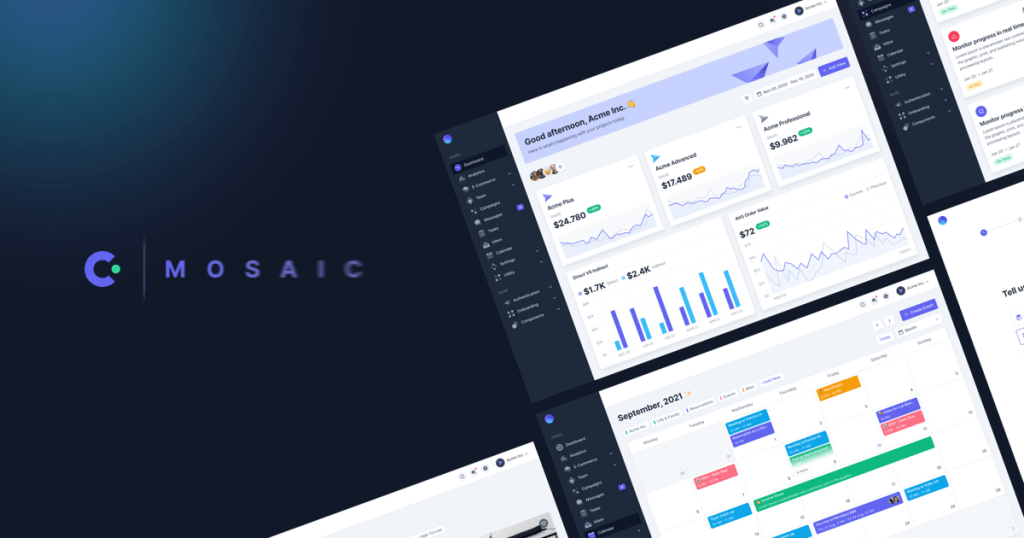
| Classic Bundle | $79 one-time for the 20 older templates, such as Mosaic, Stellar and Open PRO. Former Unlimited Access buyers keep these. |
| Single templates | Flux, Cadence and Relay cost $79 each and Artifact $129, so $366 for all four. The bundle page says "worth $287", which adds up only three of them. Classic templates cost $49, Mosaic $69. |
| Stack | Flux, Cadence and Relay: Next.js 16 with TypeScript, or Astro 6, both on Tailwind CSS 4, as separate downloads. Artifact: Next.js 16, TypeScript, Tailwind CSS 4 and shadcn/ui only. |
| Size | Cruip lists 14 pages for Flux, "8+" and 10 for Cadence (its page says both), 15 for Relay and 100 for Artifact. We found 24, 9, 26 and 88 distinct URLs; Artifact's command menu lists 103 screens. |
| Design files | A Figma file per template, which Cruip calls a visual reference without auto layout |
| Updates | Cruip's changelog has one entry per Classic template, all dated 7 July 2026, most of them moving to Tailwind CSS 4.3.2 and Next.js 16.2.10. The four Modern templates have no entries yet. |
| License | Unlimited end products for you or your clients. No website builders or theme generators, no reselling, and access can't be shared with other people. Cruip lists no team license. Terms and license |
| Support and refunds | Support for one year after purchase. No refunds unless a product is defective or won't download. Students get 25% off. |
What we found in the four Modern demos
Flux, Cadence and Relay share a pattern: a made-up product, a pricing page with a monthly and annual switch, sign-in and sign-up screens, legal pages and a theme toggle that remembers your choice but ignores the system setting. None of the 12 pages we loaded at 390 px scrolled sideways.
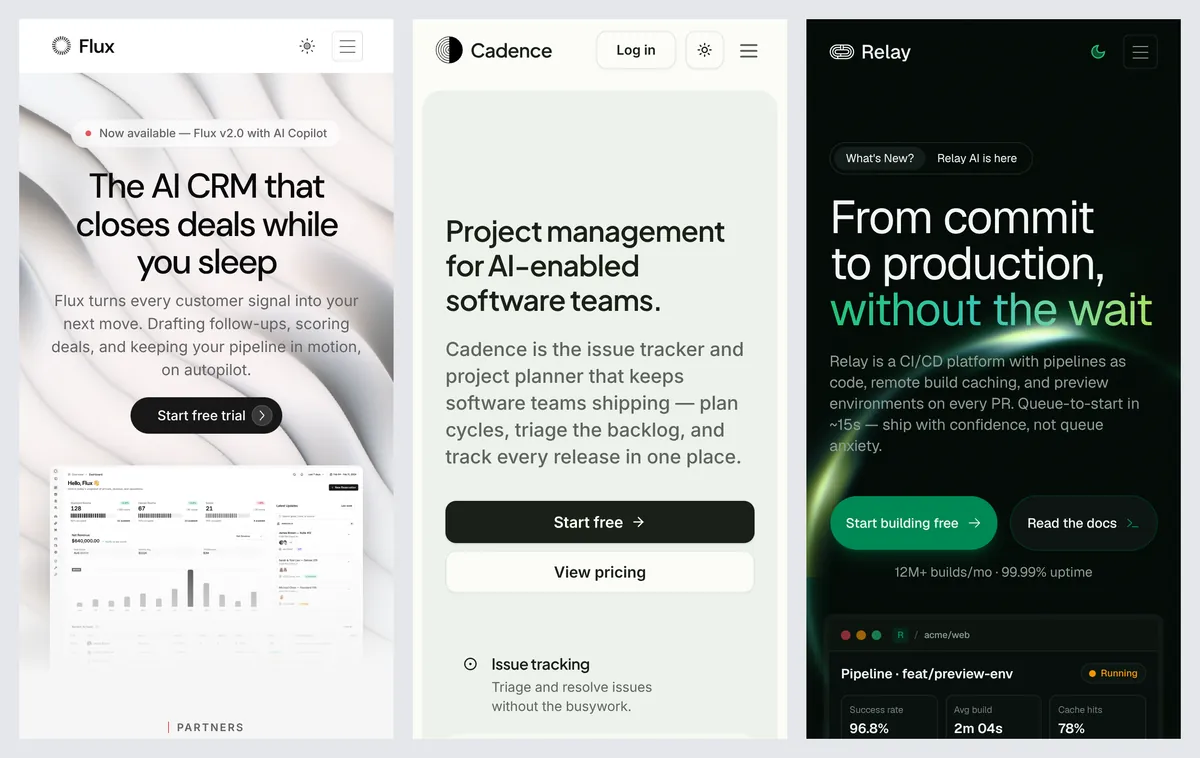
Flux: a shader hero for a sample AI CRM
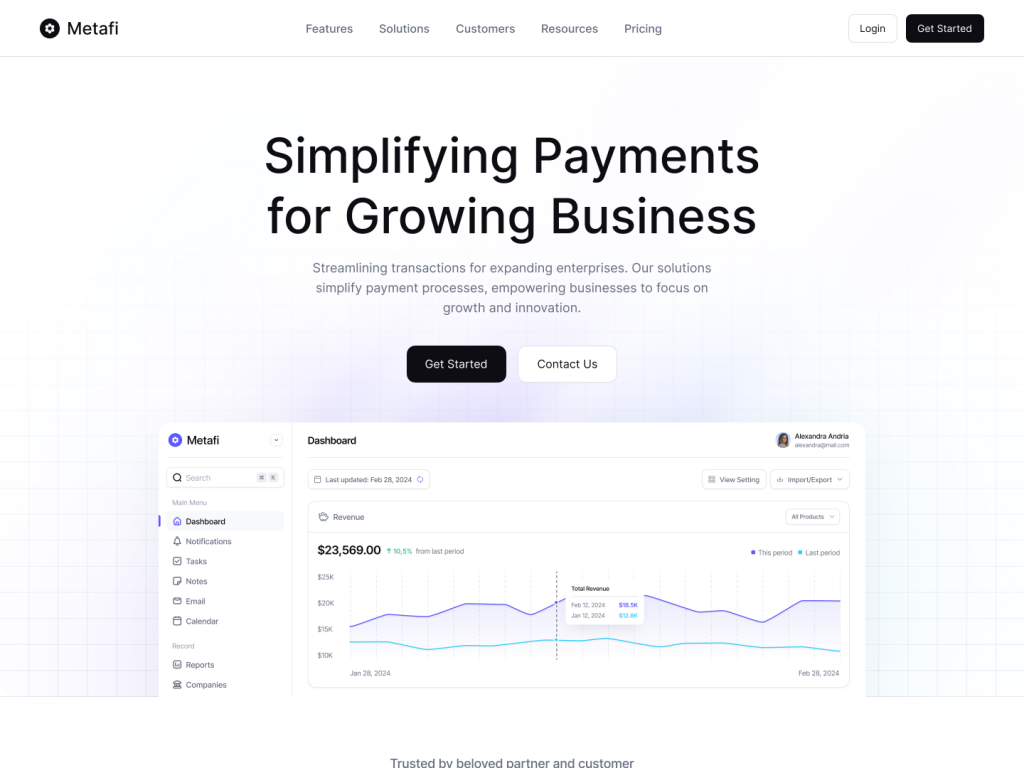
Flux dresses a sample AI CRM in a three.js shader that animates behind the hero and stops for visitors who ask for reduced motion. We counted 24 pages, including 10 blog posts and 3 job listings that Cruip says are MDX files. The pricing switch correctly takes 25% off for annual billing ($25 a month becomes $19).
Three things need work. Every page we measured downloads the same 237 KiB bundle, three.js included, twice under two file names, even the pricing page, which has no 3D scene. The "Schedule a demo" form has no field names or submit handler, so Continue does nothing. And the product screenshot under the CRM headline shows a hotel reservations dashboard, so plan on your own.
Cadence: nine calm pages and a contact form that isn't validated
Cadence sells a sample project management tool in a quieter layout set in Plus Jakarta Sans, across 9 pages: home, pricing, about, FAQ, contact, sign-up, log-in, terms and privacy. Its hero product shots are Artifact's issue screens, down to the same "Renewal Forecast Console" project, so the bundle's templates fit together.
Cruip promises "a contact page with a fully validated form". In both the Next.js demo and the Astro build, no field is required and the form has no submit handler. An empty form submits, and a filled one reloads the page with the name, email and message in the address (/contact?fullName=…&email=…), and so in browser history and in any log that records URLs. The "Number of employees" field also shows a "Company name" placeholder.
Relay: the most complete site, with search that works
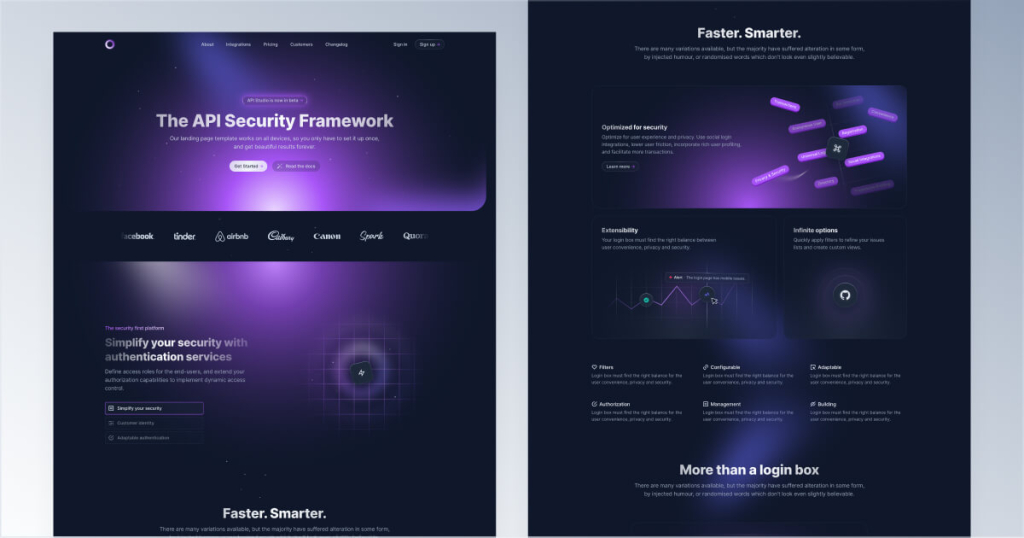
Relay markets a sample CI/CD service, dark by default, with an unlabeled moon button that switches to light. At 26 pages it is the largest of the three: 15 site pages, among them features, download, status, security and a changelog, plus five documentation pages, five blog posts and a code-entry screen for sign-in. The documentation runs on Fumadocs, and its Ctrl+K search works in the browser: "runner" returned 18 results, "cache" 11 and "kubernetes" correctly none.
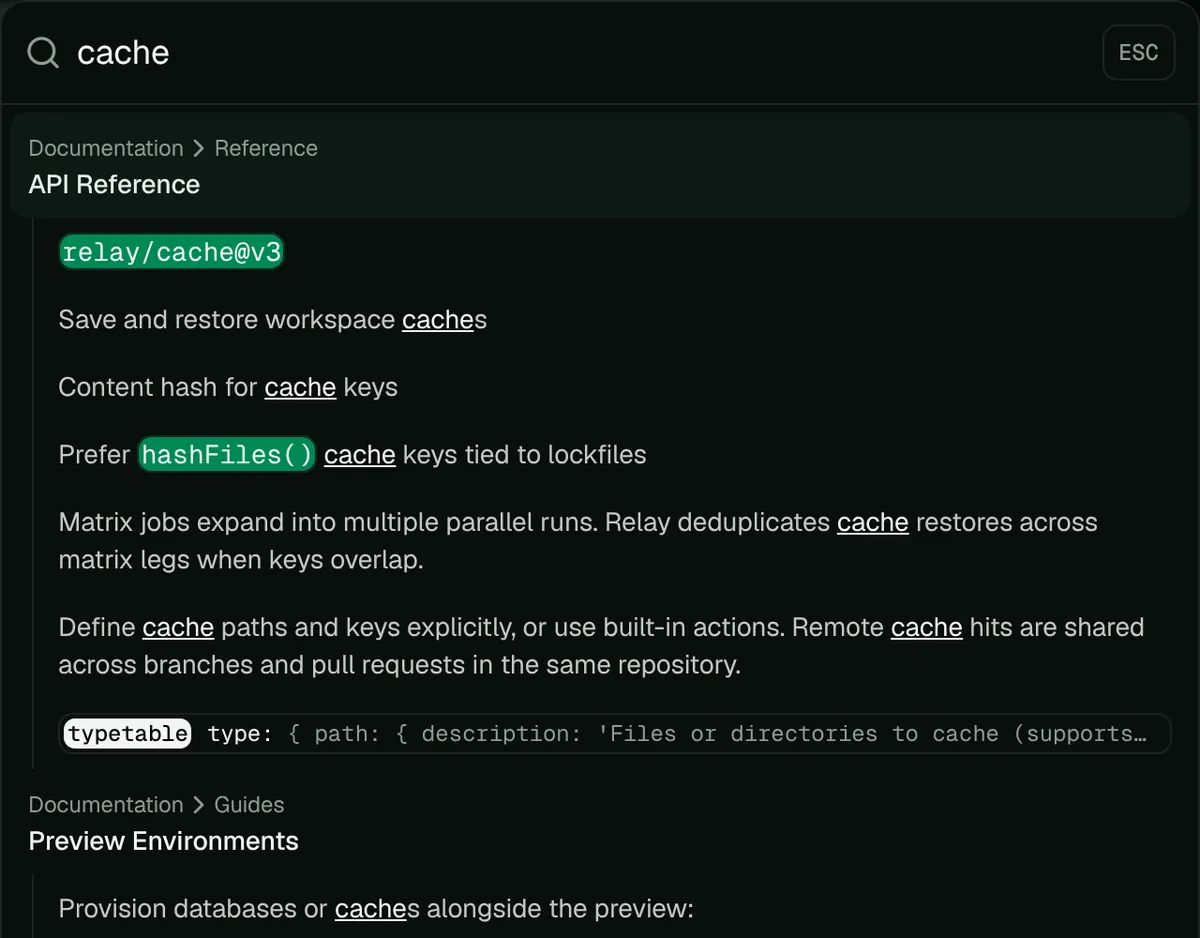
Two things to clean up. Three documentation URLs keep slugs from another product (Preview Environments lives at /docs/crm-csv, Runners at /docs/file-systems), and sign-in has no validation: an empty form goes straight to the code screen, where entering six digits does nothing.
Artifact: 103 screens and 43 color presets on sample data
Artifact is what makes the bundle good value. Its command menu lists 103 screens: Ecommerce (34), Project Management (32), Todo (14), a general dashboard with settings (11), Developers (4) and sign-in and error pages (8), on 88 distinct URLs that all loaded. The issue board has 18 draggable cards, and the forms validate: saving an empty product lists five errors, from "Product name is required" to "Enter a price".
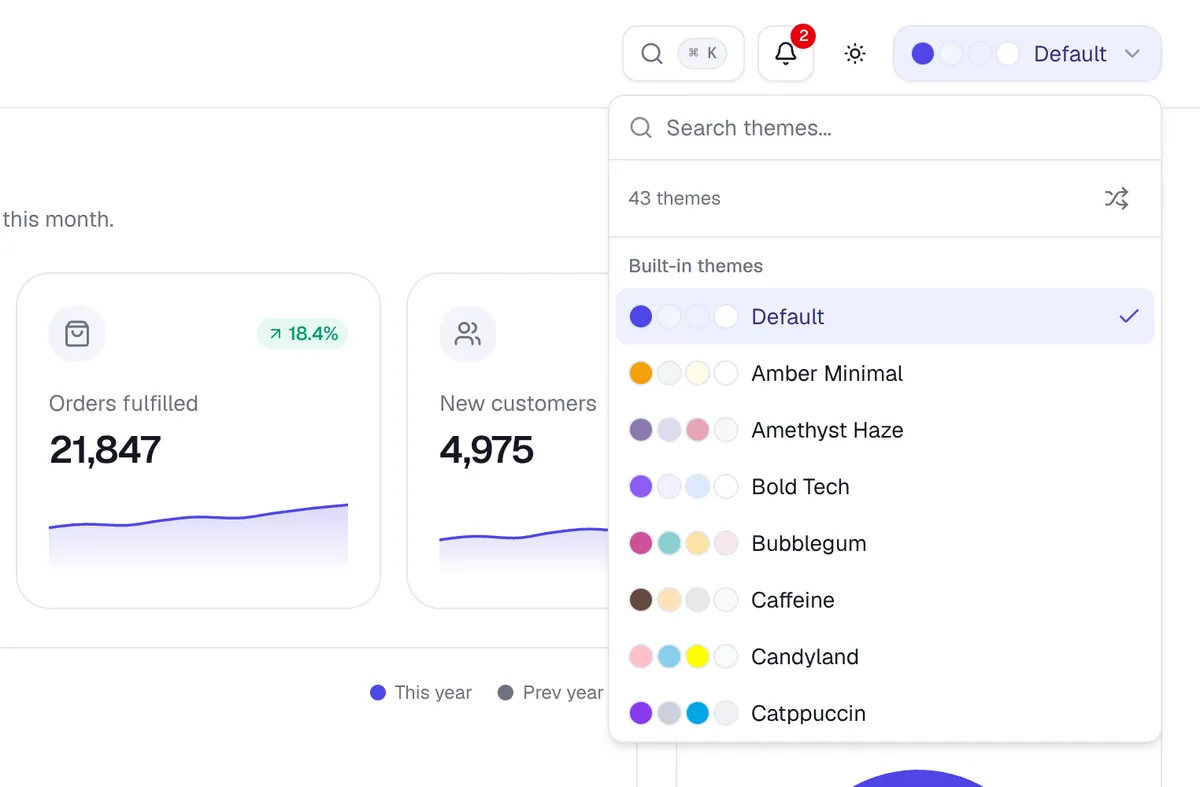
The picker saves your preset in the browser (localStorage key theme-preset), but 27 of the 43 presets name a web font the kit doesn't load, such as Poppins or Montserrat, so they render in a fallback font, while every first visit preloads 11 font files. Some controls are placeholders: the 7D, 30D and 12M buttons move the highlight but not the chart, Export does nothing, and a valid login stays on the login page. No screen we watched called an API; the figures are sample data.
Performance and SEO
One Lighthouse 12.8.2 run per page and form factor, 23 October 2026, on the Next.js demos unless noted. Accessibility, best practices and SEO are from the mobile runs.
| Page | Performance, mobile / desktop | Accessibility | Best practices | SEO |
|---|---|---|---|---|
| Flux home | 37 / 56 | 100 | 96 | 100 |
| Flux home, reduced motion | 53 / 95 | 100 | 96 | 100 |
| Flux pricing | 83 / 99 | 98 | 96 | 100 |
| Cadence home | 78 / 99 | 87 | 100 | 100 |
| Cadence home, Astro build | 83 / 100 | 87 | 100 | 100 |
| Cadence pricing | 94 / 100 | 94 | 100 | 100 |
| Relay home | 39 / 60 | 87 | 100 | 100 |
| Relay home, reduced motion | 56 / 89 | 87 | 96 | 100 |
| Relay docs, Getting Started | 75 / 100 | 96 | 100 | 100 |
| Artifact store dashboard | 67 / 99 | 100 | 100 | 100 |
| Artifact issue board | 78 / 99 | 100 | 100 | 100 |
Read the WebGL home pages with care. Our test machine has no graphics processor, so Chrome rendered the three.js scenes in software, and that work landed on the main thread as blocking time (133 s on Flux and 91 s on Relay in the mobile runs), far beyond what a phone with a GPU would see. With reduced motion forced on, the scenes stop and the mobile scores rise to 53 and 56. The code weight is real either way: Flux pages carry about 770 KiB of JavaScript, 474 KiB of it the duplicated three.js bundle.
Cadence's home page transferred 13.7 MB, 12.7 MB of it three Unsplash photos of 6.8, 3.3 and 2.6 MB served at full size; the Astro build ships the same photos with about half the JavaScript. Fonts make up 386 KiB of the 846 KiB Artifact's dashboard transfers. Accessibility failures are minor, mostly low-contrast text, plus Relay's unlabeled theme button.
For search engines, the Next.js editions ship no sitemap, robots.txt or canonical tags; the Astro builds generate a sitemap and canonical tags. None of the seven builds outputs structured data, and 7 of Cadence's 9 pages and 6 of Relay's 26 share a generic title.
What you still have to build
Form handling. Validation, a backend or form service, and spam protection for every form.
Authentication. Sign-in, sign-up, password reset and Relay's code screen are layouts; connect an auth provider.
Data. Wire Artifact's screens, date ranges and Export to your backend.
SEO basics. On the Next.js editions, a sitemap, robots.txt, canonical tags, unique titles and structured data such as Article for blog posts.
Your own content. Replace the sample products and screenshots, the real company logos in Flux's "Trusted by modern teams" row (Anthropic, Meta, Vercel and four others), the example.com addresses and Relay's "Star on GitHub" button, which points to github.com.
Page weight. Resize Cadence's photos, load three.js once in Flux and trim Artifact's font preloads.
The Classic Bundle in brief
We did not test the 20 Classic templates. Cruip codes them in HTML, Next.js and Vue; Mosaic adds React and Laravel, Stellar adds Astro. For apps and content sites: Mosaic (a dashboard), JobBoard, Community, Docs, Podcast and Creative. For landing pages and company sites: Stellar, Open PRO, Simple, Gray, Waitlist, Tidy, Cube, Neon, Appy, FinTech and Talent. For personal and freelance work: DevSpace, DevFolio and Quoty. Cruip also gives away lighter versions of Mosaic, Simple and Open PRO on GitHub, a way to see its code before paying.
Pros and cons
Pros
At $149, the Modern Bundle costs less than any two of its templates bought separately, and one of the four is a 103-screen admin kit.
Next.js and Astro editions of each marketing template for one price.
Relay includes working documentation search, a changelog, and status and security pages.
Artifact's 88 URLs all load, its forms validate and its theme choice persists.
Pages fit a 390 px screen, and the WebGL scenes respect reduced motion.
Cons
No form in the four demos is connected, and Cadence's "fully validated" contact form has no validation.
Heavy pages: 13.7 MB on Cadence's home page, three.js loaded twice on every Flux page.
No sitemap, canonical tags or structured data in the Next.js editions.
Placeholder controls in Artifact, and 27 of its 43 presets fall back to another font.
A one-person license, no refunds, no Astro documentation and no changelog entries for the Modern templates.
How Cruip compares
Shadcnblocks Premium costs $299 one-time for 21 Next.js and Astro marketing templates built on shadcn/ui, plus its block library and Admin Kit. The templates we reviewed there also stop at the front end. Pick it if you want many designs; pick Cruip if three or four will do.
Lexington Themes Full Access is $99 one-time during its current 50% sale ($198 regular) for 51 Astro themes with GitHub repository access. Pick it if you build only in Astro and want range rather than an admin kit.
Shadcn UI Kit Pro is $79 for one user during its current sale ($129 regular) and lists 16 admin dashboards, 17 web apps and 6 website templates on Next.js 16. Pick it over Artifact if dashboards are the main need.
See all template libraries, or browse Astro templates and Next.js templates.
Who should buy Cruip
Buy the Modern Bundle if you build SaaS or developer-tool sites in Next.js or Astro, would use at least two of Flux, Cadence, Relay and Artifact, and have a developer for forms, sign-in, data and SEO files. The Classic Bundle covers HTML, Vue and Laravel projects, though we haven't tested it. Look elsewhere if the site must collect leads or sign users in on day one, if several people need one license, or if you want a large catalog more than a few polished designs.
FAQ
What is the difference between Cruip's Classic and Modern bundles?
The Modern Bundle ($149) holds Flux, Cadence and Relay for Next.js and Astro plus the Artifact admin kit for Next.js, and new templates are added to it. The Classic Bundle ($79) holds the 20 older templates in HTML, Next.js and Vue, with React, Laravel or Astro versions for some. They are separate one-time purchases.
Do I get both the Next.js and Astro versions?
Yes for Flux, Cadence and Relay: one purchase includes separate Next.js and Astro downloads. Artifact comes in Next.js only. Cruip's live demos show the Next.js builds, and its documentation has no Astro section.
Do the forms and sign-in screens work?
No. In the demos, no contact, sign-in or sign-up form is connected to a backend, and Cadence's contact form and Relay's sign-in have no validation at all. Artifact's login checks your input, but a valid login goes nowhere. Plan to add form handling and an authentication provider.
Can I use Cruip templates for client projects?
Yes. The license covers unlimited end products for you or your clients, but not website builders, theme generators or resale. Access is for one person, Cruip lists no team license, and it gives no refunds unless a product is defective or won't download.
What happened to Cruip Unlimited Access?
Cruip folded it into the Classic Bundle: earlier Unlimited Access buyers keep all 20 Classic templates. Cruip's FAQ does not extend it to the Modern templates, which are sold in the Modern Bundle.
Get new templates like Cruip weekly
Every Monday: the templates, components and tools added to Tailkits that week, each checked by an editor. Free, unsubscribe in one click.
20 new in the last 30 days311 products reviewed so farSee what you get
KEEP EXPLORING
More templates