
Next.js and Astro single-product store with a model picker and checkout UI
Strand
Next.js template for genomics and lab software, with product views in code
cruip.comExplore the product
AT A GLANCE
Details about Strand
KEY POINTS
- Tailwind CSS v4
- Figma file
- MDX support
Short verdict: Strand is a 34-page marketing site for a genomics software company whose product views are built in HTML and SVG instead of screenshots, and a few of them respond: an ACMG classifier re-scores a variant as you toggle evidence. It suits lab software, bioinformatics and health-data products sold to scientists. The catches: no form sends anything, the home page loads 1.2 MB of full-size photos, and the customer stories quote named staff at NVIDIA, Databricks, Snowflake and AWS for a product that does not exist. Skip it if you want a generic SaaS look or working forms on day one.
How we reviewed it: On 24 November 2026 we used the live Next.js demo, without Cruip's purchase banner, on 1,440 px desktop and 390 px phone screens. We opened all 34 pages in its sitemap, used every control on the product pages, timed the hero slider with and without reduced motion, and submitted every form with fake details while logging requests and blocking other sites. Performance figures are from Lighthouse 12.8.2, one run per page that day. We did not buy Strand, so we could not check its code, its Figma file, or the HTML, Vue and Astro editions Cruip lists. Prices and terms are from cruip.com that day.
Disclosure: Our links to Cruip carry a referral tag.
What you get for $49
| Price | $49 one-time. Strand is also one of 13 templates in Cruip's Modern Bundle: $149 one-time, or $74.50 in Cruip's Black Friday sale (no end date given). Students get 25% off. |
|---|---|
| Version | No version number or release date. Strand appeared on cruip.com after 23 October 2026, and Cruip's changelog has no entry for it. |
| Size | "20+ pages", per Cruip. The demo's sitemap lists 34 URLs: home, four product pages, customers with four stories, integrations, pricing, book a demo, about, careers with six roles, contact, a blog with six posts, three legal pages, sign up and log in. |
| Stack | The demo runs Next.js 16.4.6, Tailwind CSS v4 and shadcn/ui (we found its button and accordion), hosted on Vercel. Cruip's page also lists HTML (with Alpine.js), Vue and Astro downloads, none of which has a public demo. Cruip says the blog uses MDX and that each template comes with a Figma file meant as a visual reference. |
| License | Unlimited end products for yourself or clients, per Cruip's terms. No reselling or redistribution, no use in website builders, no shared access, and no team license. One year of support; no refunds unless the files are defective or will not download. |
What we found in the demo
Product views built in code, three of twelve tiles that respond
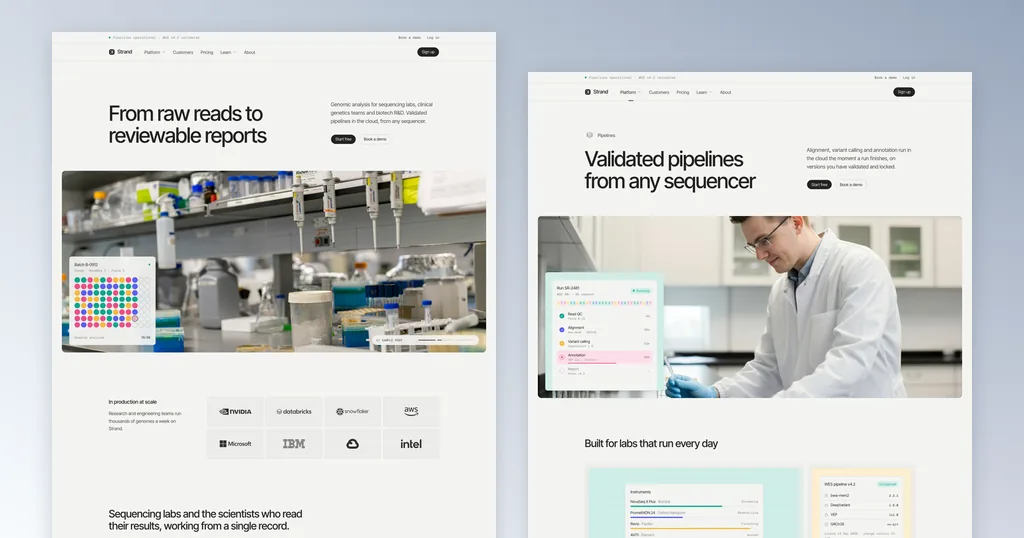
Each product page opens with a "live product view" over a lab photo, then a bento of three tiles, all markup with one accent colour per DNA base (teal A, indigo C, amber G, pink T). How much responds varies:
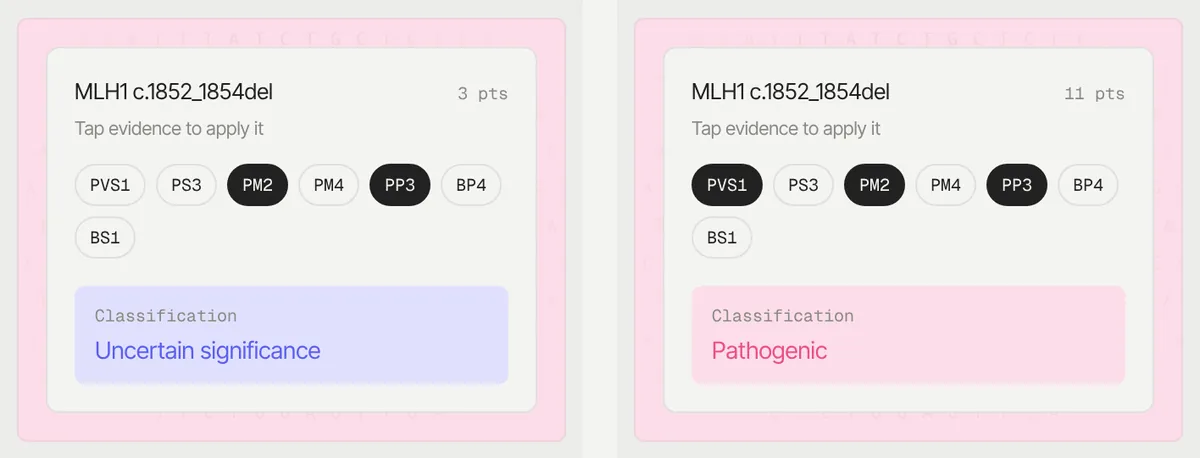
Interpretation does the most. Its variant list filters by classification, and each of the five variants opens an evidence panel. The ACMG tile is a working points calculator: MLH1 starts at 3 points, "Uncertain significance"; adding PVS1 makes 11, "Pathogenic"; adding BS1 then drops it to 7, "Likely pathogenic".
Case review: the BRCA1 coverage chart reads out position and depth under the pointer, down to 17.1× in exon 11.
Pipelines: the run card loops about every 17 seconds, and its counter briefly shows 102% between stages. Seven day bars show samples per day on hover or focus.
Compliance: a region picker moves storage between Frankfurt, London, N. Virginia and Montréal; the audit trail and the other tiles are static.
Cruip's "bento of interactive tiles" is generous: three of the twelve tiles have controls, and the rest are static drawings detailed enough to pass for product UI. Nothing is saved on reload.
A home page slider that stops for reduced motion
The hero rotates three lab photos every 6 seconds under a 96-well plate card whose counter keeps filling. Progress bars jump between slides and hovering pauses the rotation, but keyboard focus and touch do not, and there is no pause button. With reduced motion turned on, the slider, counters and DNA tickers stop: we counted zero running animations. Further down, the workflow track fades in once and the isometric run drawing is static.
Pricing by the sample
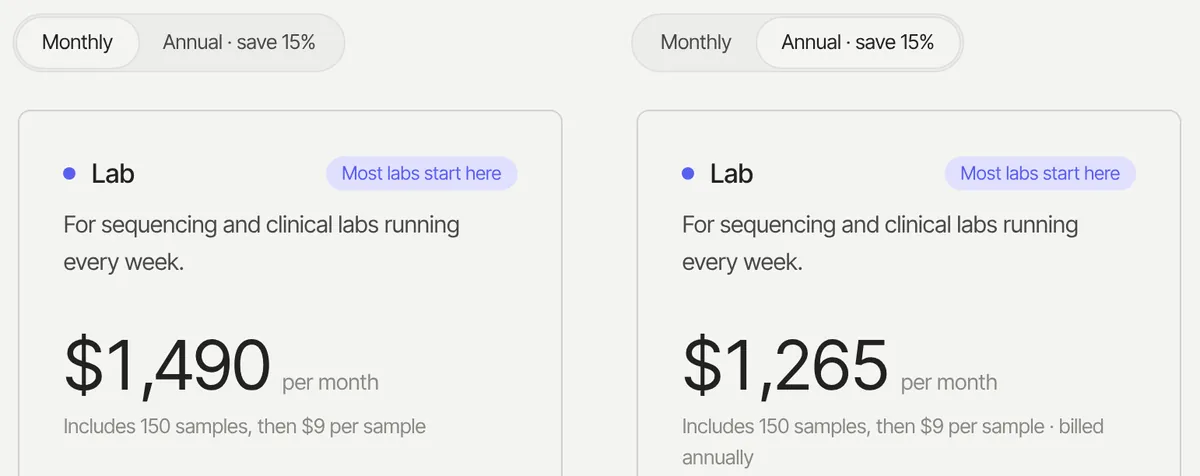
Research is free for 10 samples a month, Enterprise is custom, and Lab defaults to annual billing: $1,265 a month against $1,490 monthly, 15.1% less, as the "save 15%" label says. The $9 per extra sample stays the same, and the choice resets on reload. Below come a 15-row comparison table that labels its ticks for screen readers, three add-ons (a $4,800 validation pack, archive storage and extra regions) and five FAQs. One slip: the Enterprise price reads "Custom custom".
Forms that say thank you and send nothing
Book a demo, the newsletter, sign up and log in use the browser's built-in validation, which blocks empty fields, a broken email and a sign-up password under 12 characters. Valid entries get "Request received", "Thanks, you are on the list" or "Confirm your email", but the page sent no network request at all. Log in admits it: "Sign-in is not wired up in this template". "Edit request" brings the demo form back empty, the Google, Microsoft and SSO buttons do nothing, and Reset password links back to log in. Contact and the six job pages only offer email links to example.com addresses.
Navigation and the phone layout
On desktop, a status strip ("Pipelines operational / WGS v4.2 validated") scrolls away and the main bar sticks. Platform and Learn open full-width panels on hover or keyboard focus, but Tab jumps from Platform to Customers and skips its four product links. At 390 px nothing scrolls sideways; the menu fills the screen, locks the page, expands Platform and Learn in place and closes on Escape, though it leaves out Integrations.
Customer pages that borrow real brands
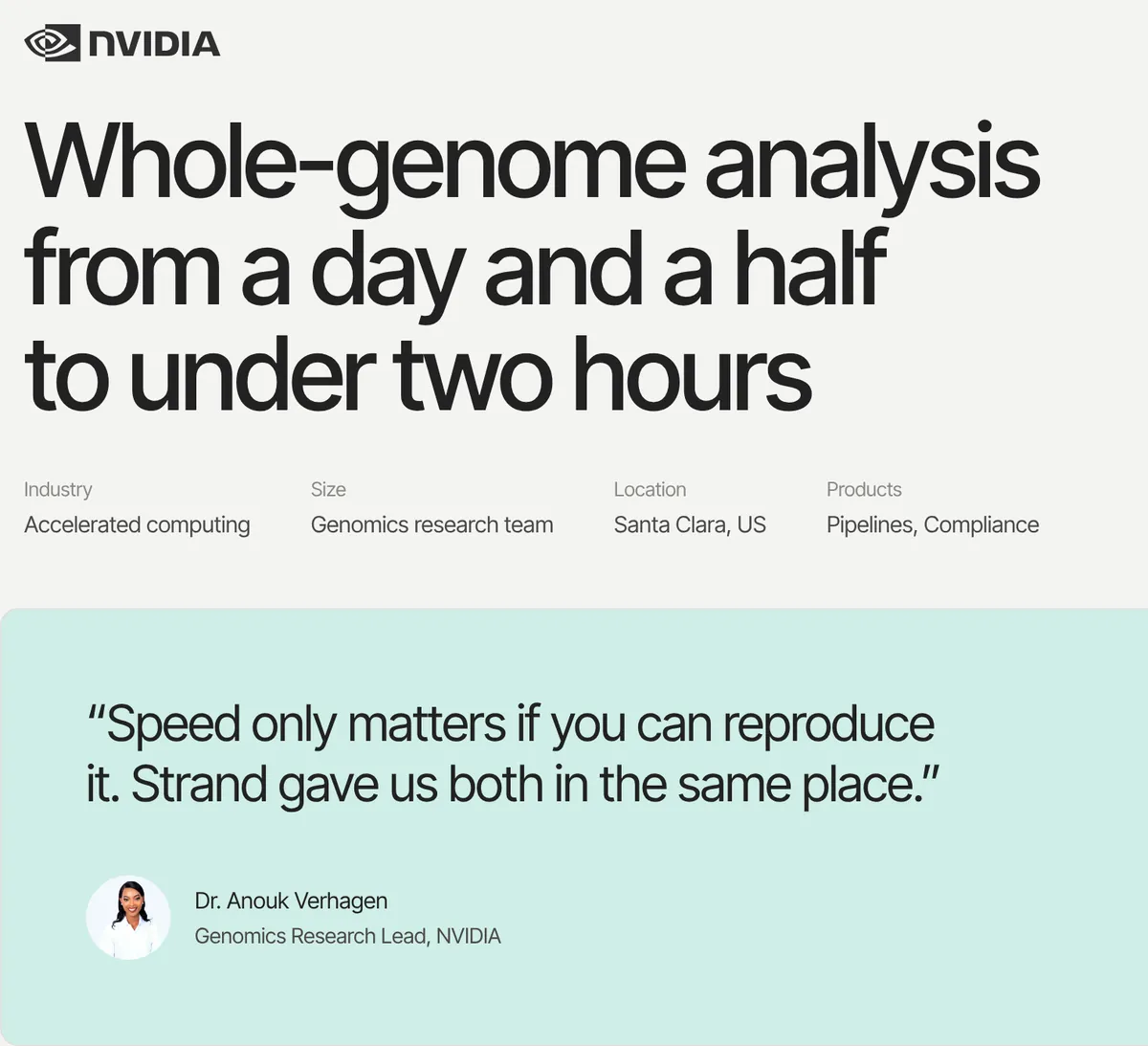
The home and customers pages show NVIDIA, Databricks, Snowflake, AWS, Microsoft, IBM, Google Cloud and Intel logos under lines such as "In production at scale". The four stories, at addresses like /customers/nvidia, add locations, results (4.1× more genomes per GPU node for NVIDIA) and a quote from a named person with a job title at each company. Strand is fictional, so publishing these as your own would claim customers and quotes you do not have.
Performance and SEO
Lighthouse 12.8.2, one run per page on 24 November 2026:
| Page | Performance | Accessibility | Best practices | SEO |
|---|---|---|---|---|
| Home, mobile | 88 | 90 | 100 | 100 |
| Home, desktop | 99 | 90 | 100 | 100 |
| Pricing, mobile | 95 | 96 | 100 | 100 |
| Pricing, desktop | 100 | 96 | 100 | 100 |
The home page moved 1,591 KB on mobile, 1,219 KB of it the three slider photos: 2,400 px JPEGs (525, 377 and 317 KB), all loaded at once for a frame 377 px wide on a phone. Strand uses Next.js's image component but serves the original files, with no smaller sizes and no WebP or AVIF; Lighthouse estimates 1,040 KB of savings from sizing alone. Pricing, without photos, moved 342 KB. Mobile largest contentful paint was 3.8 s on the home page and 2.3 s on pricing, with no layout shift.
The pale palette costs accessibility points: 45 text elements on the home page and 24 on pricing fail contrast, mostly small grey labels at around 3:1, and the home stats misuse definition-list markup.
Titles, descriptions, canonical tags (not on the home page), Open Graph images, a sitemap and robots.txt are in place, with every URL on strand.example.com. No page has structured data, so there are no sample ratings to remove.
What you still have to build
Form handling for demo requests, the newsletter, contact and job applications.
Accounts. Sign up, log in, single sign-on and password reset are screens only.
Customers and claims. Replace the brand logos, stories and quotes, the stats (2.4M+ genomes, 380+ labs, 1.2B variants), the "WGS v4.2 validated" strip and the uptime figures (99.9% and 99.95%). For clinical buyers, every validation or accreditation claim needs evidence.
Company details. Nine team names and portraits, offices in Cambridge (UK) and Boston, example.com addresses, sample legal pages and the "© 2026 Cruip.com" credit.
Smaller images, by turning on image optimization or exporting resized photos.
Pros and cons
Pros
Product views are code you can restyle and feed real data.
A complete B2B site of 34 pages, down to six job pages and a themed 404 page.
Reduced motion stops every animation we checked.
100 for best practices and SEO, and 99 to 100 for desktop performance.
Cons
Forms only simulate success; contact and careers are email links.
Real-brand logos and attributed quotes to remove before launch.
1.2 MB of full-size photos on the home page.
Low-contrast labels, a menu gap for keyboard users and no way to pause the slider on touch.
Only the Next.js edition can be seen, and the copy is genomics throughout.
How Strand compares
Path ($49), Cruip's general B2B SaaS sibling, has a neutral look and four solution pages Strand lacks. Its contact and careers pages are email links too, and its stories also use real brands. Pick it if your product is not scientific.
Clause ($49), the legal-tech sibling (navy, serif, WebGL hero), adds a contact form, a job application form and four solution pages. Pick it for legal or compliance buyers.
Scalar by Shadcnblocks ($79, or $47 with its Black Friday code) has 30 pages and Next.js 16 and Astro editions in one purchase, both with public demos (version 1.2.0, updated 16 September 2025). It is built for developer tools, with no domain-specific product UI. Pick it if you need Astro.
Cruip's Modern Bundle holds Strand, Path, Clause and ten more for $74.50 in the sale, less than two single templates.
See all SaaS templates for more options.
Who should buy Strand
Buy it if you are launching the marketing site for lab software, a genomics platform or a health-data product, and have a developer to connect forms and sign-up. Look elsewhere if you need working forms out of the box, a confirmed stack other than Next.js, or a site outside the life sciences.
FAQ
Do the forms in Strand send anything?
No. In our test the demo request, newsletter, sign-up and log-in forms showed success messages without making a single network request, and contact and job applications are email links to example.com. Connect a form service, an email list and an identity provider before launch.
Can I keep the NVIDIA, Databricks, Snowflake and AWS customer stories?
No. They are demo content for a fictional company: real logos, sample results and quotes attributed to named staff at those firms. Replace them with your own customers or delete the pages.
Which framework editions does Strand come in?
Cruip's page lists Next.js, HTML, Vue and Astro downloads, but only the Next.js 16 edition has a public demo, and the template's own description names only Next.js 16, React 19, Tailwind CSS 4 and shadcn/ui. Ask Cruip before buying for another stack, since Cruip only refunds defective files or failed downloads.
Is Strand cheaper in a bundle?
Yes, while Cruip's Black Friday sale lasts. Strand alone is $49; the Modern Bundle, with Strand and 12 other Modern templates, is $74.50 instead of $149. Cruip gives no end date for the sale.
Can Strand work for a product outside genomics?
Yes, but plan a full rewrite. The page layouts are general B2B SaaS (products, pricing, customers, careers), while the product views, copy, stats and even the 404 page are written for a sequencing lab platform.
New templates like Strand, in your inbox
The best developer tools, templates and UI components added to Tailkits, each reviewed by an editor. Free, unsubscribe in one click.
26 new in the last 30 days322 products reviewed so farSee what you get
KEEP EXPLORING
More templates Good company for Strand.
Do you make Strand? Get a badge for your site
An optional "Featured on Tailkits" badge that links to this page. Pick light or dark and paste the code into your site, for example in the footer.