
Next.js and Astro single-product store with a model picker and checkout UI
Path
Next.js B2B SaaS template with 35 pages and a dithered WebGL call to action
cruip.comExplore the product
AT A GLANCE
Details about Path
KEY POINTS
- Tailwind CSS v4
- Figma file
- MDX support
Short verdict: Path gives a B2B software company its whole marketing site for $49: 35 pages, from product and solution pages to careers, a blog and sign-up, with app screens built in code and a dithered WebGL call to action that respects reduced motion. Everything stops at the browser: the forms validate, then report success without sending anything. The sample content also presents Asana, Notion, Retool, Miro and four other real companies as customers, with invented quotes and results. Buy it if a developer will connect accounts and forms; skip it if you need working sign-up on day one or a non-Next.js edition you can check before paying.
How we reviewed it: On 24 November 2026 we used the live Next.js demo, without Cruip's purchase banner, on a desktop and a 390 px phone screen. We loaded all 35 pages, submitted every form with sample data while logging and blocking outbound requests, tried every filter, menu and switch, and checked the animation with reduced motion turned on. Lighthouse 12.8.2 ran once per page on the home and pricing pages, mobile and desktop. We did not buy the template, so we saw no source code, Figma file or other editions. Prices and terms are from cruip.com that day.
Disclosure: Our links to Cruip carry a referral tag.
What you get for $49
| Price | $49 one-time. Path is also one of 13 templates in Cruip's Modern Bundle: $149 one-time, or $74.50 in Cruip's Black Friday sale (no end date given), which is less than two single templates. |
|---|---|
| Editions | Cruip's sidebar lists HTML (with Alpine.js), Next.js, Vue and Astro downloads, but its "What's included" text describes only the Next.js 16 build. Only the Next.js demo is online, so we could not verify the other three. |
| Version | No version number or release date. Path appeared on cruip.com after 23 October 2026, and Cruip's changelog has no entry for it yet. |
| Size | 22 pages, per Cruip. The demo serves 35 URLs: the 34 in its sitemap plus the log-in page, counting 4 product pages, 4 solution pages, 4 customer stories, 5 job pages and 4 blog posts. |
| Stack | Next.js 16 (the demo runs 16.4.6), React 19, Tailwind CSS 4 and shadcn/ui, as Cruip says. The demo also ships the Motion animation library, which Cruip doesn't mention for Path. The blog is written in MDX, per Cruip. |
| Design files | A Figma file, which Cruip calls a visual reference without auto layout or components |
| License | Unlimited end products for you or your clients. No website builders or theme generators, no reselling, and no sharing your access with other people. Cruip lists no team license. Terms and license |
| Support and refunds | Support for one year after purchase. No refunds unless a product is defective or won't download. Students get 25% off. |
What we found in the demo
A full site for a sample onboarding platform
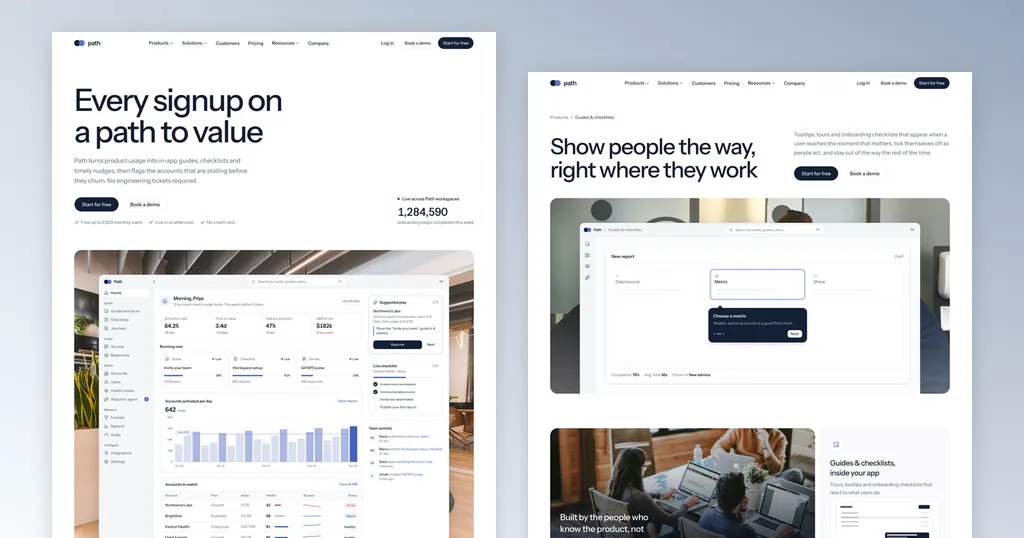
The demo sells a made-up product adoption tool, also called Path, with four modules, from in-app guides to an "AI adoption agent". Product pages combine an app screen, a photo bento, how-it-works steps and related products; solution pages pair a customer spotlight with a before-and-after table. The app screens are HTML, not images, and some, like the hero's "Suggested play" card, respond to clicks. All 35 pages fit a 390 px screen without sideways scrolling.
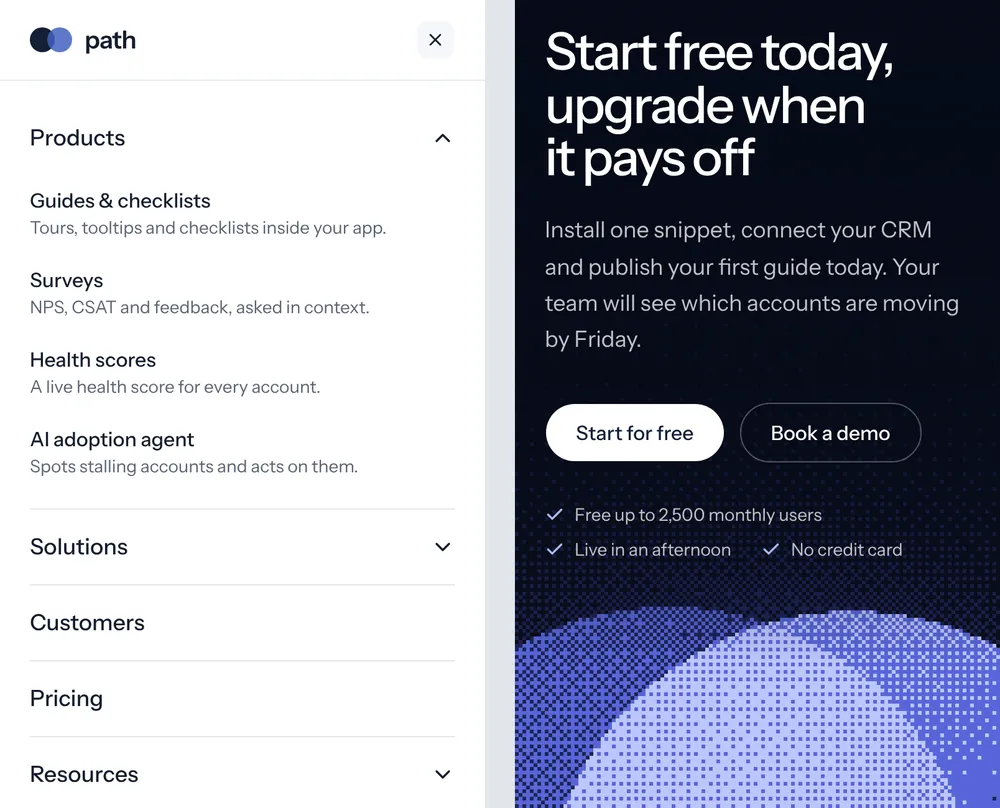
The three desktop dropdowns carry photos, customer results and the latest article, and work with the keyboard too. On a phone the menu fills the screen, locks the page behind it and closes after you pick a link, but Escape doesn't close it and Tab lets focus slip into the hidden page.
Sign-up, log-in and demo forms that validate, then stop
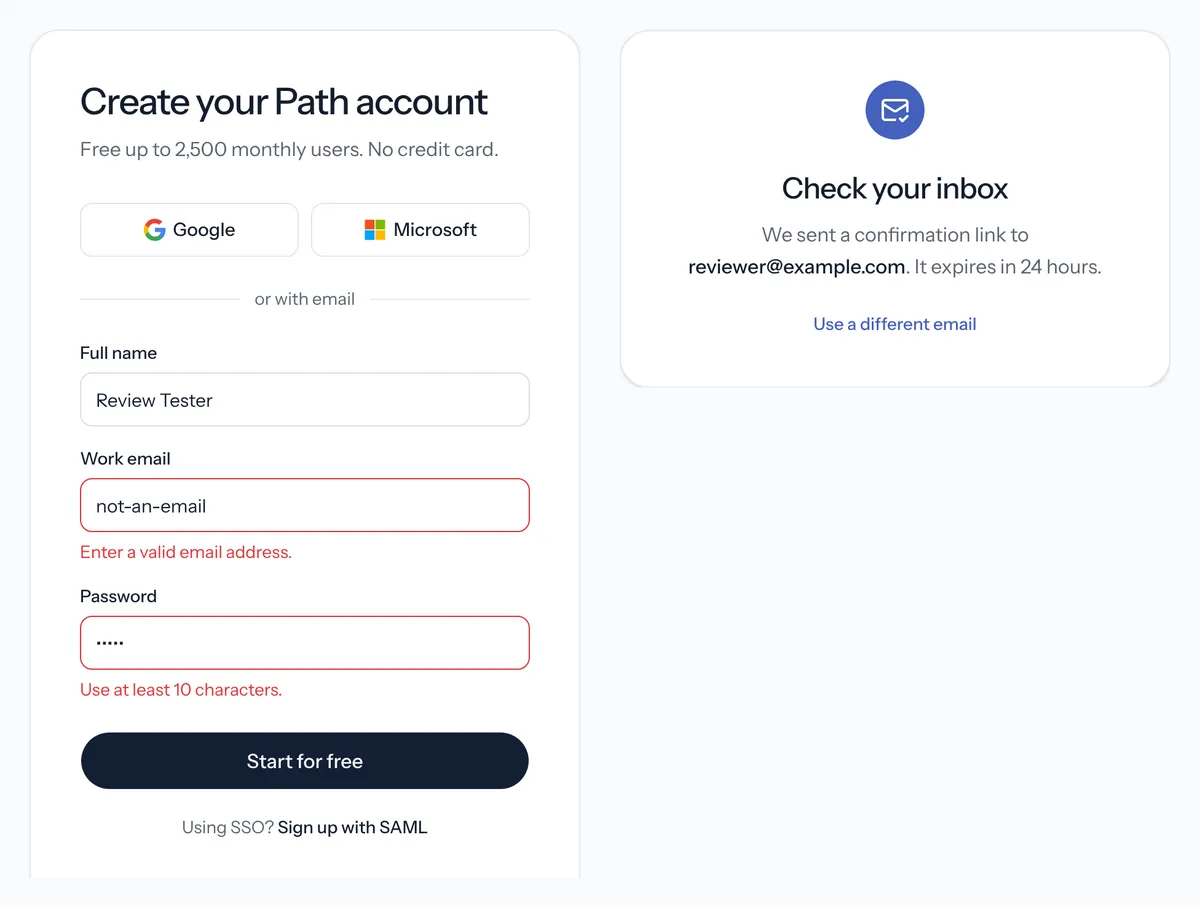
The sign-up form requires a name, a valid email and a password of at least 10 characters, with each error linked to its field. Valid sample data brings "Check your inbox. We sent a confirmation link", yet no request left the page. The demo form (four required fields) promises a reply "within one business day" and the newsletter says "You're subscribed"; neither sent anything. Only log-in admits it is a demo. The Google and Microsoft buttons do nothing, the SAML and "Forgot password?" links point to #, the contact page has no form, and job applications are email links.
Pricing with a working annual switch
Four plans: Free (up to 2,500 monthly users), Growth ($249 a month billed annually, $299 monthly), Business ($799 or $959) and Enterprise (custom). The "saves about 17%" note is right (16.7%), and the switch uses accessible radio buttons.
A blog with four posts, so "load more" never shows
The blog has four posts, one featured, each with an author, a date, a 1,600 px cover photo and an "On this page" table of contents. The three category buttons leave one post each, and the URL doesn't change. "Load more" is in the code, six posts per click, but it appears only when more than six posts match, so the demo never shows it.
A dithered call to action that respects reduced motion
The call to action that ends 21 of the 35 pages is a WebGL shader: two shaded spheres echoing Path's logo, dithered in four navy-to-lavender tones and drifting toward the pointer. It is plain WebGL in a 3.8 KiB download and animates only while on screen. With reduced motion on, it draws one still frame, other animations stop and counters show final values. The other 14, such as careers, contact and legal pages, end without it.
Real companies in the sample content
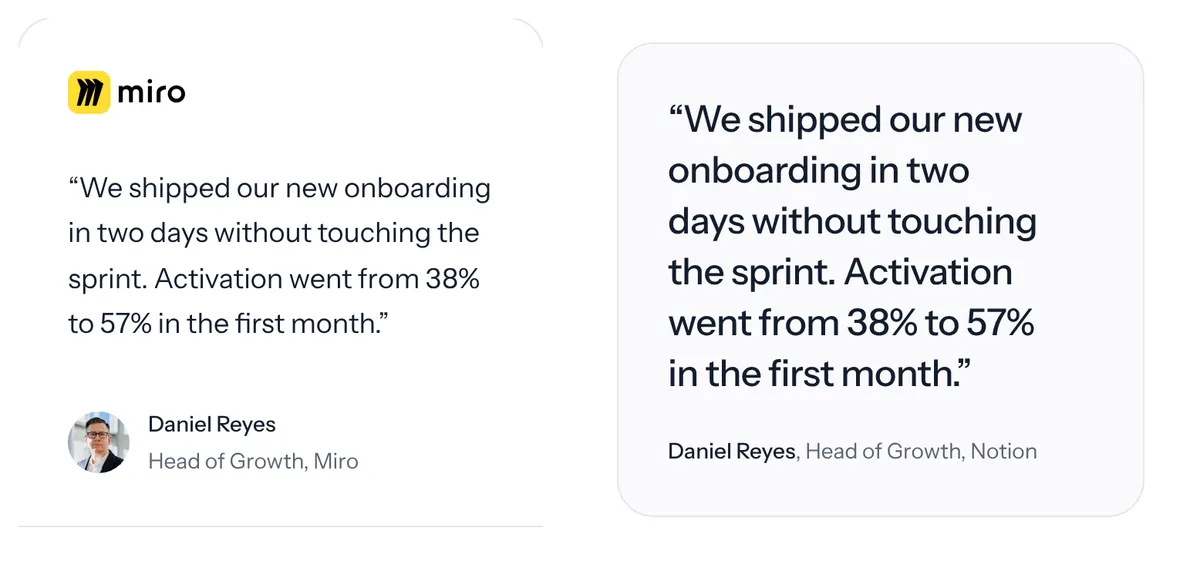
The home, customers and demo pages show logos of Notion, Loom, Miro, Airtable, Asana, Webflow, ClickUp and Retool under "2,400+ software teams use Path", and the four customer stories are named after Asana, Notion, Retool and Miro, with headcounts, quotes and results such as "lifted trial activation from 38% to 57%". The quoted people are invented; their photos are Unsplash stock images with alt text such as "Maya Okafor, VP of Customer Success at Asana". It isn't consistent either: the home page credits the activation quote to Daniel Reyes of Miro, the Notion story to Daniel Reyes of Notion, and two blog posts are bylined to these "customers".
Also replace the SOC 2 and GDPR badges, the 99.95% uptime SLA, "60+ native integrations" (the integrations page lists 16), the team, the addresses and the "© 2026 Cruip.com" footer; the legal pages are placeholders.
Performance and SEO
One Lighthouse 12.8.2 run per page, 24 November 2026:
| Page | Performance | Accessibility | Best practices | SEO |
|---|---|---|---|---|
| Home, mobile | 81 | 92 | 100 | 92 |
| Home, desktop | 99 | 92 | 100 | 92 |
| Pricing, mobile | 94 | 96 | 100 | 100 |
| Pricing, desktop | 100 | 96 | 100 | 100 |
On mobile, the home page's largest contentful paint (4.6 s) is one photo: a 2,400 × 1,600 px JPEG of 686 KiB, sent unchanged to a 390 px screen, 61% of the 1,132 KiB loaded at first. Lighthouse estimates 559 KiB of savings on it alone. Photos have no phone-sized versions; scrolling the whole home page on a phone reached about 2 MB. Both pages load about 290 KiB of JavaScript, including a 54 KiB file built around the Motion library.
Accessibility lost points for a "Product areas" switcher marked up as a tab list without tabs, tiny low-contrast labels in the dashboard mockup and light text on the highlighted pricing card. The home page's 92 for SEO comes from four "Learn more" links.
Metadata, sitemap, robots file and canonical links all point at path.example.com, so set your domain before launch; the home page has no canonical link. No page outputs structured data, so there are no sample ratings to remove. The animated figures read zero in the HTML ("0% faster time to first value") until JavaScript runs.
What you still have to build
Accounts. An auth provider behind sign-up and log-in, the Google, Microsoft and SAML buttons, and password reset.
Form delivery. Demo requests and newsletter sign-ups sent to your CRM or email tool, and a contact form if you want one.
Your own proof. Logos, stories, quotes, people, numbers and badges.
Legal pages and domain. Real policies, your domain in the metadata, your footer.
Image delivery. Resized photos or Next.js image optimization, starting with the hero.
Pros and cons
Pros
35 pages, including solution, customer, careers and sign-up pages.
Forms validate properly, so only delivery is left to build.
A light WebGL call to action that pauses off screen and respects reduced motion.
Menus, the pricing switch, filters and search all work at 390 px too.
$49 alone, or $74.50 for 13 templates while Cruip's sale runs.
Cons
Real company logos, quotes and results throughout, some contradicting each other.
Forms report success without sending anything; OAuth, SAML and password reset are not wired.
A 686 KiB hero photo slows the mobile home page to a 4.6 s largest paint.
Only the Next.js edition can be checked before buying, and Cruip gives no refunds.
The phone menu ignores Escape and lets keyboard focus slip behind it.
How Path compares
Clause is Cruip's $49 sibling for legal and compliance software: the same kind of product, solution and careers pages, with serif headings and a WebGL shader behind the hero. Its home page scored 68 for mobile performance in the same Lighthouse run (Path: 81). Pick it for legal, finance or procurement buyers.
Strand, also $49, suits science, health and data products: a light grey layout, lab photography and product views drawn in code, per Cruip.
Meridian from Shadcnblocks ($79, or $47 with its Black Friday code) is a dark template for developer tools with Fumadocs documentation and ⌘K search, and one purchase includes Next.js 16 and Astro 7, per Shadcnblocks. Its demo has no sign-up, log-in, careers or customer pages. Pick it if you sell to developers and need docs.
Cruip's Modern Bundle ($149, or $74.50 in the sale) adds Clause, Strand and ten more templates to Path.
See all SaaS templates for more options.
Who should buy Path
Buy Path if you market a B2B product with several modules, want the whole site designed at once in Next.js, and have a developer for accounts and forms plus time to replace every sample name and number. It suits onboarding, analytics and customer success tools. Look elsewhere if you need working sign-up on day one, an edition you can inspect before paying, or a dark look for developers.
FAQ
Do Path's sign-up and log-in pages work?
No. They check the fields and show a success screen, but nothing is sent, and the Google, Microsoft and SAML buttons are not connected. You add an auth provider yourself, along with password reset.
Is Path available for Astro, Vue or plain HTML?
Cruip's page lists those downloads, but its own description covers only the Next.js 16 build and only the Next.js demo is online, so we could not check them. Ask Cruip before paying, because it gives no refunds unless a product is defective.
Should I buy the Modern Bundle instead of Path alone?
While Cruip's Black Friday sale runs, yes if you might use a second template: the bundle costs $74.50 for 13 templates, against $49 for Path alone. At the regular $149 it costs about as much as three single templates.
Can I use Path for client projects?
Yes. Cruip's license allows unlimited end products for you or your clients. You can't resell the template, use it in a site builder or theme generator, or share your access, and there is no team license.
Can I keep the customer logos and stories from the demo?
No. They name real companies such as Asana, Notion, Retool and Miro, with invented quotes and results that would misrepresent them on your site. Replace them with your own customers or remove those sections.
New templates like Path, in your inbox
The best developer tools, templates and UI components added to Tailkits, each reviewed by an editor. Free, unsubscribe in one click.
26 new in the last 30 days322 products reviewed so farSee what you get
KEEP EXPLORING
More templates Good company for Path.
Do you make Path? Get a badge for your site
An optional "Featured on Tailkits" badge that links to this page. Pick light or dark and paste the code into your site, for example in the footer.