Next.js and Astro single-product store with a model picker and checkout UI
Flabbergasted
Dark Astro voice AI SaaS theme with a playground UI and five-plan pricing
PaidTemplates
lexingtonthemes.comExplore the product
AT A GLANCE
- Website
- lexingtonthemes.com
- Pricing
- Paid
- Categories
- Templates
- Listed
- Mar 2023
- Updated
- Oct 2026
Details about Flabbergasted
KEY POINTS
- Tailwind CSS v4
Short verdict: Flabbergasted gives a voice AI or speech API startup a polished dark site with the pages that product needs: five-plan pricing with a full comparison table, a release timeline, customer stories, integrations and a help center. The hero playground is a mock-up: whatever you type, Listen plays the same 11-second recording. Forms send nothing, all 53 pages share a placeholder title, and the legal pages were written for another company. It suits a developer-tool team with someone comfortable in Astro; skip it if you need docs, a light theme or a site you can launch without code changes.
How we reviewed it: On 30 October 2026 we used the live Astro demo at 1440 px, at 1024 px and on a 390 px phone screen. We typed our own sentence into the playground and pressed Listen, played the voice presets, switched pricing to annual, opened both menus, crawled all 53 pages and submitted the contact, sign-in, sign-up and newsletter forms while logging every request. We ran Lighthouse 12.8.2 on the home page and on a blog post. We did not buy the theme, so we can't judge the source code or the Sanity and EmDash editions, which have no public demo. Prices, editions and license terms come from Lexington Themes on the same day.
Disclosure: Our links to Lexington Themes carry a referral tag.
What you get for $89
| Price | $89 one-time for the Astro edition, $129 for the Sanity or EmDash edition. Lexington Themes Full Access Personal costs $99 (shown as 50% off $198) and includes all 53 Lexington Astro themes, so for $10 more you get this theme and every other one. |
|---|---|
| Editions | Astro (the public demo), Astro + Sanity ("the same designs wired to Sanity, with live preview editing") and Astro + EmDash (an admin built in, deployed to Cloudflare Workers), per Lexington. |
| Version | Astro 7.4.1 and Tailwind CSS 4.3.3, per Lexington; the demo's stylesheet confirms Tailwind 4.3.3. Redesigned on 6 October 2026. |
| Size | 53 pages in the demo, counting the 404: 12 static pages (home, about, team, contact, sign-in, sign-up, 404 and five style-guide pages) plus 10 blog posts, 6 releases, 6 customer stories, 8 integrations, 4 help articles, 2 legal pages and their index pages. Lexington no longer publishes page or component counts. |
| Stack | Astro and Tailwind CSS 4, with a little vanilla JavaScript for the menus, the pricing switch, the audio and Lenis smooth scrolling. No React, Vue or Alpine.js. |
| Delivery | A private GitHub repository through Polar.sh, with AGENTS.md, Cursor rules and a design skill for AI coding tools, per Lexington. No Figma file. |
| Deploys to | Any static host, such as Netlify or Vercel. Lexington's setup guide still says Node.js 20 or later, but Astro 7.4 requires 22.22 or newer. |
| License | Unlimited sites for yourself and for clients, including commercial and white-label work, with no attribution. No reselling as a template and no use as the core of a site builder; one seat per named person. License terms |
What we found in the demo
The playground plays one recording
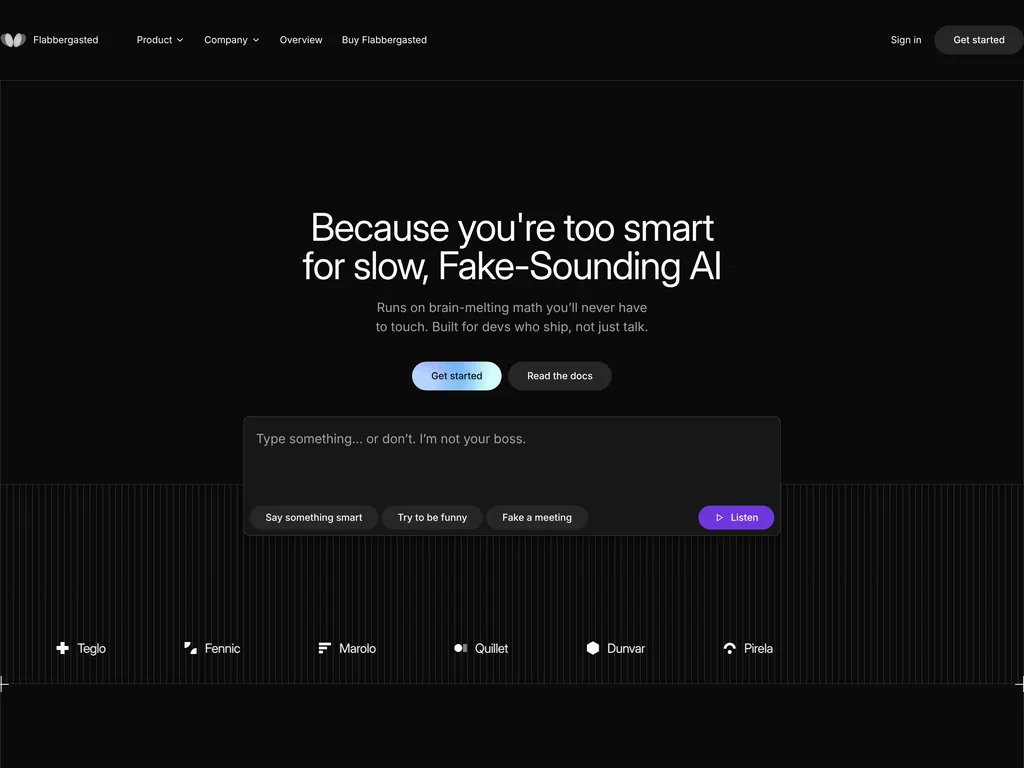
The hero is a text box with three prompt chips and a Listen button. The chips only fill the box with a sample line. We typed our own sentence and pressed Listen: the page played /audio/sample1.mp3, an 11-second clip, and sent no request to any speech service. The voice presets further down work the same way: Normal, Chipmunk and Deep all play that file, Chipmunk seven semitones higher and Deep five lower. Until you connect your own text-to-speech API, a visitor who types something hears a line they did not write.
Pricing built for a usage-based API
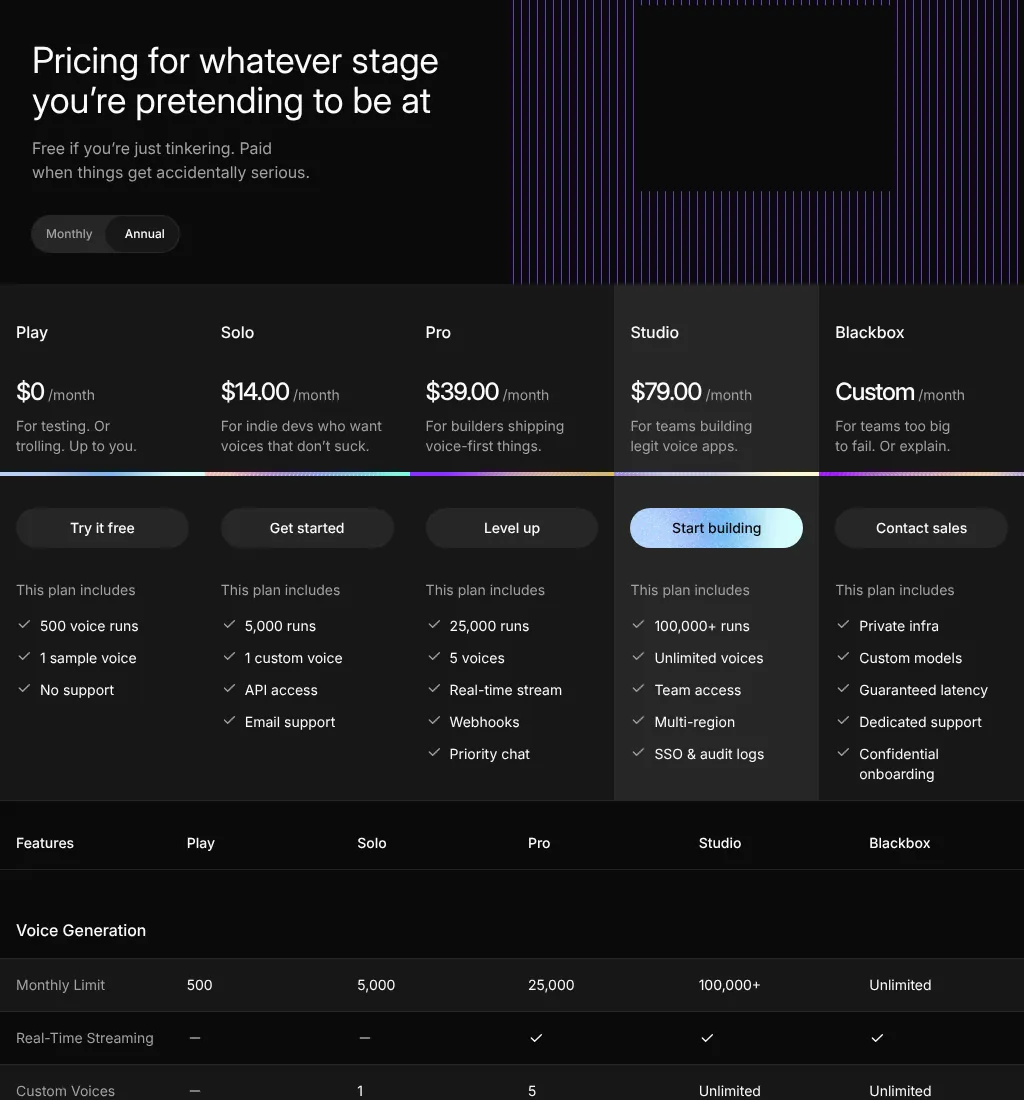
Five plans sit on the home page; there is no separate pricing page. Play is free, a Monthly and Annual switch moves Solo, Pro and Studio from $19, $49 and $99 to $14, $39 and $79 a month, and Blackbox is custom (its card reads "Custom /month"). Under the cards, a comparison table lists 20 features in four groups, from monthly limits and audio formats to SSO and support, and on wide screens the plan names stay pinned to the top while you scroll through it. Eight FAQs follow, built on plain <details> elements that work without JavaScript.
Release notes, customer stories and integrations
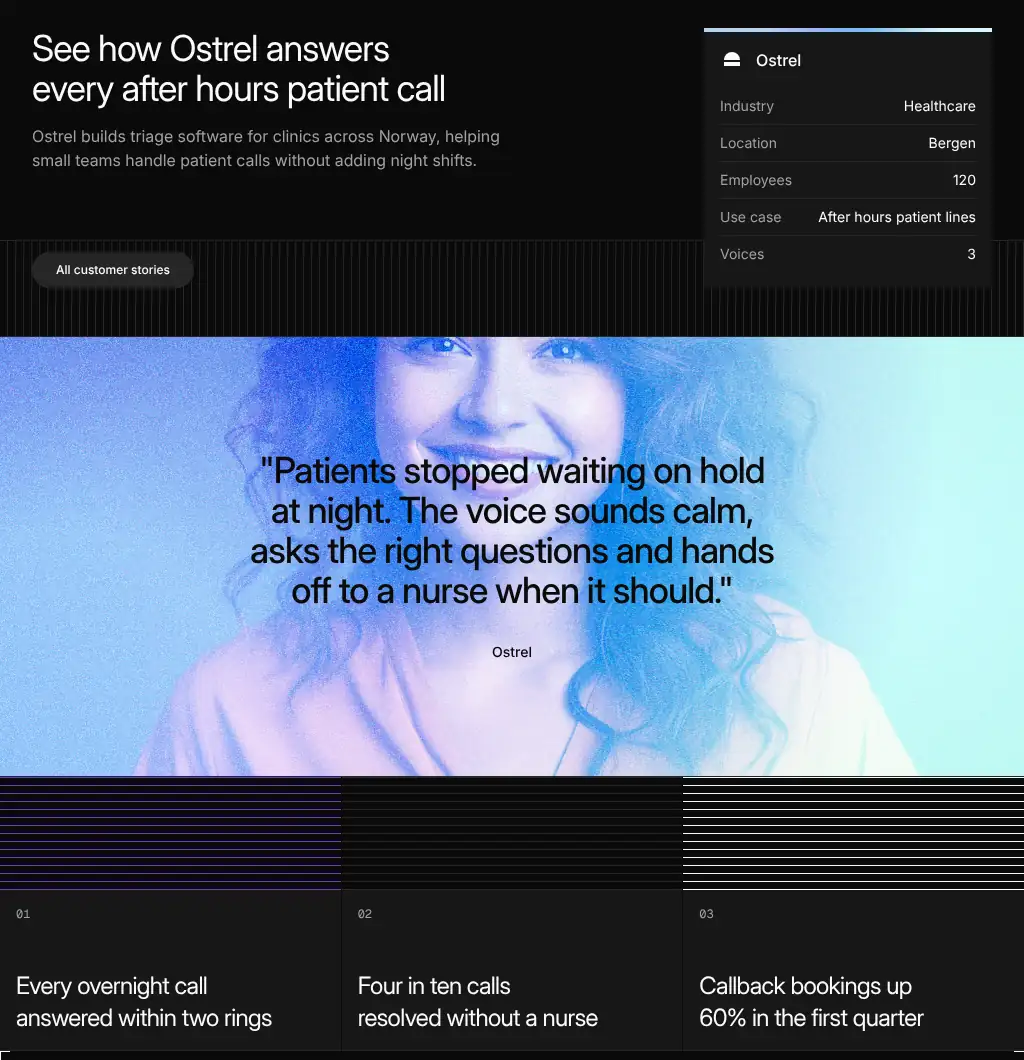
The changelog is a timeline of six releases, v2.0 to v2.5, each with a date, a version and an area such as API or Billing, and the full notes inline; release pages have previous and next links. Customer stories open with a details card (industry, location, employees, use case), then a quote over a tinted photo and three result tiles. Each of the eight integrations gets a page with a permissions list and setup steps, and the four help articles carry their own FAQs. According to the demo's style guide, these collections are Markdown files: add one and the index and detail pages follow.
Company pages, forms and mobile
About has headline figures, a founding story, three principles and a team teaser; the team page lists ten people. The contact page gives sales, support and press their own addresses. None of the forms is connected. Contact, sign-in, sign-up and the blog's newsletter box have no action, so submitting reloads the page with every field in the address bar, including the password on sign-in and sign-up. Nothing is sent and nothing confirms it. On a 390 px screen we found no sideways scrolling, and at 1024 px the desktop menu still fits.
A dark design with hand-set gradients
The site is dark only, with Inter for text, Geist Mono for code, vertical stripes, corner crosses on the section borders and mesh gradients on cards and the main buttons. The compiled CSS defines seven color tokens, as Lexington says, and five style-guide pages under /system show them. The six mesh gradients, though, use their own hex colors, so a rebrand means editing those too.
Performance and SEO
One Lighthouse 12.8.2 run per page, 30 October 2026, on a shared test machine:
| Page | Performance | Accessibility | Best practices | SEO |
|---|---|---|---|---|
| Home, mobile | 95 | 95 | 96 | 100 |
| Home, desktop | 93 | 95 | 96 | 100 |
| Blog post, mobile | 96 | 100 | 96 | 100 |
| Blog post, desktop | 99 | 100 | 96 | 100 |
JavaScript is small (12 KiB on the home page); fonts are not. Inter loads from rsms.me as files of 345 KiB and 107 KiB, so every page we measured carried at least 452 KiB of fonts (475 KiB on the home page, with Geist Mono). Across our runs the home page transferred 625 to 884 KiB, depending on how much of the 327 KiB sample clip had downloaded; the clip starts loading before anyone presses Listen. The headline is the largest paint, so on phones it waits for the fonts (2.3 s in our mobile run); self-hosting a smaller Inter subset is the first fix. Accessibility lost points for the three preset play buttons, which have no accessible name, and best practices for favicon and manifest files the layout links to but the demo lacks. Lexington's product page lists 99, 100, 100 and 100.
SEO needs work before launch. All 53 pages share the title "Your Page Title", the description "A detailed description of your page content." and a canonical link to https://yourwebsite.com/current-page. Lighthouse still gives SEO 100, because it checks that these tags exist, not what they say. The sitemap (52 URLs) and RSS feed (10 posts) are generated but point at yourdomain.com until you set your site URL, and no page has structured data.
What you still have to build
Speech. Connect the playground and the presets to your text-to-speech API through a server route.
Forms and accounts. Give the forms an endpoint (a form service, your CRM or your auth provider) and switch them to POST so passwords stay out of URLs. Sign-in and sign-up are screens only.
Page metadata. Real titles, descriptions, canonical URLs and a share image for each page, and your domain in the site config for the sitemap and RSS.
Legal pages. "Terms" is a privacy policy for Unwrapped AB dated 1 January 2024, with a contact address at unwrapped.design, a domain that did not resolve on 30 October 2026. "Privacy" is a California-only CCPA section. Replace both.
Icons. Add the favicon and manifest files the layout already links to.
Sample claims. The customer results (callback bookings up 60%), the about-page figures and the testimonials are invented; swap in your own or remove them.
Pros and cons
Pros
Pricing fits a usage-based API: five plans, an annual switch and a 20-feature comparison table with pinned plan names.
The pages a developer product needs are designed: changelog timeline, customer stories, integrations and help center, fed by Markdown collections.
Little JavaScript (12 KiB on the home page), accessibility of 95 to 100 and a clean 390 px layout.
Cons
The playground and voice presets are a mock-up built on one recording.
Forms send nothing and put passwords in the URL until you wire them.
Placeholder titles and canonical links on every page, and legal text written for another company.
About 450 KiB of fonts from a third-party host on every page.
Dark only, and no documentation section beyond four help articles.
How Flabbergasted compares
Buio ($89, also by Lexington) is the other dark SaaS theme, built for Web3: white ink on near black, WebGL dither art, a status page, a chaptered whitepaper and job listings. Its home page weighed 109 KiB in our mobile run, but its pricing is three plans on the home page with no comparison table.
Alfred ($89, Lexington) is the light alternative, made for security products: charcoal, warm grey and serif headings, with a separate pricing page, a status page and written incident reports. Choose it if your product should look calm rather than technical.
Relay by Cruip ($79) is a dark, developer-first SaaS template in Next.js 16 or Astro 6 with a searchable docs section, status and security pages and a Figma file, per Cruip. Pick it if your API needs documentation on the same site.
See all Tailwind templates for more options.
Who should buy Flabbergasted
Buy it if you are launching a voice AI, speech or developer API product, want a dark site whose pricing, changelog and customer pages are already designed, and have a developer to connect a real speech demo, the forms and the page metadata. Look elsewhere if you need documentation inside the site, a light theme, or a playground that speaks your visitors' words without backend work.
FAQ
Does the Flabbergasted playground generate speech from what I type?
No. Listen plays one recorded 11-second clip whatever you type, and the Normal, Chipmunk and Deep presets play that same clip at different pitches. To let visitors hear their own text, connect your text-to-speech API through a server route so the API key stays private.
Is Flabbergasted cheaper as part of Lexington Full Access?
Usually, yes. Flabbergasted alone costs $89, while Full Access Personal costs $99 (shown as 50% off $198) and includes all 53 Lexington Astro themes, so for $10 more you get this theme and every other one.
Can I use Flabbergasted for client projects?
Yes. Lexington's license allows unlimited websites for yourself and for clients, including commercial and white-label work, without attribution. You can't resell the theme as a template, and each seat covers one named person.
Does Flabbergasted come with a CMS?
Not the $89 Astro edition, which keeps content in Markdown files. The Sanity and EmDash editions cost $129 each and add a CMS, per Lexington. Neither has a public demo, so we could not test them.
Can I get a refund on Flabbergasted?
Only in limited cases. Lexington refunds a theme that is not as described or differs materially from the live preview, and a purchase whose repository was not accessed within 14 days. There is no refund for a change of mind after you access the repository, so test the demo first.
KEEP EXPLORING
More templates