
Munch
Build modern restaurant websites with Munch.
- MDX Support
- Copy & Paste
- Tailwind CSS v4
- Responsive Design
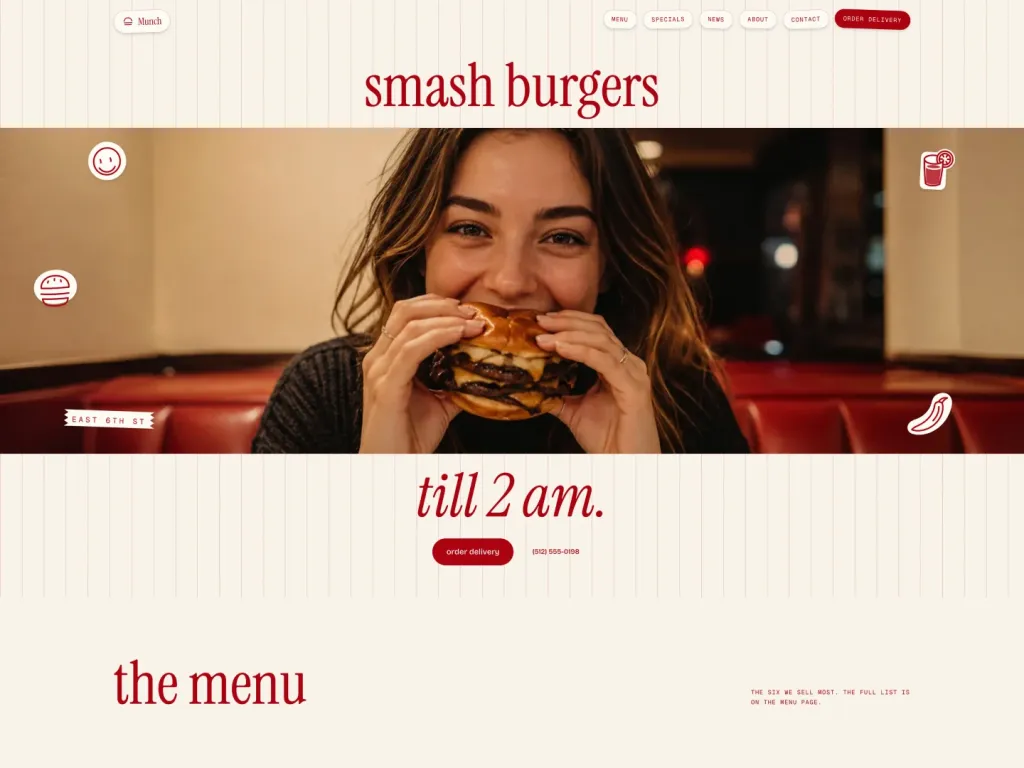
Munch is a premium restaurant template for Next.js and Astro. It combines a distinctive food-focused visual style with a complete menu, nutrition details, a browser-persistent order cart, MDX content, and more than 40 reusable components.
Munch includes 15 pages and is available in both Next.js and Astro editions. Built with the latest shadcn/ui, Tailwind CSS 4, TypeScript, and Markdown, it gives developers a polished foundation for launching a restaurant, café, burger shop, or delivery-focused food brand.
What Is the Munch Template?
Munch is a multi-page restaurant website template designed for food businesses that want more than a simple menu page. Its structure supports brand storytelling, menu discovery, online ordering flows, news content, and legal information in one cohesive experience.
The design leans into a warm editorial direction with prominent food photography, bold typography, playful illustrated details, and clear calls to action. The content can be adapted for restaurants, cafés, takeout concepts, food trucks, bakeries, and other hospitality brands.
The product page lists Munch at $79, with purchase access to both framework editions. It also lists version 1.0.0 and a last update of August 26, 2026.
What Features Does Munch Include? ✨
Munch covers the core building blocks needed for a modern restaurant website.
40+ reusable components
15 prebuilt pages
Full menu with categories
Price and calorie count for each menu item
Order cart that persists in the browser
MDX-powered news articles
MDX-powered legal pages
Responsive mobile-first layouts
Next.js SEO and metadata support
Block-based sections that are easy to extend
Next.js and Astro editions included with the purchase
The menu and cart experience is the main practical advantage. Visitors can browse categorized items, see pricing and calorie information, and keep selected items in a cart while moving through the site. Because the cart persists in the browser, the template provides a useful frontend starting point for ordering without forcing a specific backend or payment provider.
What Components Are Included? 📒
Munch includes more than 40 components across 15 pages. The component set focuses on food discovery, conversion, editorial content, and restaurant communication.
The included structure supports components such as:
Restaurant homepage hero sections
Featured food and menu highlights
Menu category navigation
Menu item cards with price and calorie details
Order cart and cart summary views
Order and delivery calls to action
Restaurant information and contact sections
News listing and article pages
Legal content pages
Navigation and footer sections
Responsive mobile layouts
Reusable block sections for future pages
The block-based organization makes it straightforward to rearrange sections or extend the site with additional blocks from the Shadcnblocks library. That is especially useful for agencies creating different restaurant sites from the same frontend foundation.
What Are the Pros and Cons of Munch?
Munch is a strong fit for developers who want a visually distinctive restaurant site with menu and cart functionality already designed. Its limitations are mostly related to the implementation work that remains outside the frontend template.
What Are the Pros? ✅
Designed specifically for restaurants and food brands
Includes more than 40 components
Provides 15 complete pages
Includes both Next.js and Astro editions
Uses the latest shadcn/ui components
Built with Tailwind CSS 4 and TypeScript
Provides a full menu with category organization
Shows pricing and calorie information for menu items
Includes a browser-persistent order cart
Supports MDX news and legal pages
Responsive across desktop, tablet, and mobile
Easy to extend with additional block sections
Tested for deployment on Vercel, Netlify, and Cloudflare Pages
What Are the Cons? ⚠️
Requires development knowledge to install and customize
Its visual direction is strongly tailored to food and hospitality brands
Restaurant copy, menu data, and photography must still be replaced
The browser-persistent cart does not by itself provide payments, inventory, or order fulfillment
Live ordering, delivery, POS, and reservation integrations may require custom development
No visual drag-and-drop editor is listed as part of the template
No dedicated CMS integration is listed in the standard product details
What Integrations Can Be Used With Munch?
Munch is built around a modern frontend stack and can be connected to the services a restaurant needs.
Next.js: For a React-based production website with built-in metadata and SEO support
Astro: An alternative edition for content-focused, performance-oriented sites
Shadcn/ui: Supplies the reusable interface components
Tailwind CSS 4: Handles styling and responsive layouts
TypeScript: Provides typed application code
Markdown and MDX: Power the news and legal content
Vercel: A tested deployment target for the template
Netlify: A tested deployment target for the template
Cloudflare Pages: A tested deployment target for the template
Ordering and payment services: The cart can be extended with a backend, checkout provider, or restaurant ordering platform
POS, delivery, and reservation tools: External restaurant workflows can be connected through APIs or custom application code
Vercel, Netlify, and Cloudflare Pages are listed as tested deployment platforms. The product details do not list ready-made payment, POS, delivery, reservation, or CMS integrations, so those connections should be planned as implementation work.
Who Should Use the Munch Template?
Munch is best for developers, agencies, and restaurant owners who want a branded website with a strong menu experience and a lightweight ordering foundation.
It is particularly suitable for:
Independent restaurants
Burger shops and fast-casual concepts
Cafés and bakeries
Takeout and delivery-focused brands
Food trucks and pop-up kitchens
Restaurant groups launching a new location
Agencies building hospitality websites for multiple clients
The template is a good match when visual identity, menu clarity, and content flexibility matter. It is less suited to teams looking for a no-code editor or a complete restaurant operations platform out of the box.
Is Munch Worth Considering?
Munch is a practical choice when a restaurant website needs a distinctive brand presence, a structured menu, and a simple cart experience in addition to standard marketing pages. The combination of 15 pages, 40+ components, MDX content, and two framework editions gives developers a substantial starting point.
Its biggest strength is the balance between expressive restaurant design and useful frontend functionality. If the project also needs payments, live delivery tracking, inventory, POS synchronization, reservations, or customer accounts, Munch should be treated as the presentation and ordering layer that will need to be connected to those services.
FAQ
Does Munch include both Next.js and Astro versions?
Yes. The product page states that the purchase includes both the Next.js and Astro editions.
Does Munch include a restaurant menu with nutrition details?
Yes. The menu supports categories and lists a price and calorie count for each item.
Does Munch include an order cart?
Yes. It includes an order cart that persists in the browser. Payments, inventory, fulfillment, and POS connections may still require additional backend work.
Can Munch be deployed to Vercel, Netlify, or Cloudflare Pages?
Yes. The product page lists Vercel, Netlify, and Cloudflare Pages as tested deployment platforms.