Hosted headless CMS with a GROQ API and an open-source React Studio
Statamic
Flat-file Laravel CMS that saves entries as Markdown and YAML in your repo
FreemiumCMS

statamic.comExplore the product
AT A GLANCE
- Website
- statamic.com
- Pricing
- Freemium
- Categories
- CMS
- Listed
- Jun 2025
- Updated
- Oct 2026
Details about Statamic
Short verdict: Statamic is a Laravel CMS that stores entries, blueprints and users as Markdown and YAML files in your project, so every edit is a reviewable file change. The free Core edition includes Live Preview and scheduled publishing, and both worked in our test, but it holds exactly one user: a team needs Pro, $349 per site plus $99 a year for updates after the first year. Every install, Core included, also reports its domain and versions to Statamic's license server, after front-end visits and command-line runs too, and only Enterprise avoids that. It suits PHP and Laravel teams with a few editors, not teams that want free multi-user editing, a JavaScript stack or single sign-on without an enterprise contract.
How we reviewed it: On 25 October 2026 we installed Statamic 6.38.0 with the official statamic new wizard (PHP 8.3.6, Laravel 13.38.0, Linux) as a blank flat-file site, created the first user with php please make:user and built a Blog collection with Bard rich text and an image field in the Control Panel. We published, scheduled and drafted posts and used Live Preview, then turned on Pro locally, which Statamic allows free during development (a live site needs a license), to test roles, revisions, the APIs, Git automation and multi-site. The Control Panel ran in Chromium at 1,440 × 900 with outside requests blocked, a local proxy logged and blocked the server's own traffic, and we read the source of every call home. We did not create a statamic.com account or test Enterprise, SSO or the Collaboration addon. Timings are single runs in a shared 4-core container.
What Statamic costs and what you get
| Price | Core free: one user, one form, Live Preview. Pro $349 per site, including one year of updates, then $99 a year; free while in development. Enterprise from $10,000 a year (SSO, audit logging, offline license validation). Per Statamic. Statamic pricing |
|---|---|
| License | Proprietary and source-available, although Statamic's docs call Core "free and open source". One license covers one production site and unlimited development sites. |
| Version | 6.38.0, released 23 October 2026; 20 stable releases in the last 90 days (16 on 6.x, 4 fixes for 5.x) |
| Stack | PHP 8.3+ and Laravel 12.40+ or 13, a Vue 3 Control Panel, Antlers or Blade templates; the starter adds Vite and Tailwind CSS 4 |
| Storage | Markdown and YAML files by default; a database through the optional Eloquent driver |
| APIs | Read-only REST API and GraphQL, Pro only, both off by default |
| Hosting | Self-hosted only. A Platform plan for site networks costs $12 per site a month, $240 minimum. |
| Owner | Statamic, LLC |
| Project health | 237,751 Packagist installs in the last month; 4,911 GitHub stars and 206 open issues, per Packagist |
What we found in a local install
The wizard preselects Pro and installs 162 packages
statamic new asked about a starter kit, flat files or a database, Pro (preselected Yes, then a license-key prompt), the static site generator, a super user, Git, and starring Statamic's repository. We chose a blank flat-file site on Core. Composer installed 162 packages (124 without development tools), and vendor unpacks to 151 MB. Our 9 minute 55 second install is not comparable: our sandbox blocks GitHub's archive downloads, so Composer cloned every package's repository instead. Disabled Composer plugins broke nothing, because since 6.23 the compiled Control Panel ships inside each release. The front end added 96 npm packages (91 MB) and built in about a second.
Blueprints and entries are files you can diff
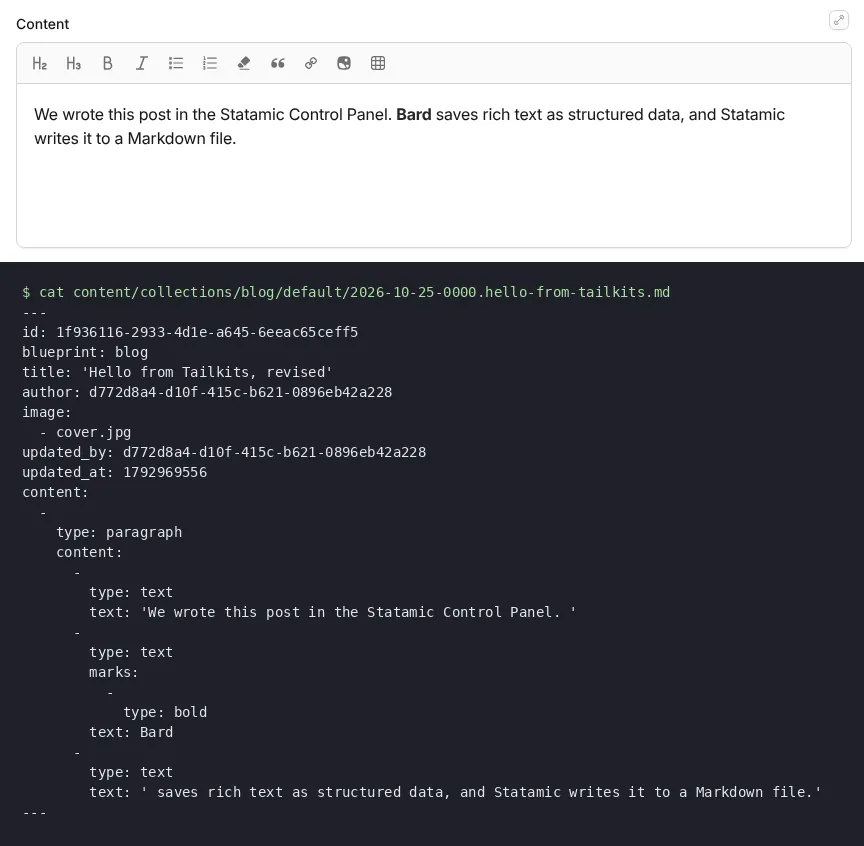
We built the Blog blueprint in the Control Panel, swapping the default Markdown field for Bard, Statamic's rich-text editor, and adding an image field. The builder saved resources/blueprints/collections/blog/blog.yaml, and Save & Publish wrote content/collections/blog/2026-10-25.hello-from-tailkits.md and put the image in public/assets. Bard saves a node tree, not Markdown prose: our two-sentence paragraph with one bold word took 16 lines of YAML. Users are files too, with bcrypt password hashes, and the starter's .gitignore doesn't exclude them.
Live Preview and scheduling work in the free Core
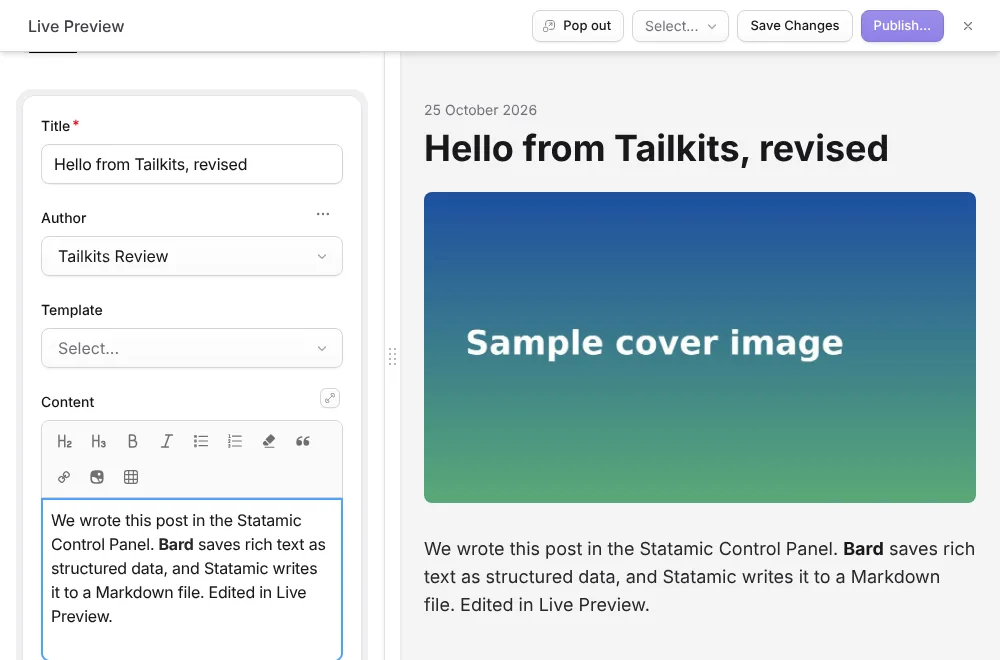
Live Preview puts the editor beside the rendered page. We typed 24 characters into Bard, and the preview showed them 0.43 s after the last keystroke. With publish dates on, future-dated posts stay private: one dated 23:05 UTC returned 404 at 23:04:51 and 200 at 23:05:01 with no cron job or scheduler running, and the entry list showed it as Scheduled. Cron only refreshes caches and search indexes on time.
Core holds one user; teams need Pro
With one account in place, php please make:user stopped with "Statamic Pro is required." and offered to enable it, and the REST API returned the same error. php please pro:enable switched the Control Panel to "Pro – Trial Mode". A Writer role allowed to create and edit blog posts but not publish them saw three menu items and got "Create Revision…" instead of Publish. With revisions on, saving a published post wrote a working copy and left the live file alone until we published with a message. The REST API and GraphQL returned our two published posts, nothing for a draft, and refused a status filter until allowed. php please multisite converted the site in about a second, and a French site got an unpublished translation file linked to the original.
Pro's Git integration committed every save as the logged-in user. Its first commit held 10 files, including both user files with their password hashes; converting to multi-site and adding one translation made six more. Pushing is off by default.
So three editors need Pro: $349, then $99 a year from year two. Ten editors with SSO point to Enterprise, listed from $10,000 a year, unless you add OAuth logins through Laravel Socialite to Pro yourself (our reading of the docs; not tested).
Every site checks in with Statamic, Core included
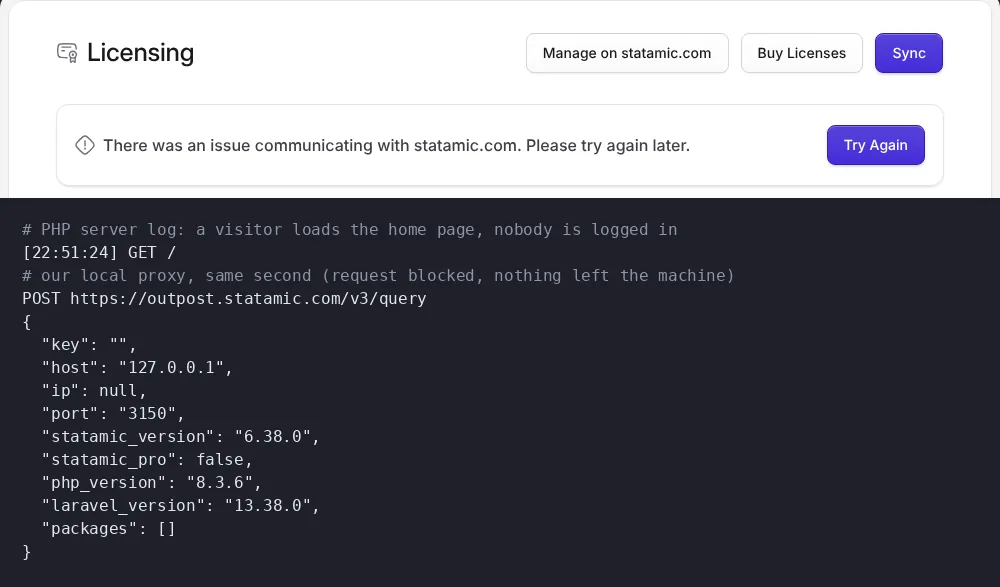
A visitor loading our home page, with nobody logged in, triggered a license check, a POST to Statamic's Outpost service at outpost.statamic.com, in the same second, with the license key (empty here), host, server IP and port, the Statamic, PHP and Laravel versions and any addons. Since version 6.29 (August 2026) this also runs after front-end requests and most command-line runs, while the docs still say "only when logged into the control panel"; a success is cached for about an hour, a failure for 5 to 10 minutes. Control Panel pages also fetched Statamic's release list; the browser sent nothing off our machine. One check got out during our install, before we routed the server through our proxy. With calls blocked, editing kept working. Core and Pro have no off switch, the license forbids altering validation, and Enterprise offers offline validation.
Install, build and Control Panel weight
| Measurement | Result |
|---|---|
| Composer packages | 162 (124 runtime, 38 development); no Composer plugins |
vendor size | 151 MB as release archives unpack it; 124 MB without development packages |
| Install time, empty Composer cache | 9 min 55 s, not comparable: GitHub archive downloads are blocked in our sandbox, so Composer cloned 162 repositories |
| Front-end install, empty npm cache | 13.4 s, 96 packages, 91 MB of node_modules |
| Front-end build (Vite) | 0.7 to 1.4 s in three runs; 24.3 KB of CSS (5.4 KB gzipped) |
| Control Panel login page, 1,440 × 900, cache off | 34 requests, 4.5 MB uncompressed from PHP's built-in server, about 1.5 MB with gzip |
| Dashboard after login | 32 requests, 4.2 MB |
| Live Preview update | 0.43 s after the last keystroke (one run) |
| Scheduled post | Live within 10 s of its time (we polled every 10 s), no cron |
PHP's built-in server sends the Control Panel's 3.8 MB of JavaScript uncompressed, so serve it with compression. Visitors never load it: our post page was 1.4 KB of HTML, 24 KB of CSS and a 34 KB image that Glide resized from a 52 KB upload.
What you still have to set up
A PHP host. PHP 8.3 or later, Composer, a web server with compression and, for static caching or search, a cron entry for Laravel's scheduler.
A license before launch. Create a site on statamic.com, attach Pro and set
STATAMIC_LICENSE_KEY.User storage. Keep
users/out of your repository, or move users to a database, before turning on Git automation.API access. The REST API is public once enabled; set
STATAMIC_API_AUTH_TOKENor use Laravel Sanctum for private content.Co-editing. The free Collaboration addon needs Pro and a WebSockets server (Laravel Reverb) or Pusher; we did not test it.
Pros and cons
Pros
Content, blueprints and settings are plain files, so every edit is a Git diff and leaving Statamic means keeping your files.
Live Preview and scheduled publishing in the free Core; scheduled posts go live without cron.
Pro is $349 once per site with unlimited users, not a monthly seat price.
Careful API defaults: off until enabled, no drafts in responses, filters opt-in.
Two-factor authentication and passkeys in every edition, although the pricing page lists 2FA under Enterprise.
Cons
Core allows a single user, so any team needs Pro.
Every site reports its domain, IP and versions to Statamic from the Control Panel, front end and command line, with no off switch below Enterprise.
A proprietary license despite the "open source" wording, and updates cost $99 a year after the first.
Bard stores rich text as verbose YAML, and Git automation commits password hashes by default.
SSO means Enterprise, from $10,000 a year, unless you set up OAuth yourself.
How Statamic compares
TinaCMS also keeps content as files in Git (Markdown, MDX, JSON, YAML or TOML) and has free click-to-edit visual editing, but editing a live site needs TinaCloud ($29/month on Team for 3 users) or a backend you run, and it has no scheduled publishing. Pick it for an Astro or Next.js site.
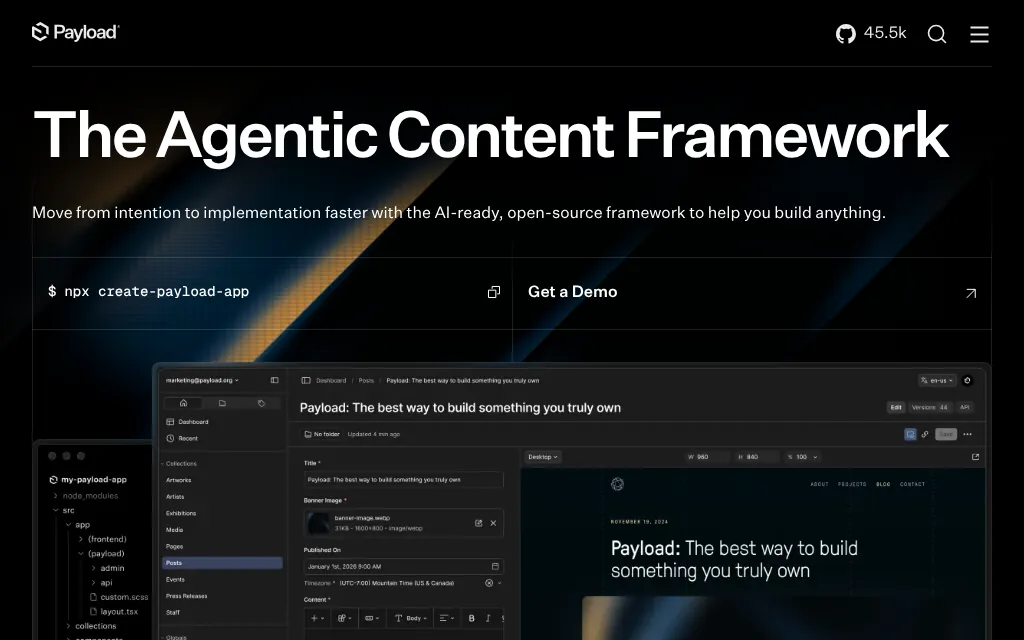
Payload is MIT-licensed with no seat or project limits, so three editors cost $0 self-hosted. It runs inside a Next.js app with content in MongoDB, Postgres or SQLite, and scheduled publishing needs a job runner you set up. Pick it for a TypeScript team.
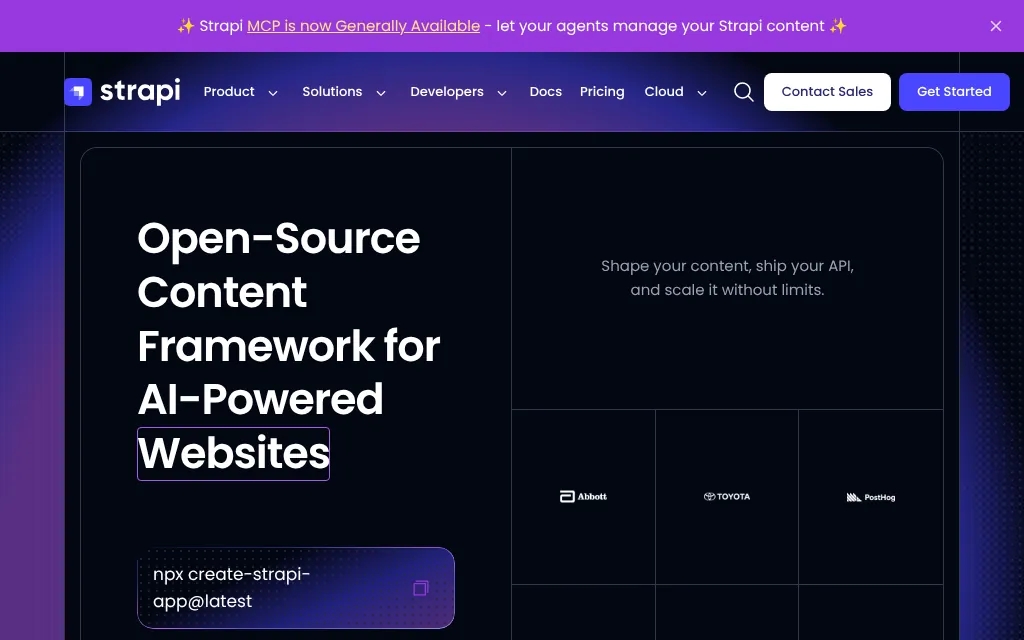
Strapi prices the other way round: its free Community plan has unlimited users, but Live Preview and scheduled publishing need Growth, $45/month for 3 users. Pick it for a Node.js content API on your own SQL database.
See all CMS platforms we list.
Who should use Statamic
Use it if your team works in PHP or Laravel, wants content under version control and is building a marketing site, blog or docs site that Statamic renders itself: one developer runs Core free, and a team pays $349 once per site. Look elsewhere for many editors without a license fee, a JavaScript stack, SSO without an enterprise contract, or a CMS that never contacts its vendor.
FAQ
Is Statamic free?
Yes, for one person. Statamic Core is free with a single user account, one form, Live Preview and all front-end features. A second user, roles, revisions, the REST and GraphQL APIs, multi-site and Git automation need Pro, $349 per site, which you can use free while developing.
What does Statamic Pro cost after the first year?
$99 a year per site for updates, per Statamic. The $349 license includes one year of updates; after that, the Control Panel asks you to renew or downgrade if you install a version released later.
Does Statamic need a database?
No. Entries, blueprints, users and settings are Markdown and YAML files by default, and Laravel's SQLite file is not used for content. The installer also offers database storage through Statamic's Eloquent driver.
Does Statamic send data to Statamic?
Yes. Every site, Core included, posts its license key, domain, server IP and port and its Statamic, PHP and Laravel versions to outpost.statamic.com, about once an hour when the check succeeds, triggered by Control Panel visits, front-end requests and most command-line runs. Core and Pro have no setting to turn it off; Enterprise offers offline license validation.
Does Statamic support single sign-on?
Through Enterprise, which Statamic lists from $10,000 a year. Pro supports OAuth logins through Laravel Socialite, with built-in providers such as Google and GitHub and community ones for others, so you can connect an identity provider yourself.
Get new tools like Statamic weekly
Every Monday: the templates, components and tools added to Tailkits that week, each checked by an editor. Free, unsubscribe in one click.
17 new in the last 30 days313 products reviewed so farSee what you get
KEEP EXPLORING
More CMS platforms