
Anthropic's coding agent for terminal, IDE, desktop and web, from $20 a month
OpenCode
Open-source coding agent with free models, 75+ providers and local LLMs
FreeAI Coding
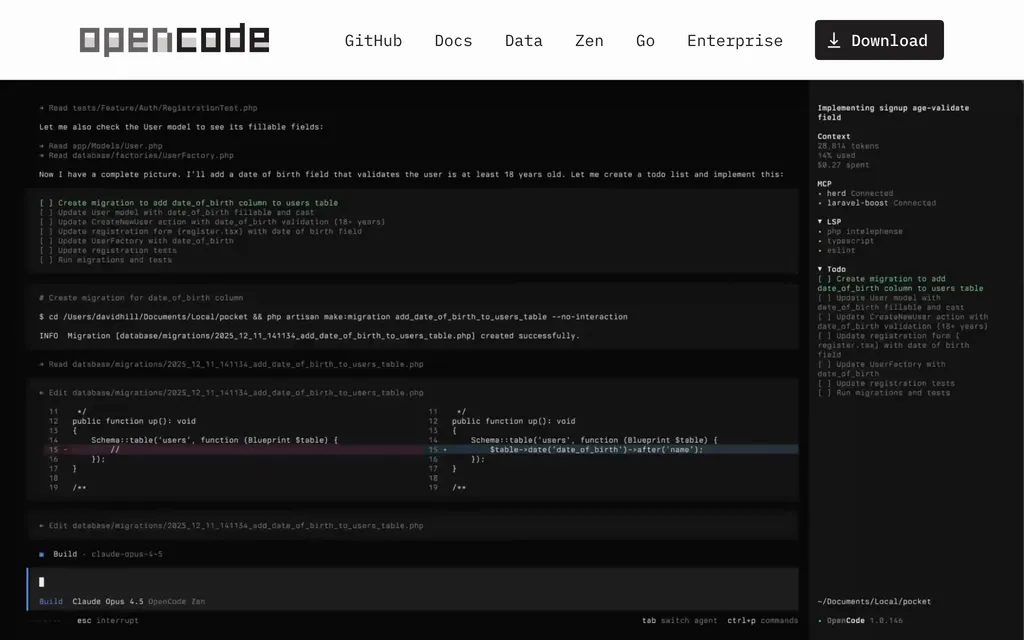
opencode.aiExplore the product
AT A GLANCE
- Website
- opencode.ai
- Pricing
- Free
- Categories
- AI Coding
- Listed
- Sep 2026
- Updated
- Oct 2026
Details about OpenCode
Short verdict: OpenCode is an MIT-licensed coding agent from Anomaly, the team behind SST, that runs as a terminal interface, a desktop app, a local web UI and an editor extension. It is not tied to one model company: it connects to more than 75 providers, to local models through Ollama or LM Studio, and to ChatGPT Plus or Pro, GitHub Copilot and GitLab Duo subscriptions, and it ships with free models capped at 200 requests a day. The agent costs nothing; the catches are that results depend on the model you bring, several free models log or train on prompts, and the project is partway through a breaking move to version 2. It suits developers who want one agent across many models, local models or their own gateway; if you want a frontier model built in with no setup, a vendor's own agent is simpler.
How we reviewed it: We did not sign up for OpenCode, Go or Zen, and we did not run it against a model. On 21 October 2026 we read OpenCode's homepage and download page, its version 1 and version 2 documentation (providers, agents, models and privacy, and the migration guide), the Go, Zen and Enterprise pages with their FAQs, the changelog, the privacy policy and the anomalyco/opencode repository, plus the npm registry entries for @opencode/cli (version 2.1.2, published 21 October 2026) and opencode-ai (1.19.3, the version 1 line). Free models and Go's line-up change often; check the Go page before you subscribe.
What OpenCode costs and includes
| What | OpenCode on 21 October 2026 |
|---|---|
| Type | Open-source coding agent: terminal interface, desktop app, local web UI and IDE extensions, made by Anomaly (the repository moved from GitHub's sst organization to anomalyco) |
| Where it runs | CLI for macOS, Windows and Linux; desktop app for macOS, Windows (x64 and ARM64) and Linux (.deb, .rpm, AppImage); a web UI started with opencode pair; extensions for VS Code, Cursor, Zed, Devin Desktop (formerly Windsurf) and VSCodium; GitHub and GitLab automation in your own CI runners |
| Models | 75+ providers through Models.dev with your own API keys; sign-in for ChatGPT Plus or Pro, GitHub Copilot and GitLab Duo; local models through Ollama, LM Studio or Atomic Chat. Claude Pro and Max subscriptions are not supported |
| Free tier | The agent is free. Free models (Big Pickle plus rotating promotions) allow 200 requests a day without an account |
| Paid plans (optional) | Go $10 a month and Go Plus $40 a month for 29 curated models; Zen pay-as-you-go at provider prices with no markup ($20 top-ups plus a $1.23 card fee); Enterprise priced per seat. OpenCode Go |
| How usage is limited | Free models: 200 requests a day. Go: up to 20% of the monthly allowance per 5 hours and 50% per week; per OpenCode, about 110 Kimi K3 requests per 5 hours on Go and 440 on Go Plus. With your own provider, its limits apply |
| Open source | MIT license; anomalyco/opencode, 219.6k GitHub stars on 21 October 2026 |
| Data use | OpenCode says it stores no code or context; data is stored only when you use its free models, and some of those may use prompts to improve the model |
| Latest notable release | OpenCode 2 (version 2.0.0 on npm, 11 September 2026); version 2.1.2 on 21 October 2026 |
What OpenCode does differently
Bring almost any model, but not a Claude subscription
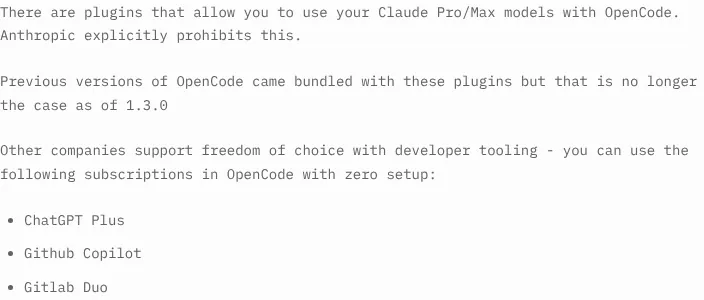
OpenCode reads its provider and model catalog from Models.dev and connects to more than 75 providers, plus GitHub Copilot through a device sign-in and ChatGPT Plus or Pro through an OpenAI login. Ollama is detected automatically at 127.0.0.1:11434, so local models appear in the model list without an account. Claude models work with an Anthropic API key, but OpenCode's docs say Anthropic prohibits using Claude Pro or Max subscriptions in it, and OpenCode stopped bundling the plugins that did so in version 1.3.0.
Language servers, parallel sessions and share links
OpenCode loads the right language servers (LSP) for the model automatically. You can run several agents in parallel on the same project, and share a link to any session so someone else can review or debug it.
Agents defined in Markdown files
A Markdown file in .opencode/agents/ defines an agent: a system prompt, a preferred model and permission rules. The docs' example is a read-only reviewer subagent that is denied file edits and shell commands, which the main agent can call for code reviews. Skills, plugins, MCP servers and the Agent Client Protocol extend it further.
Low-cost model plans that also work in other agents
Go costs $10 a month (Go Plus $40) for 29 models the OpenCode team has tested, including Kimi K3, Claude Haiku 5.5, GPT 6 Luna and DeepSeek V4.1 Flash, and its FAQ lists each model's training and retention policy. Zen passes provider prices through with no markup. Both can be used from other coding agents too.
Limits and costs to watch
Version 2 breaks plugins and integrations. V1 plugins do not run in V2, the server API changed, and terminal settings move to a single
cli.json. Both versions use theopencodecommand and are not installed side by side, and GitHub's "Latest" release is still 1.19.3 while V2 ships as tags.Free models come with strings. They are limited-time promotions capped at 200 requests a day. For Big Pickle, Exo Free, the MiMo free models and Flint 40B Free, "collected data may be used to improve the model", and NVIDIA's free Nemotron endpoints log use and ask you not to send personal or confidential data. Setting
OPENCODE_DISABLE_FREE_MODELS=1hides them.Some Go models trade privacy for price. Go's Gemini 4 Argon Contributor and Muse Spark Contributor models may be used to train future Google and Meta models; the other 26 are listed as not used for training, 21 of them with 0 days of retention.
Results depend on your model. OpenCode has no model of its own, so quality and cost come from the provider you connect.
No Windows package managers for version 2. Use the installer or a standalone binary.
Pros and cons
Pros
Free and MIT-licensed, with 219.6k GitHub stars.
Works with 75+ providers, local models, and ChatGPT, Copilot or GitLab Duo subscriptions.
Runs in the terminal, on the desktop, in the browser and in five editors.
Markdown-defined agents with their own models and permissions.
Optional $10 Go plan and at-cost Zen if you don't want to manage providers.
Cons
Claude Pro and Max subscriptions can't be used.
Free models are capped at 200 requests a day, and several may train on prompts.
The move to version 2 breaks plugins and server integrations.
No model of its own; quality depends on what you connect.
How OpenCode compares
Cline is also free and open source (Apache-2.0, 70.7k GitHub stars) and takes any provider or local model, but it runs as a VS Code and JetBrains extension (and a CLI) with Plan and Act modes that approve each step; optional ClinePass costs $9.99 a month. Choose it if you want the agent inside your IDE.
Kilo Code builds its CLI on a fork of OpenCode and adds VS Code and JetBrains extensions, a gateway to 500+ models at provider rates (top-ups carry a 5% processing fee) and a Teams plan at $15 per user a month; Anaconda bought it in July 2026. Choose it if you want OpenCode-style tooling with a team plan.
OpenAI Codex also has an open-source CLI (Apache-2.0) that can run local models, but it is built around OpenAI's models and a ChatGPT plan, which adds cloud tasks and GitHub pull request reviews from Plus at $20 a month. Choose it if you mostly use OpenAI models and want cloud tasks without managing providers.
Browse all AI coding tools for more agents and AI code editors, or AI app builders for prompt-to-app vibe coding.
Who should use OpenCode
OpenCode fits developers who want a free, open-source agent and the freedom to switch models: a ChatGPT or Copilot subscription today, a cheap open-weight model through Go tomorrow, or a local model through Ollama. Teams with their own LLM gateway can buy OpenCode Enterprise per seat, with no charge for tokens. If you mainly use Claude through a Pro or Max subscription, or want a vendor's own model and agent with no setup, choose that vendor's agent instead.
FAQ
Is OpenCode free?
Yes. As of 21 October 2026, OpenCode is free and open source under the MIT license and includes free models capped at 200 requests a day. You pay only for a provider you connect, or for OpenCode's optional Go plan ($10 a month), Go Plus ($40 a month) or Zen pay-as-you-go.
Can I use my Claude Pro or Max subscription with OpenCode?
No. OpenCode's provider docs say Anthropic prohibits it, and OpenCode stopped bundling the plugins that allowed it in version 1.3.0. You can use Claude models with an Anthropic API key, or sign in with ChatGPT Plus or Pro, GitHub Copilot or GitLab Duo instead.
Does OpenCode store or train on my code?
OpenCode says it does not store your code or context, and that data is stored only when you use its free models. Some of those, such as Big Pickle and Exo Free, may use collected data to improve the model, so set OPENCODE_DISABLE_FREE_MODELS=1 if that matters. With your own provider, that provider's policy applies.
Can OpenCode run local models?
Yes. OpenCode detects Ollama running on your machine automatically and also supports LM Studio and Atomic Chat, so you can use it without a cloud model.
KEEP EXPLORING
More AI coding tools Good company for OpenCode.
AI code editor with parallel cloud agents, sold in The X Subscription from $8
OpenAI's coding agent for CLI, IDE, ChatGPT app and cloud, from $20 a month