
OpenCode vs Claude Code
OpenCode is a free, MIT-licensed coding agent that works with almost any model; Claude Code is Anthropic's closed agent for Claude models, from $20 a month. The deciding question is how you pay for models: OpenCode can't use a Claude Pro or Max subscription, only an Anthropic API key, while Claude Code is included in those plans.
Open-source coding agent with free models, 75+ providers and local LLMs
Anthropic's coding agent for terminal and IDEs: Pro $20, Max $100, Ultra $200
Key differences
- Price. OpenCode is free; you pay a model provider, or OpenCode's optional Go ($10 or $40 a month) or Zen at provider prices. Claude Code has no free tier and starts with Claude Pro at $20 a month.
- Models. OpenCode connects to 75+ providers, local models through Ollama, LM Studio or Atomic Chat, and ChatGPT Plus or Pro, GitHub Copilot and GitLab Duo sign-ins; Claude works only with an API key. Claude Code runs only Claude models, included in your plan.
- Open source. OpenCode is MIT-licensed (219.6k GitHub stars on 21 October 2026). Claude Code is closed source.
- Free usage. OpenCode's free models allow 200 requests a day without an account, and several of them may use your prompts to improve the model. Claude Code has no free usage.
- Agent tooling. OpenCode defines agents in Markdown files with their own model and permissions, runs parallel sessions and shares a session by link. Claude Code adds 33 hook events, six permission modes, background and cloud sessions, and Remote Control from another device.
- Version churn. OpenCode is partway through a breaking move to version 2: version 1 plugins don't run in it, and its server API changed.
- Data. OpenCode says it stores no code or context, except when you use its free models. Claude's Free, Pro, Max and Ultra plans train on sessions unless you opt out.
OpenCode and Claude Code side by side
From our reviews, checked OpenCode on 21 October 2026, Claude Code on 23 November 2026. Plans and limits change often; check each vendor's pricing page before you pay.
| What | OpenCode | Claude Code |
|---|---|---|
| Type | Open-source coding agent: terminal interface, desktop app, local web UI and IDE extensions, made by Anomaly (the repository moved from GitHub's sst organization to anomalyco) | Agentic coding tool from Anthropic: terminal agent, IDE extensions, desktop app, web and mobile sessions, background and cloud sessions |
| Where it runs | CLI for macOS, Windows and Linux; desktop app for macOS, Windows (x64 and ARM64) and Linux (.deb, .rpm, AppImage); a web UI started with opencode pair; extensions for VS Code, Cursor, Zed, Devin Desktop (formerly Windsurf) and VSCodium; GitHub and GitLab automation in your own CI runners | CLI on macOS, Linux, Windows and WSL; extensions for VS Code (also Cursor and Devin Desktop) and JetBrains IDEs; desktop app for macOS and Windows, Linux in beta (Ubuntu 22.04 or later, Debian 12 or later); claude.ai/code in the browser; the Claude app for iOS and Android; Slack, GitHub Actions and GitLab CI/CD |
| Models | 75+ providers through Models.dev with your own API keys; sign-in for ChatGPT Plus or Pro, GitHub Copilot and GitLab Duo; local models through Ollama, LM Studio or Atomic Chat. Claude Pro and Max subscriptions are not supported | Claude only: Opus 5.5 by default on Pro, Max, Ultra, Team, Enterprise and the Anthropic API, plus Sonnet 5.5, Haiku 5.5 and Fable 5.2 (the fable alias), with context windows of up to 1 million tokens. Also through Amazon Bedrock, Google Cloud, Microsoft Foundry and LLM gateways |
| Free tier | The agent is free. Free models (Big Pickle plus rotating promotions) allow 200 requests a day without an account | None. The Claude Free plan does not include Claude Code |
| Paid plans | Go $10 a month and Go Plus $40 a month for 29 curated models; Zen pay-as-you-go at provider prices with no markup ($20 top-ups plus a $1.23 card fee); Enterprise priced per seat. OpenCode Go | Pro $20 a month, or $17 a month billed annually ($200 up front); Max $100 a month; Ultra $200 a month, billed monthly only (it replaced Max 20x); Team Standard seat $25 a month ($20 billed annually) and Premium seat $125 ($100), for 2 to 150 people; Enterprise $20 per seat a month, billed annually with a 20-seat minimum, plus usage at API rates |
| Pay as you go | Not covered in our review | An Anthropic Console API key at API rates: Opus 5.5 $4 per million input tokens and $20 per million output, Sonnet 5.5 $2 and $10, Haiku 5.5 from $0.10 and $0.50, Fable 5.2 $8 and $40 |
| How usage is limited | Free models: 200 requests a day. Go: up to 20% of the monthly allowance per 5 hours and 50% per week; per OpenCode, about 110 Kimi K3 requests per 5 hours on Go and 440 on Go Plus. With your own provider, its limits apply | A 5-hour period that starts with your first message, plus a weekly limit, shared by claude.ai, Claude Code and the desktop app. Per Anthropic, Pro gets more usage than Free, Max 5x Pro's every 5 hours and every week, and Ultra 10x Pro's every week with no 5-hour limit once the account is verified. Team seats are sized by tier and shared with Claude chat and Cowork |
| Open source | MIT license; anomalyco/opencode, 219.6k GitHub stars on 21 October 2026 | No. The GitHub repository's license reads "All rights reserved" |
| Data use | OpenCode says it stores no code or context; data is stored only when you use its free models, and some of those may use prompts to improve the model | Free, Pro, Max and Ultra: used for model training unless you opt out, and kept 5 years while training is on (30 days when it is off). Team, Enterprise and API: not used for training by default |
| Latest notable release | OpenCode 2 (version 2.0.0 on npm, 11 September 2026); version 2.1.2 on 21 October 2026 | Version 2.1.330 (20 November 2026), which lets scheduled tasks and /loop run for up to 30 days instead of 7; 23 releases on npm since 21 October 2026 |
Choose OpenCode if
- You want a free, open-source (MIT) agent.
- You switch models: 75+ providers, a ChatGPT, Copilot or GitLab Duo sign-in, or local models through Ollama.
- You want cheap tested models through Go ($10 a month), or provider prices with no markup through Zen.
- You want to define your own agents in Markdown, each with its own model and permissions.
Choose Claude Code if
- You pay for Claude Pro or Max: OpenCode can't use those subscriptions.
- You want Anthropic's tooling for long, parallel work: subagents, background sessions in git worktrees, cloud sessions and scheduled tasks.
- You want cloud sessions that keep running, scheduled tasks and Remote Control from your phone.
- You would rather not manage providers and API keys.
FAQ
Can I use my Claude Pro or Max subscription with OpenCode?
No. OpenCode's docs say Anthropic prohibits it, and OpenCode stopped bundling the plugins that did it in version 1.3.0. You can use Claude models in OpenCode with an Anthropic API key, or use your subscription in Claude Code.
Is OpenCode really free?
The agent is free and MIT-licensed, and its free models allow 200 requests a day. You pay for whichever provider you connect, or for OpenCode's optional Go ($10 a month), Go Plus ($40) or Zen pay-as-you-go. Prices as of 21 October 2026.
Which is better for privacy, OpenCode or Claude Code?
OpenCode says it stores no code or context, except when you use its free models, some of which may use prompts to improve the model; with your own provider, that provider's policy applies. Claude's Free, Pro, Max and Ultra plans train on sessions, Claude Code included, unless you opt out; Team, Enterprise and API use are not used for training by default.
Can OpenCode or Claude Code run local models?
OpenCode can: it detects Ollama automatically and also supports LM Studio and Atomic Chat. Claude Code runs only Claude models.
More comparisons
Read both reviews.
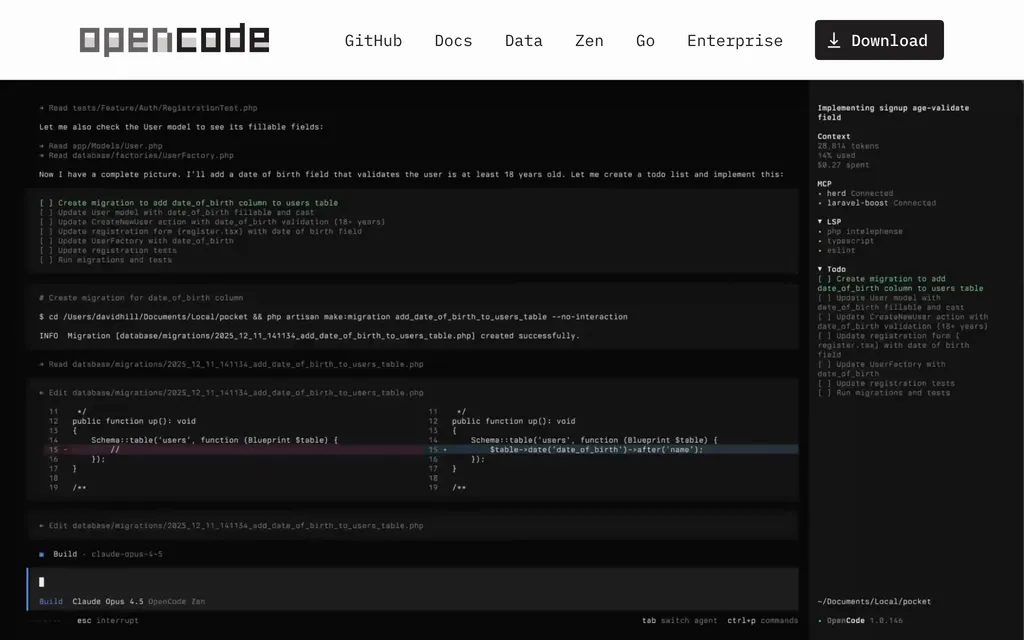
Open-source coding agent with free models, 75+ providers and local LLMs
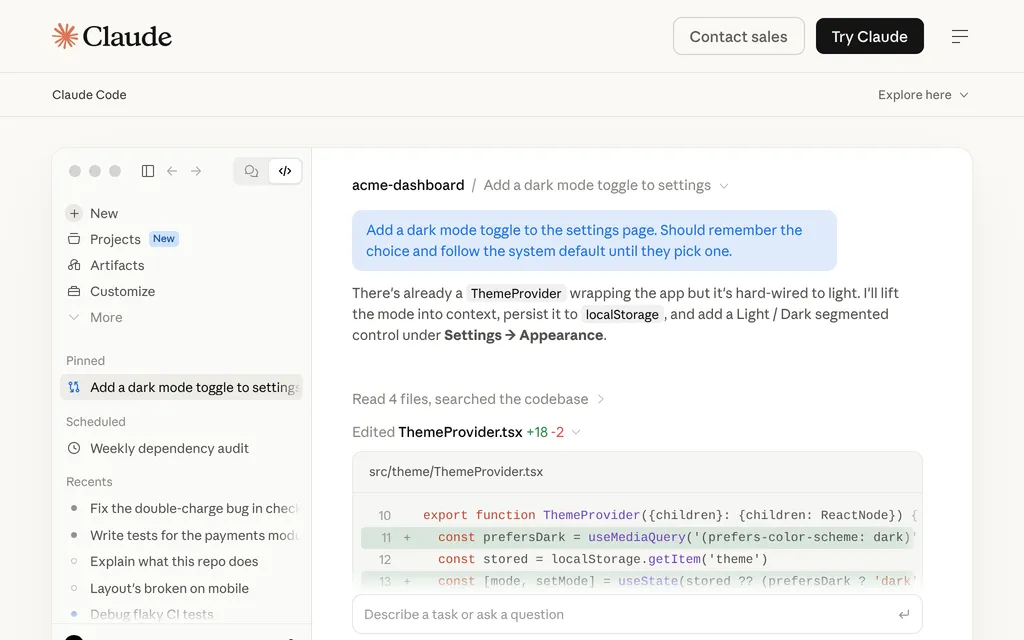
Anthropic's coding agent for terminal and IDEs: Pro $20, Max $100, Ultra $200