
AI code editor with parallel cloud agents, sold in The X Subscription from $8
Claude Code
Anthropic's coding agent for terminal, IDE, desktop and web, from $20 a month
PaidAI Coding
claude.comExplore the product
AT A GLANCE
- Website
- claude.com
- Pricing
- Paid
- Categories
- AI Coding
- Listed
- Sep 2026
- Updated
- Oct 2026
Details about Claude Code
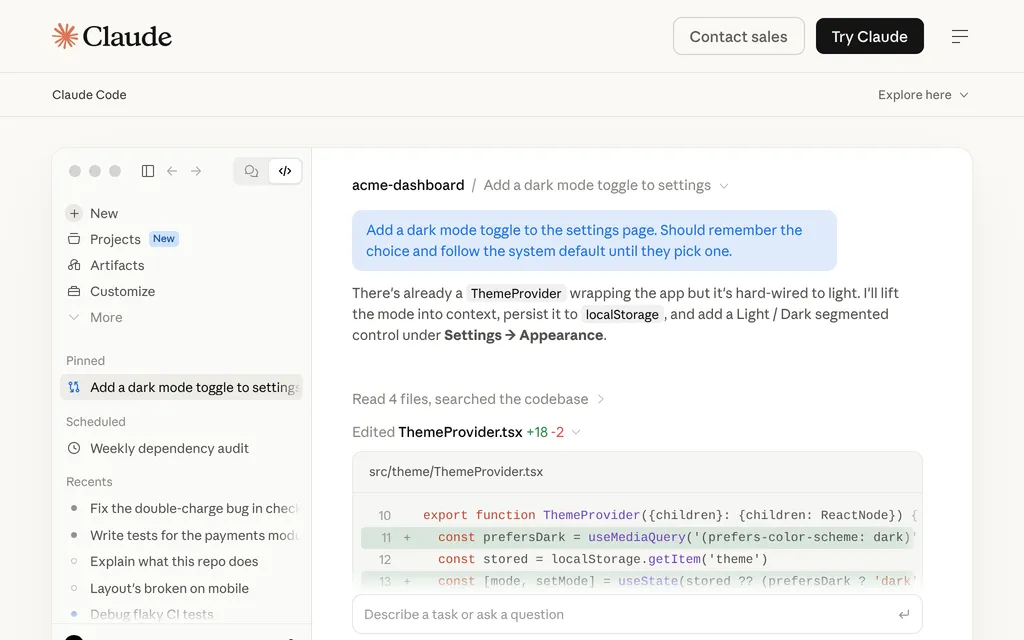
Short verdict: Claude Code is Anthropic's coding agent: it reads a codebase, edits files, runs commands and opens pull requests from the terminal, VS Code, JetBrains IDEs, a desktop app, the browser and the Claude phone app. It is built for long, multi-step work, with subagents, hooks, plan and auto modes, and cloud sessions that keep running after you close the laptop. The catch is access and limits: it is not on the free plan, Anthropic pitches the $20 Pro plan at "short coding sprints in small codebases", and every plan shares one 5-hour and weekly usage pool with Claude chat. It suits developers who are happy with Claude models only and will pay $100 to $200 a month for heavy use; look elsewhere for a free tier, other vendors' models or open-source code.
How we reviewed it: We did not sign up for Claude Code or run it against a model. On 21 October 2026 we read Anthropic's pricing and product pages, the Claude Code docs on models, costs, permission modes, hooks, parallel agents and data usage, the changelog, the consumer terms and a support article on Pro and Max limits, plus the npm registry entry for @anthropic-ai/claude-code (version 2.1.306, published that day). Plans and limits change often; check the pricing page before you pay.
What Claude Code costs and includes
| What | Claude Code on 21 October 2026 |
|---|---|
| Type | Agentic coding tool from Anthropic: terminal agent, IDE extension, desktop app and cloud sessions |
| Where it runs | CLI on macOS, Linux, WSL and Windows; extensions for VS Code (also Cursor) and JetBrains IDEs; desktop app for macOS and Windows, Linux in beta; claude.ai/code in the browser; the Claude app for iOS and Android; Slack, GitHub Actions and GitLab CI/CD |
| Models | Claude only: Opus 5.5, the default for Pro, Max, Team, Enterprise and API accounts since version 2.1.280 (22 September 2026), plus Sonnet 5.5, Haiku 5.5 and Fable 5.1, with context windows of up to 1 million tokens. Also through Amazon Bedrock, Google Cloud and Microsoft Foundry |
| Free tier | None. The Claude Free plan does not include Claude Code |
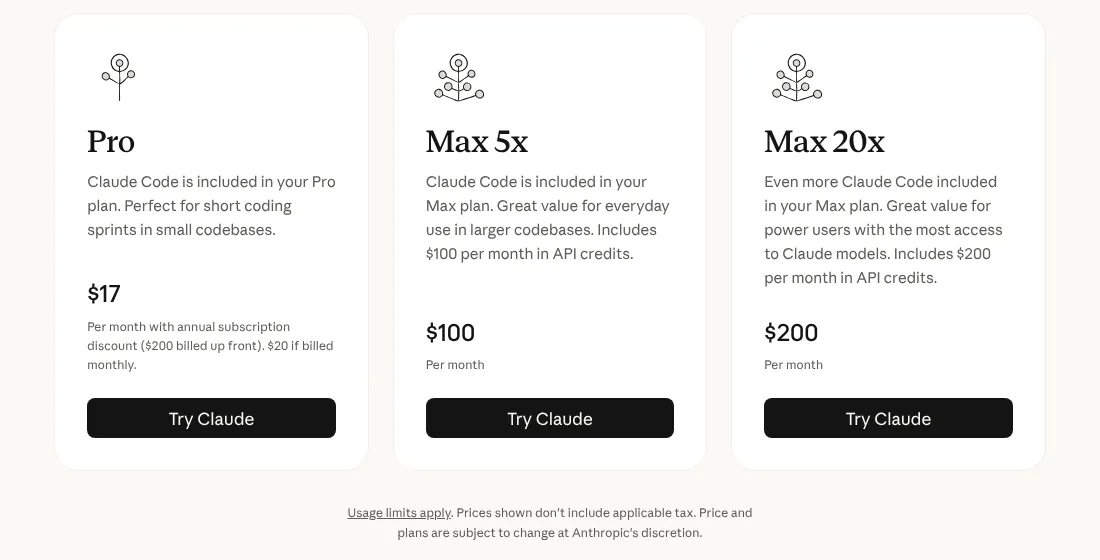
| Paid plans | Pro $20 a month, or $17 a month billed annually ($200 up front); Max 5x $100 and Max 20x $200 a month, billed monthly, with $100 or $200 a month in API credits; Team Standard seat $25 a month ($20 billed annually) and Premium seat $125 ($100); Enterprise $20 per seat a month, billed annually with a 20-seat minimum, plus usage at API rates. Claude pricing |
| Pay as you go | An Anthropic Console API key at API rates (Opus 5.5: $4 per million input tokens, $20 per million output), or usage credits on a subscription at the same rates |
| How usage is limited | A rolling 5-hour session window plus weekly limits, shared with Claude on web, desktop and mobile; per Anthropic, Pro gives at least 5x the usage of Free per window and Max 5x or 20x that of Pro |
| Open source | No. The GitHub repository (152.7k stars on 21 October 2026) holds the changelog, issues and plugins; its license reads "All rights reserved" |
| Data use | Free, Pro and Max: used for model training unless you opt out. Team, Enterprise and API: not used for training by default |
| Latest notable release | Code Review generally available for Team and Enterprise (15 October 2026); CLI version 2.1.306 (21 October 2026) |
How Claude Code handles long and parallel work
Five ways to split work across agents
The docs list five: subagents that work in their own context, agent view (claude agents, a research preview) for background sessions, agent teams (experimental and off by default) run by a lead agent, dynamic workflows that script many subagents for jobs such as "a 500-file migration", and Projects, a public beta on Pro and Max that starts parallel cloud sessions from one conversation. The /batch skill splits a change across 5 to 30 subagents, each in its own git worktree. Anthropic warns that parallel work "multiplies token usage".
33 hook events and six permission modes
Hooks run a shell command, HTTP request, MCP tool, prompt or subagent at 33 points in a session, from SessionStart to SessionEnd, for example to format every edited file or block a command. Six permission modes range from Manual, where only reads run unprompted, through plan mode for exploring before any change, to auto mode, where a second model reviews actions instead of you, and bypass. Auto mode became the default on Pro, Max and Team on 7 August 2026 and, since version 2.1.283, is the starting mode for interactive terminal and VS Code sessions.
One engine from terminal to phone
Every surface runs the same engine, so CLAUDE.md (or AGENTS.md), settings, skills and MCP servers apply everywhere. Remote Control continues a local session from a phone or browser, claude --teleport pulls a cloud session into your terminal, and cloud scheduled tasks run while your computer is off. Team and Enterprise organizations also get Code Review on every new pull request, generally available since 15 October 2026; Anthropic says a review takes 6 to 10 minutes.
Limits and costs to watch
One pool for chat and code. Claude chat and Claude Code share an allowance that resets on a rolling 5-hour window, with weekly limits on top. Anthropic publishes no message counts and may add caps "at our discretion". At a limit you can wait, upgrade or buy usage credits at API rates.
Extras cost extra. Fable bills only to usage credits on Pro and has its own weekly cap on Max; fast mode for Opus 5.5 costs $8 per million input tokens and $40 per million output.
A stray API key switches billing. With
ANTHROPIC_API_KEYset, Claude Code bills the API instead of your plan.Heavy use adds up. Anthropic puts the enterprise average at about $13 per developer per active day ($150 to $250 a month).
Training is opt-out for individuals. Anthropic lists model training as opt-out on Free, Pro and Max, a policy announced on 28 August 2025: sessions, Claude Code included, are used for training unless you switch it off, and kept for 5 years instead of 30 days while it is on. Team, Enterprise and API use is excluded.
Pros and cons
Pros
One agent and one set of settings across the terminal, IDEs, desktop, browser and phone.
33 hook events and six permission modes, including plan and auto mode.
Built-in parallel work: subagents, worktrees,
/batch, dynamic workflows and cloud scheduled tasks.Max includes $100 or $200 a month in API credits.
No training by default on Team, Enterprise and API use.
Cons
No free tier, and Pro is pitched at short sprints in small codebases.
Usage is shared with Claude chat and published as multiples, not numbers.
Claude models only, and closed source.
Individual accounts train Anthropic's models unless you opt out.
Fable needs usage credits on Pro and has a weekly cap on Max.
How Claude Code compares
OpenAI Codex is OpenAI's equivalent, included in ChatGPT plans: Plus at $20 a month unlocks the CLI, IDE extension and cloud tasks, and ChatGPT Free gets GPT-6 Luna in the desktop app. Its CLI is Apache-2.0 open source and can run local models. Choose it if you already pay for ChatGPT or want an open-source CLI.
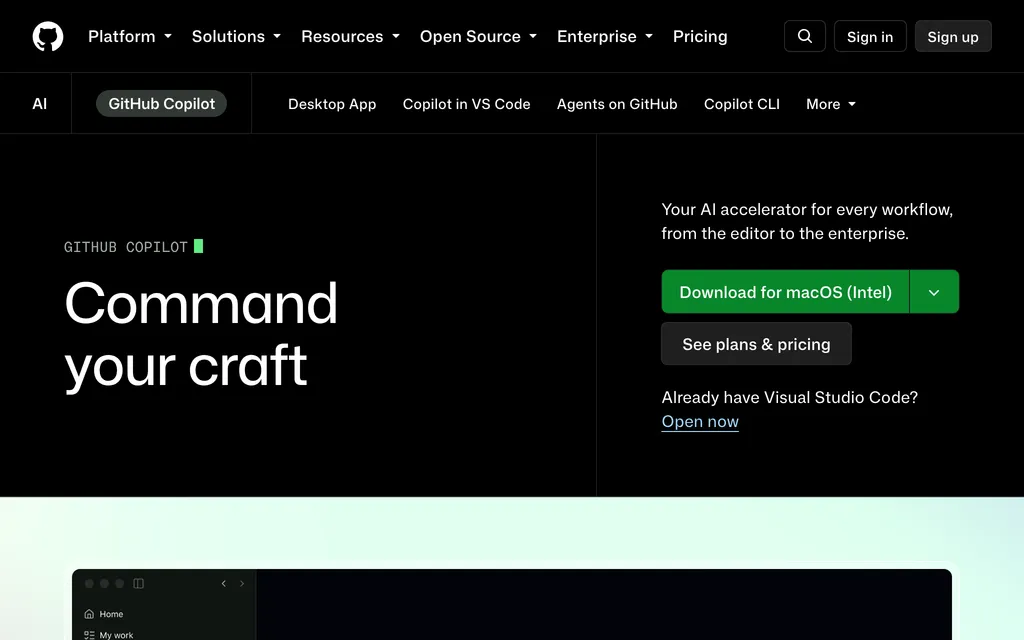
GitHub Copilot starts at $10 a month with 1,500 AI credits, runs in VS Code, Visual Studio, JetBrains, Xcode, Eclipse, Neovim and Zed, and its cloud agent turns a GitHub issue into a pull request; Claude Opus and Fable need Pro+ ($39) or Max ($100). Choose it if your team works on GitHub and wants a cheaper start.
OpenCode is free and MIT-licensed, connects to 75+ providers and local models, and includes free models capped at 200 requests a day; it runs Claude through an API key, not a Pro or Max subscription. Choose it for an open-source agent and the freedom to switch models.
Browse all AI coding tools for more agents and AI code editors, or AI app builders for prompt-to-app vibe coding.
Who should use Claude Code
Claude Code fits developers and teams who like Claude's models and want one agent that plans, edits, tests and opens pull requests from the terminal, an IDE or a phone, and who can budget for Max at $100 or $200 a month once Pro's limits bite. It is a poor fit if you need a free option, other vendors' or local models, or open-source tooling. For VS Code setup, see our guide to installing Claude Code in VS Code.
FAQ
Is Claude Code free?
No. As of 21 October 2026, Claude Code is not part of the Claude Free plan. It is included with Pro at $20 a month ($17 a month billed annually), Max, Team and Enterprise, or you can pay per token with an Anthropic Console API key.
How much does Claude Code cost?
As of 21 October 2026: Pro $20 a month ($17 billed annually), Max 5x $100 and Max 20x $200 a month (with $100 or $200 a month in API credits), Team $25 per Standard seat or $125 per Premium seat a month ($20 and $100 billed annually), and Enterprise $20 per seat a month billed annually plus usage at API rates. Every subscription shares 5-hour and weekly usage limits with Claude chat.
Does Claude Code train on my code?
On Free, Pro and Max accounts it can. Anthropic lists model training as opt-out on those plans, so sessions, Claude Code included, are used for training unless you turn the setting off in Claude's privacy settings, and are kept for 5 years while it is on (30 days when it is off). Team, Enterprise and API use is not used for training by default.
Is Claude Code open source?
No. Its GitHub repository holds the changelog, issue tracker and plugins, but the license reads "© Anthropic PBC. All rights reserved." Claude Code runs only Claude models, through Anthropic or through Amazon Bedrock, Google Cloud or Microsoft Foundry.
KEEP EXPLORING
More AI coding tools Good company for Claude Code.
OpenAI's coding agent for CLI, IDE, ChatGPT app and cloud, from $20 a month
GitHub's coding agent for your editor, terminal and PRs, Pro from $10 a month