
Anthropic's coding agent for terminal, IDE, desktop and web, from $20 a month
OpenAI Codex
OpenAI's coding agent for CLI, IDE, ChatGPT app and cloud, from $20 a month
FreemiumAI Coding
openai.comExplore the product
AT A GLANCE
- Website
- openai.com
- Pricing
- Freemium
- Categories
- AI Coding
- Listed
- Sep 2026
- Updated
- Oct 2026
Details about OpenAI Codex
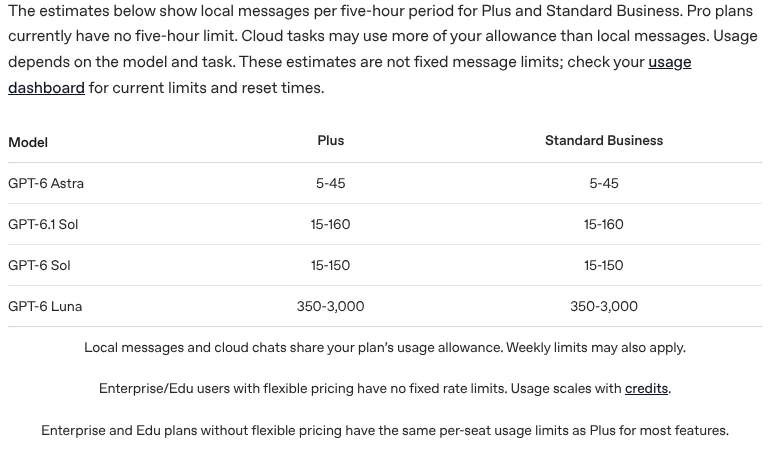
Short verdict: OpenAI Codex is OpenAI's coding agent, and it now runs in four places tied to one ChatGPT account: an open-source CLI, an extension for VS Code-style editors, the Codex view of the ChatGPT desktop app, and cloud tasks you can start from the web or your phone. It does well on reach and control: the Apache-2.0 CLI can run local models, local work runs in an operating-system sandbox, and paid plans include cloud tasks and automatic GitHub pull request reviews. The catch is vague limits: OpenAI publishes ranges, such as 15 to 160 local messages per 5 hours with GPT-6.1 Sol on Plus, and the free and $8 Go plans only get GPT-6 Luna in the desktop app. It suits developers who already pay for ChatGPT; if you need fixed quotas, or want code kept out of training without changing settings, read the limits first.
How we reviewed it: We did not sign up for Codex or run it against a model. On 21 October 2026 we read the Codex product page, OpenAI's Codex documentation, now at learn.chatgpt.com (pricing, models, CLI, IDE extension, cloud, sandboxing, open source and the changelog), ChatGPT's pricing page and data-controls article, the openai/codex repository, and the npm registry entry for @openai/codex (version 0.163.0, published 15 October 2026). We could not verify how the three ChatGPT Pro tiers differ: OpenAI's help article on Pro plans refused our browser, and the ChatGPT pricing page showed it no prices. Check the Codex pricing page before you pay.
What OpenAI Codex costs and includes
| What | OpenAI Codex on 21 October 2026 |
|---|---|
| Type | Coding agent from OpenAI: open-source CLI, IDE extension, the Codex view of the ChatGPT desktop app (the standalone Codex app was folded into it on 9 July 2026), and Codex Cloud |
| Where it runs | CLI on macOS, Linux and Windows (installer, npm or Homebrew); extension for VS Code, Cursor and Devin Desktop (formerly Windsurf), with Xcode and JetBrains integrations; ChatGPT desktop app for macOS and Windows, Linux in preview; Codex Cloud from the web, desktop or phone; the ChatGPT app for iOS and Android to start and approve tasks; GitHub, Slack and Linear |
| Models | GPT-6.1 Sol (recommended for complex work), GPT-6 Astra, GPT-6 Sol, GPT-6 Luna and GPT-5.6 models; local models through Ollama or LM Studio with --oss; Amazon Bedrock, Azure or other providers through the config file |
| Free tier | ChatGPT Free: "Explore Codex capabilities on quick coding tasks", with GPT-6 Luna in the desktop app, subject to rollout. Go ($8 a month) gets the same model access |
| Paid plans | Plus $20 a month; Pro $100, $200 or $500 a month (Ultrafast mode only on $500; other differences between the tiers not verified); Business $25 per user a month, or $20 billed annually, for 2 or more users; Enterprise and Edu through sales. No annual billing for individual plans. Codex pricing |
| Pay as you go | ChatGPT credits after you reach your limits (GPT-6.1 Sol: 50 credits per million input tokens, 250 per million output), or an API key at API prices |
| How usage is limited | Per OpenAI, estimated local messages per 5 hours on Plus and Standard Business: 15 to 160 with GPT-6.1 Sol, 5 to 45 with GPT-6 Astra, 350 to 3,000 with GPT-6 Luna; weekly limits may apply; Pro has no 5-hour limit; shared with ChatGPT Work |
| Open source | CLI, SDK and app server under Apache-2.0 (openai/codex, 130.3k stars on 21 October 2026); the IDE extension and Codex Cloud are closed |
| Data use | Personal plans: tasks are used for training unless you opt out. Business, Enterprise and Edu: not used for training by default |
| Latest notable release | GPT-6.1 Sol in Codex (29 September 2026); GPT-5.5 retired from Codex for ChatGPT sign-in (14 October 2026); CLI 0.163.0 (15 October 2026) |
What Codex does differently
An open-source CLI that can run local models
The Codex CLI, SDK and app server are open source under Apache-2.0. Besides ChatGPT sign-in or an API key, the CLI can use a local provider such as Ollama or LM Studio with --oss, the built-in Amazon Bedrock or Azure providers, or your own proxy through openai_base_url. The desktop app, CLI and IDE extension share one config.toml, so a model or provider set once applies to all three.
Sandboxing at the operating-system level
Local Codex runs commands inside a sandbox: Seatbelt on macOS, bubblewrap on Linux and WSL2, and a native sandbox on Windows. When a command needs to step outside it, Auto-review can hand the approval to a reviewer agent instead of you.
Cloud tasks, pull request reviews and phone approvals
Codex Cloud runs tasks in reusable environments built from your GitHub repositories, and they keep working while your computer sleeps; GitLab support is in beta. Paid plans add pull request reviews when you tag @Codex or turn on automatic reviews, tasks from Slack and Linear, and approvals from the ChatGPT mobile app for commands on a connected Mac or Windows PC.
Subagents, and an import from other agents
Codex hands focused work to subagents, with a configurable cap on concurrent threads per session, and its Ultra reasoning mode uses them by design. Since August 2026 the CLI's /import command brings setup and recent chats over from Claude Code and Cursor.
Limits and costs to watch
Ranges, not quotas. Usage varies with the model, context and task; cloud tasks use more than local messages, weekly limits may apply, and Fast mode uses included usage 2.5x faster (Ultrafast 8x). Out of usage, Plus and Pro users can buy credits or switch to an API key.
Free and Go are narrow. Both get GPT-6 Luna in the desktop app, "subject to rollout", and GPT-6.1 Sol's launch excluded them.
Models retire quickly. GPT-5.4 left Codex for ChatGPT sign-in on 31 August 2026 and GPT-5.5 on 14 October 2026, so saved model settings, custom agents and scripts had to be updated twice in seven weeks.
API keys lose the cloud. API-key sign-in keeps the CLI, SDK and IDE extension but drops Codex Cloud, GitHub code review and Slack.
Training is opt-out on personal plans. On Free, Go, Plus and Pro, content is used for training unless you turn off "Improve the model for everyone", which covers Codex tasks; a separate "Include environments" setting covers context from your Codex environments and is not changed by that opt-out.
Pros and cons
Pros
One ChatGPT subscription covers the CLI, IDE extension, desktop app, cloud tasks and GitHub reviews.
Apache-2.0 CLI that can run local models or other providers.
Operating-system sandboxing on macOS, Linux and Windows.
Cloud tasks keep running while your computer sleeps, and you can approve work from your phone.
Business, Enterprise and Edu workspaces are not used for training by default.
Cons
Usage limits are wide ranges, and weekly caps may apply on top.
Free and Go only get GPT-6 Luna in the desktop app.
Two model retirements since August 2026 forced configuration changes.
Personal-plan tasks train OpenAI's models unless you opt out, with a second toggle for environments.
OpenAI's docs don't make clear what the $200 and $500 Pro tiers add beyond Ultrafast mode.
How OpenAI Codex compares
Claude Code costs the same $20 a month with Claude Pro but has no free tier, runs only Claude models (Opus 5.5 by default) and is closed source; its usage is shared with Claude chat on 5-hour and weekly windows. Choose it if you prefer Claude's models.
Google Antigravity has a free individual plan with a weekly quota Google calls "meaningful" and unlimited Tab completions, across a desktop app, CLI and IDE extensions; Gemini 4 Argon and Claude 5.5 models need Google AI Pro at $19.99 a month, and there is no bring-your-own-key option. Choose it if you want a recurring free quota.
OpenCode is free and MIT-licensed, signs in with a ChatGPT Plus or Pro subscription, and also connects to 75+ other providers and local models. Choose it if you want to keep your ChatGPT plan but use a fully open-source agent or mix in other models.
Browse all AI coding tools for more agents and AI code editors, or AI app builders for prompt-to-app vibe coding.
Who should use OpenAI Codex
Codex fits developers who already pay for ChatGPT Plus or Pro and want one agent in the terminal, the editor and the cloud with pull request reviews included, and Business or Enterprise teams that want admin controls and no training on their data by default. The open-source CLI also suits people who want to try local models. Look elsewhere if you need fixed, published quotas, a fully open-source stack, or a free tier that goes beyond GPT-6 Luna in the desktop app.
FAQ
Is OpenAI Codex free?
Partly. As of 21 October 2026, ChatGPT Free includes limited Codex access: GPT-6 Luna in the ChatGPT desktop app, subject to rollout. Codex in the CLI, IDE extension and cloud, with GPT-6.1 Sol, is listed from Plus at $20 a month; the open-source CLI can also run local models or use an API key billed at API prices.
How much does OpenAI Codex cost?
Codex is included in ChatGPT plans. As of 21 October 2026: Free (limited), Go $8 a month, Plus $20 a month, Pro $100, $200 or $500 a month, Business $25 per user a month or $20 billed annually (2 or more users), and Enterprise and Edu through sales. Extra usage is bought as ChatGPT credits, or you can use an API key at API prices.
Does OpenAI Codex train on my code?
On personal ChatGPT plans it can: content is used for training unless you turn off "Improve the model for everyone", which also covers Codex tasks, and a separate "Include environments" setting covers context from Codex environments. Business, Enterprise and Edu workspaces are not used for training by default, and API-key use follows your API organization's data settings.
Is OpenAI Codex open source?
The Codex CLI, SDK and app server are, under the Apache-2.0 license in the openai/codex repository (130.3k stars on 21 October 2026). The IDE extension and Codex Cloud are not open source, and the repository does not accept outside pull requests.
KEEP EXPLORING
More AI coding tools Good company for OpenAI Codex.
AI code editor with parallel cloud agents, sold in The X Subscription from $8
GitHub's coding agent for your editor, terminal and PRs, Pro from $10 a month