Next.js and Astro single-product store with a model picker and checkout UI
Studiomax
Light Astro theme for model agencies, with a filterable board and booking forms
PaidTemplates
lexingtonthemes.comExplore the product
AT A GLANCE
- Website
- lexingtonthemes.com
- Pricing
- Paid
- Categories
- Templates
- Listed
- Sep 2023
- Updated
- Oct 2026
Details about Studiomax
KEY POINTS
- Tailwind CSS v4
Short verdict: Studiomax is a light, editorial site for a model agency that already thinks like one: a board filtered by women, men and new faces, profiles with measurements, campaigns linked to the models booked, services, and forms to book a model or apply. The portrait-led design is calm and the images are small and lazy-loaded. Everything that should reach the agency is unfinished: both forms send nothing anywhere, the "Print model card" button does nothing, and every page carries the placeholder title "Your Page Title". Buy it if you run a small agency and have a developer to wire forms, file uploads and SEO; don't buy it expecting a working booking or scouting system.
How we reviewed it: On 30 October 2026 we used the live Astro demo, rebuilt by Lexington Themes on 3 October 2026, in Chromium at 1,440 px and 1,000 px wide and on a 390 px phone screen. We opened all 42 pages in its sitemap, used the board filters, the mega menu and the home page slider, submitted both forms (with three test photos on the scouting form) while logging network requests, and ran Lighthouse 12.8.2 once on the home page and once on a model profile. We did not buy the theme, so we can't judge the source code or the Sanity and EmDash editions. Prices and license terms come from lexingtonthemes.com on the same day.
Disclosure: Our links to Lexington Themes carry a referral tag.
What you get for $89
| Price | $89 one-time for the Astro edition, $129 for the Sanity or EmDash edition. For $10 more, Lexington Themes Full Access Personal ($99, shown as 50% off $198) includes Studiomax and the other 52 Astro themes. |
|---|---|
| Version | Astro 7.4.1 and Tailwind CSS 4.3.3, per Lexington. First released in December 2023 as an agency theme, rebuilt from scratch as a model agency theme on 3 October 2026. |
| Size | Five static pages and five content collections, per Lexington. The demo's sitemap has 42 URLs: 6 models, 5 campaigns, 4 services, 6 journal posts with 5 topic pages, 3 legal pages and a 4-page style guide. |
| Stack | Astro and Tailwind CSS 4 with GSAP ScrollTrigger for the home page hero and Lenis smooth scroll. No Alpine.js or UI framework. Agency details, menus and agents sit in one data file, and the repository includes AGENTS.md, Cursor rules and a design skill. |
| Images | Lexington lists "free usage images" for this theme. Its license adds that stock images in demos remain their owners' property, and an agency will use its own portraits anyway. |
| License | Unlimited websites for yourself and clients, no attribution; you can't resell the theme as a template. Refunds only if the theme differs from the demo or you never accessed the repository within 14 days. License terms |
What we found in the demo
A 3D row of portraits and a mega menu
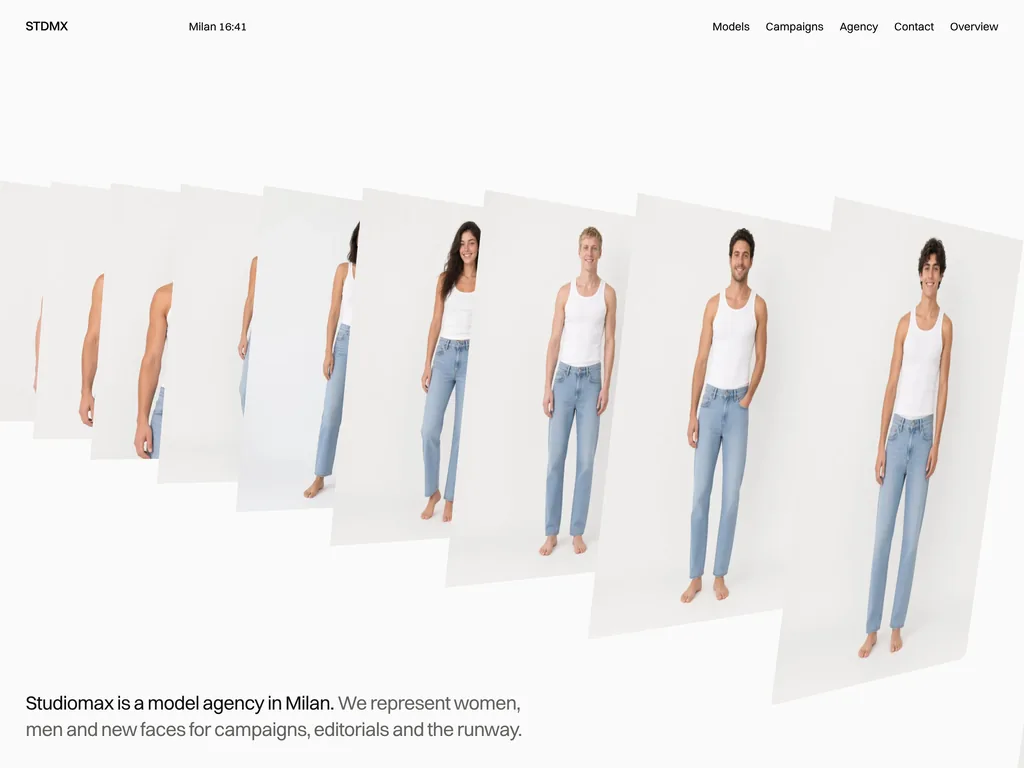
The home page opens on 18 portraits (three shots of each of the six models) set in a turning 3D row. The section stays pinned for about 2,250 px of scrolling while the row rotates, and hovering a portrait writes the model's name across it in large type. With reduced motion requested the row stays still, the section is not pinned and smooth scrolling is off. Below sit a short about text, a slider through the six models with previous and next buttons and a live counter, and the campaign list. The header buttons open a mega menu with the board and its filters, six thumbnails, the five campaigns and the agency pages; Escape closes it, and on phones the Menu button opens the same panel.
The board, profiles and campaigns
The board shows all six models on a loose grid. The filters returned 2 women, 2 men and 2 new faces, and the models keep their grid positions instead of closing ranks. Clicking a filter does not change the URL, but the board reads it from a link such as /models?board=women, which the mega menu uses. Each profile has three photos, eight measurements (height, bust, waist, hips, size, shoes, hair, eyes), a booking button, the campaigns the model was booked for and the next model. Campaign pages list type, season, photographer, notes from the set and the models booked, linked back to their profiles.
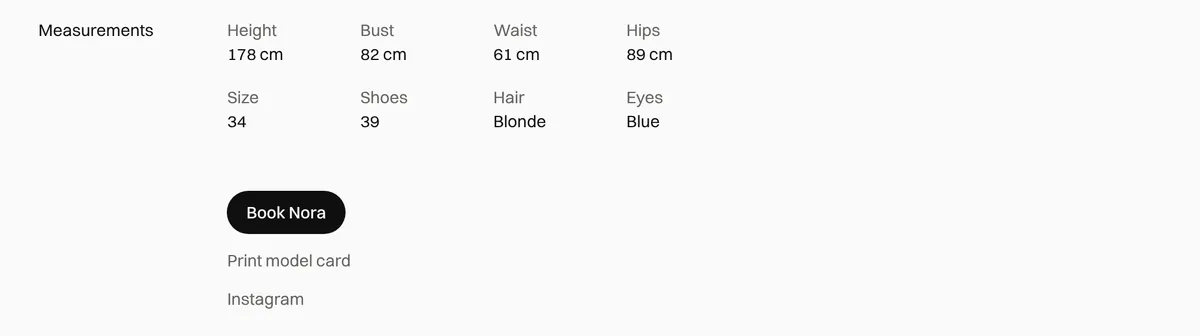
Two details fall short. "Print model card", which Lexington lists as a feature, is a button with no script and the theme has no print styles, so clicking it does nothing. "Book Nora" opens the booking form without ticking Nora among the models, although the form lists all six.
Booking and scouting forms that send nothing
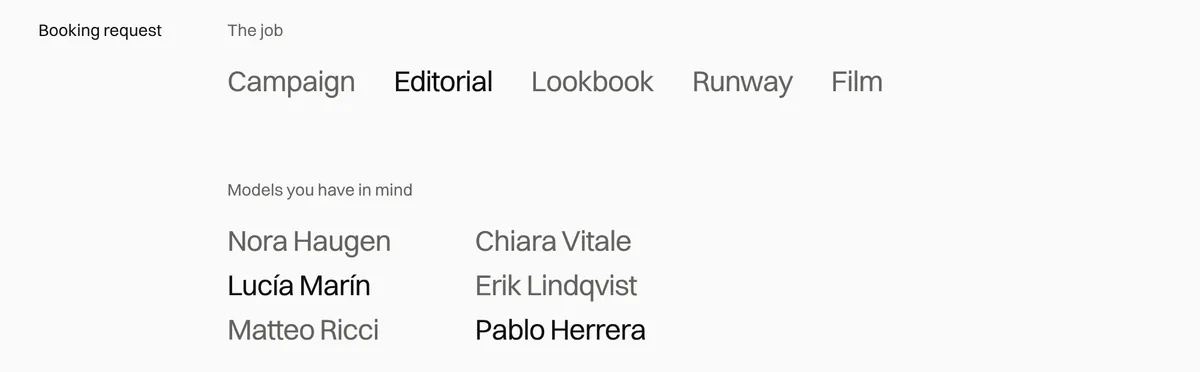
The booking form lets a client pick the job (campaign, editorial, lookbook, runway or film) and tick the models they have in mind, then asks for name, company, email, phone, dates, location and a message. No field is required, and the form has no address to send to: submitting it reloaded the page with every answer, email and phone included, in the address bar, and showed no confirmation. No request went anywhere else.
The scouting form asks for the board, name, age, city, height, email, Instagram and three photos (front, three quarter, full length). It accepted an age of 15 although the page asks for 16 to 28, and on submit only the file names went into the address bar; the photos never left the browser. The page invites under-18s to apply with a parent or guardian, so a real version needs secure photo storage and consent handling, not just a form service. The six journal posts are text only, signed by named agents, with topics, reading time and an RSS feed. On a 390 px screen we found no sideways scrolling.
Performance and SEO
One Lighthouse 12.8.2 run per page and form factor, 30 October 2026:
| Page | Performance | Accessibility | Best practices | SEO |
|---|---|---|---|---|
| Home, mobile | 88 | 100 | 96 | 100 |
| Home, desktop | 98 | 100 | 96 | 100 |
| Model profile, mobile | 98 | 100 | 96 | 100 |
| Model profile, desktop | 100 | 100 | 96 | 100 |
Lexington lists 99, 95, 100 and 100; accessibility scored higher in our runs. Images are the theme's strength: every photo is WebP from Astro's image pipeline with responsive sizes and fixed dimensions, almost all of them lazy-loaded, and a model profile transferred under 200 KB on mobile. The home page is where the cost sits. On mobile its largest paint, a hero portrait, came at 3.5 s, with 140 ms of blocking time from the GSAP script that positions the 18 panels in 3D (about 0.8 s of script work); the hero uses CSS transforms, not WebGL, so this is JavaScript a phone has to run too. Best practices loses points because the layout links favicons and a web manifest that return 404.
SEO needs work before launch. All 42 pages share the title "Your Page Title" and the description "A detailed description of your page content.", each declares its canonical URL as https://yourwebsite.com/current-page, and the share image points at the same placeholder domain, as do the sitemap and RSS feed. There is no structured data. Lighthouse still scores SEO 100 because it checks that the tags exist, not what they say.
What you still have to build
Form handling. Send booking requests to the agency by POST, add required fields and a confirmation, and keep personal details out of URLs.
Scouting uploads. Store applicants' photos securely, check ages and handle consent for under-18s and data deletion.
Model cards and booking links. Add print styles and a print action, and preselect the model from "Book" buttons.
SEO tags and icons. Pass a real title, description, canonical URL and share image to every page, set your domain, and add the favicon and manifest files.
Your board. Replace the six sample models, agents and contact details; social links are placeholders.
Pros and cons
Pros
Built around how an agency works: board filters, measurements, campaigns linked to models, services and two intake forms.
Light, lazy-loaded WebP portraits; a profile page weighs under 200 KB on a phone.
Accessibility 100 on every page we tested, labelled controls and a menu that closes with Escape.
The 3D hero stops moving for visitors who ask for reduced motion.
Cons
Neither form sends anything, and the booking form puts personal details in the URL.
"Print model card" is a dead button.
Placeholder titles, descriptions and canonical URLs on all 42 pages.
The animated hero adds 140 ms of blocking time on mobile, and the first portrait took 3.5 s to appear in our run.
Lexington's redesign notes don't say whether the Sanity and EmDash editions got the model agency design.
How Studiomax compares
Riflesso ($89, same maker) applies the same roster idea to a photo studio, per Lexington: artist pages, series, films and an archive, on a dark page.
Hive by Shadcnblocks ($79) is a general agency portfolio template with Next.js and Astro editions, built on shadcn/ui and shipped with a Figma file, which Lexington doesn't provide. It has no board or measurements, so pick it only if you want React and plan to build the agency parts yourself.
We found no other template in our directory made for model or talent agencies. See all Tailwind templates for more options.
Who should buy Studiomax
Buy it if you run a small model or talent agency, or build sites for one, and want a quiet, portrait-led design with the board, profiles and campaigns already modelled, plus a developer to connect the forms, uploads and SEO. Look elsewhere if you need a working booking or scouting system out of the box, a dark design, or a large board with search: the demo has six models and no search.
FAQ
Do Studiomax's booking and scouting forms work?
No. Neither form has a destination: submitting reloads the page with the answers in the address bar, and the scouting form's three photos never leave the browser. You need a form service or backend, and secure storage for applicants' photos.
Is it cheaper to buy Studiomax alone or Full Access?
Studiomax alone costs $89 for the Astro edition. Full Access Personal costs $99 (shown as 50% off $198) and includes Studiomax and the other 52 Lexington Astro themes, so for $10 more you get the whole catalog.
Is Studiomax still a dark agency theme?
No. Lexington rebuilt it on 3 October 2026 as a light model agency theme. The old work, team, sign-in and sign-up pages and the global search are gone, per the changelog.
Do the Sanity and EmDash editions have the new design?
Lexington's redesign notes don't say. The EmDash edition added in August 2026 was described with work and team content from the old design, so ask Lexington before paying $129 for a CMS edition.
Can I use Studiomax for a client's agency site?
Yes. Lexington's license allows unlimited websites for yourself and for clients, with no attribution. You can't resell the theme or share the repository beyond the seats you bought.
KEEP EXPLORING
More templates