
Anthropic's coding agent for terminal, IDE, desktop and web, from $20 a month
Warp
Free open-source terminal with a built-in coding agent; AI plans from $20
FreemiumAI Coding
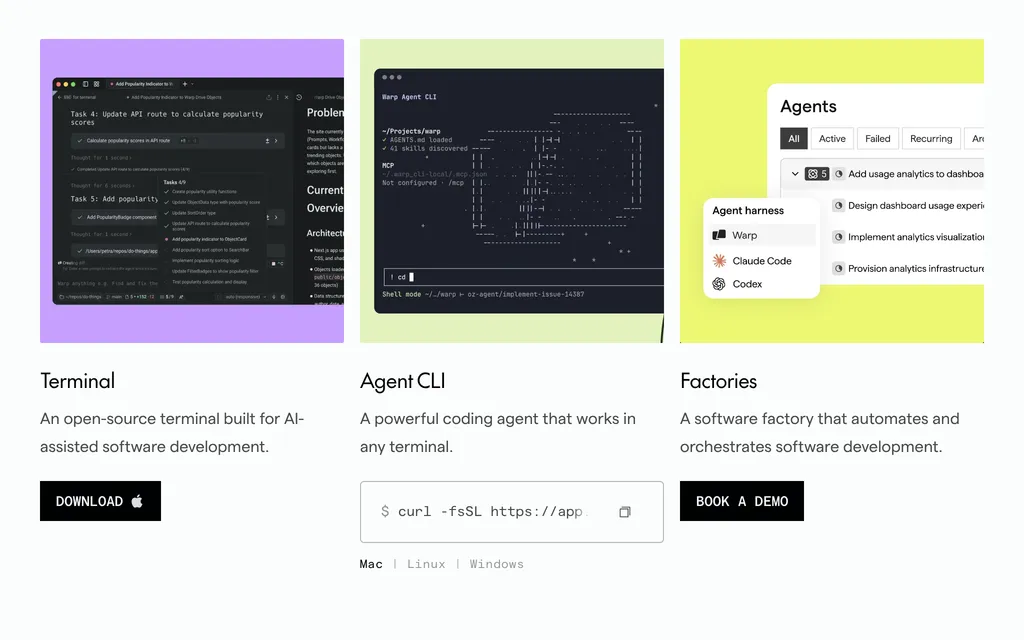
warp.devExplore the product
AT A GLANCE
Details about Warp
Short verdict: Warp is a terminal for macOS, Linux and Windows with a coding agent built in, a separate Agent CLI that brings that agent to any terminal, and cloud agents that run in the background on Warp's Oz platform. It also hosts Claude Code, Codex and other CLI agents with added review tools, and its client has been open source under AGPL since April 2026. The catch is metering: paid plans include a dollar amount of usage at API rates ($20 a month on Build), cloud runs add compute and per-hour platform fees, and the free plan includes no agent usage at all. It suits developers who live in the terminal and want one place to run several agents; anyone who wants a flat-rate subscription should look elsewhere.
How we reviewed it: We did not install Warp or the Agent CLI, sign in or run an agent. On 21 October 2026 we read Warp's pricing page with its FAQ expanded, the documentation on agents, models, billing and privacy, the 2024 to 2026 changelogs, the privacy policy and the warpdotdev/warp repository on GitHub. Plans change often; check the Warp pricing page before you pay.
What Warp costs and includes
| Item | Warp on 21 October 2026 |
|---|---|
| Type | Terminal with a built-in coding agent (Warp calls it an agentic development environment), plus the Warp Agent CLI, Oz cloud agents and Warp Factories (early access) |
| Where it runs | macOS 10.14 or later; Linux (deb, rpm, Arch and AppImage packages, x64 and ARM64); Windows 10 and 11 (x64 and ARM64); the Agent CLI in any terminal on macOS, Linux and Windows; cloud agents started from the app, the CLI, schedules, Slack, Linear or GitHub |
| Models | Auto routers plus OpenAI (GPT-6 and GPT-5.x), Anthropic (Claude Opus 5.5, Sonnet 5.5, Fable 5.1), Google (Gemini 3.x), xAI (Grok) and open models such as GLM, Kimi, Qwen and DeepSeek hosted on Fireworks |
| Free tier | $0: the terminal, the Agent CLI, limited cloud agents and 3 indexed codebases; no included agent usage, so you bring your own API key or pay as you go at 20% above paid-plan rates |
| Paid plans | Build $20 a month ($18 billed yearly) with $20 of usage; Max $200 a month ($180 yearly) with $200 of usage; Business $50 per user a month ($45 yearly), up to 25 seats, $20 of usage per seat and SAML SSO; Enterprise custom |
| How usage is limited | A dollar balance that resets every 30 days and does not roll over; add-on usage rolls over and expires after 12 months; cloud runs also bill compute and agent hours |
| Open source | The Warp client is on GitHub under AGPL-3.0, with its UI framework under MIT (65.6k stars on 21 October 2026); the cloud services are not open source |
| Data use | With "Help improve Warp" on, Warp may collect AI interactions and console inputs; switching it off gives full zero data retention, which Business and Enterprise plans get by default |
| Latest notable release | Weekly releases, most recently on 15 October 2026 (v0.2026.10.14.08.27); Warp Factories in early access since 27 August 2026 |
What Warp does that a plain terminal does not
One window for many agents, including other vendors'
The Warp Agent runs commands in a real shell, reads the output and can drive REPLs, database shells and full-screen programs. Next to it, Warp detects the third-party CLI agents listed in its docs (16, including Claude Code, Codex, OpenCode, Amp, Copilot CLI and Kiro CLI) and adds a rich input editor, notifications, inline code review and remote control to their sessions. Rules, skills, MCP servers and codebase context apply the same way in the app, the CLI and the cloud.
Cloud agents you can start, schedule and hand off
Oz, launched on 10 February 2026, runs agents in isolated cloud sandboxes built from Docker environments. You can start them from Warp, the CLI, the API, a schedule or an @Warp mention in Slack, Linear or GitHub, hand a local conversation to the cloud and back, and let a parent agent spawn child agents. Agents can use a desktop through computer use and attach screenshots or videos to pull requests. Build and Max allow 20 concurrent cloud agents with 2 or 4 vCPUs; Business allows 80 with 8 vCPUs.
Open source with your choice of model
Warp published its client on 28 April 2026, with OpenAI as the repository's founding sponsor, and community contributions run through Warp's own agents. You can pick a model per prompt, let an Auto router choose, write routing rules in YAML, or bring OpenAI, Anthropic or Google API keys, a SuperGrok subscription, a ChatGPT plan or an OpenAI-compatible endpoint such as OpenRouter.
Costs and limits to watch
No agent usage on Free. The free plan includes the terminal, but every Warp-provided model call is pay-as-you-go at a 20% premium over paid-plan rates.
Cloud runs cost three ways. A cloud run can bill inference, the Warp-hosted sandbox and "platform" agent hours. On Business and Enterprise, local runs that use your own API key still pay platform charges.
Bring-your-own-key has a size limit. Personal API keys and custom endpoints are only allowed for individuals and companies with 10 or fewer employees; larger companies need Business or Enterprise.
Privacy defaults. Warp's privacy policy lists training the models behind its AI features as a use of personal information, and AI interactions can be collected unless you turn off "Help improve Warp". Its model providers have zero data retention agreements, except for Anthropic's Claude Fable models.
Plan details drift. The Max plan card says $200 of usage, "10x Build", while the comparison table on the same page lists $240 (18,000 credits). There is no uptime SLA and no student or open-source discount.
The company's focus has moved. On 28 September 2026 Warp's founder wrote that "our entire focus is on building the technical infrastructure, Warp Factories", and the homepage now leads with Factories rather than the terminal.
Pros and cons
Pros
The terminal and Agent CLI are free, and the client is open source under AGPL.
Runs Claude Code, Codex, OpenCode and other CLI agents with added review and notification tools.
Local conversations can move to cloud agents and back, with schedules, triggers and parallel runs.
Wide model choice, including your own keys, a ChatGPT plan and open-weight models.
Cons
AI use is metered in dollars at API rates; Build's $20 a month buys $20 of model calls.
Cloud runs add compute and per-hour platform fees on top of inference.
Telemetry that includes AI interactions is on until you switch it off.
Warp's own roadmap now centers on Factories, a team product in early access.
How Warp compares
Claude Code is a terminal agent sold as a subscription (Pro $20 a month, or $17 billed yearly) with 5-hour and weekly limits instead of a dollar meter, and it runs inside Warp. Choose it for a flat price and Anthropic's models.
OpenCode is an MIT-licensed terminal agent that works with 75+ model providers, local models and ChatGPT or Copilot subscriptions, and its free models allow 200 requests a day. Choose it if you want the agent itself to be open source and free.
Zed is an open-source, GPL-licensed editor that runs external agents such as Claude Agent and Codex through the Agent Client Protocol; Pro costs $10 a month with $5 of tokens. Choose it if you want an editor, not a terminal, as the home for your agents.
See all AI coding tools for more terminal agents and editors.
Who should use Warp
Warp suits developers who spend the day in a terminal and run more than one agent: it gives Claude Code or Codex sessions a better input box and review tools, and adds its own agent and cloud runs when you want them. It costs nothing until you use Warp-provided models. If you want a fixed monthly price for heavy agent use, or a vendor focused on the terminal itself, a coding agent with a flat subscription is the simpler choice.
FAQ
Is Warp free?
Yes, the terminal and the Warp Agent CLI are free, and the client is open source. AI features need your own API key or paid usage: the Free plan includes no agent usage, and Build costs $20 a month ($18 billed yearly) with $20 of usage, as of 21 October 2026.
Is Warp open source?
Yes, since April 2026. The Warp client is on GitHub as warpdotdev/warp under AGPL-3.0, with its UI framework under MIT, and it had 65.6k stars on 21 October 2026. The services behind cloud agents and Warp Factories are not open source.
Can I use Claude Code or Codex in Warp?
Yes. Warp detects Claude Code, Codex, OpenCode and the other CLI agents listed in its docs and adds a rich input editor, notifications, inline code review and remote control to their sessions. Its cloud agents can also run Claude Code or Codex instead of the Warp Agent.
Does Warp train on my data?
It can unless you opt out. Warp's privacy policy lists training and fine-tuning the models behind its AI features as a use of personal information, and with Help improve Warp switched on it may collect AI interactions and console inputs. Turning that setting off gives full zero data retention; Business and Enterprise plans have zero data retention by default.
KEEP EXPLORING
More AI coding tools Good company for Warp.
AI code editor with parallel cloud agents, sold in The X Subscription from $8
OpenAI's coding agent for CLI, IDE, ChatGPT app and cloud, from $20 a month