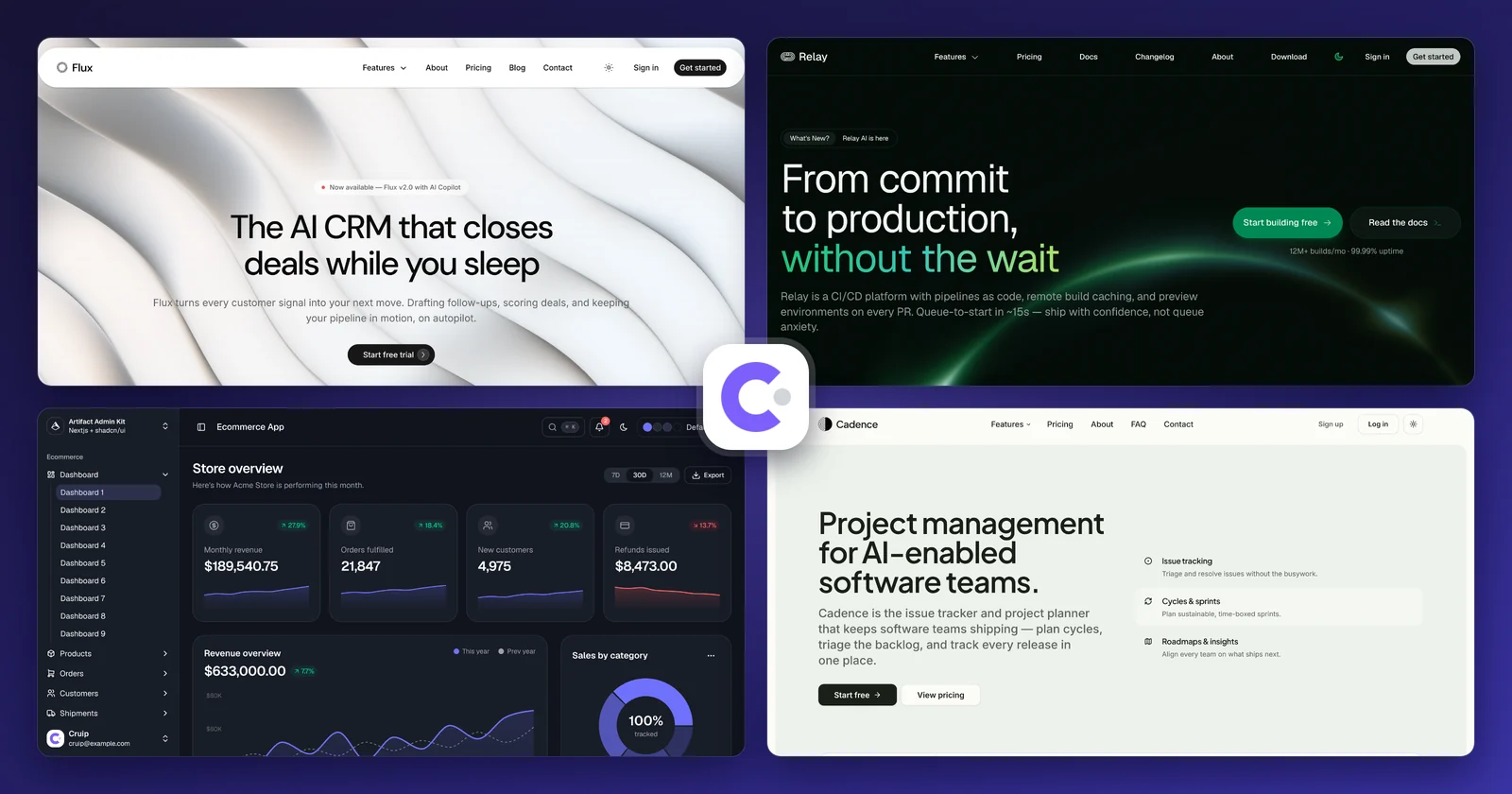
Flux, Cadence, Relay and Artifact: Tailwind templates for Next.js and Astro
Orion
Next.js and Astro AI agent landing page with an animated workflow hero
PaidTemplates
shadcnstudio.comExplore the product
AT A GLANCE
- Website
- shadcnstudio.com
- Pricing
- Paid
- Categories
- Templates
- Listed
- Mar 2026
- Updated
- Nov 2026
Details about Orion
KEY POINTS
- Tailwind CSS v4
- MDX support
- Figma file
Short verdict: Orion is a warm, light AI agent landing page whose hero does the explaining: six workflow tabs animate an input, the agent's steps and the result. Beyond the home page it has an integrations directory with working search and filters, a blog with 12 MDX posts and four sign-in screens, in Next.js and Astro. Those screens are a click-through with nothing behind them, the sign-in form refuses to submit until Remember Me is ticked, and the copy needs a pass: the closing section promotes "FlowMate" and the sign-in panel asks for a "Shadcn Studio account". It suits an AI automation startup that wants a shadcn/ui landing page and will build sign-in itself; it is not a full site, with no pricing, contact or legal pages.
How we reviewed it: On 22 November 2026 we used both live demos, Next.js and Astro, on a desktop and on a 390 px phone screen. We crawled all 19 routes of each, played the workflow tabs, searched and filtered the integrations page, switched the pricing toggle and the theme, and submitted the sign-in, sign-up, password and newsletter forms with a sample example.com address while logging network requests. We ran Lighthouse 12.8.2 on both home pages and on the integrations page; mobile scores are the median of three runs because our test machine was shared, desktop scores are one run. We did not buy Orion, so we could not check the source code, the contents of the download or the Figma file. Prices, plans and license terms come from shadcn/studio's product, pricing, checkout and license pages on the same day.
Disclosure: our links to shadcn/studio carry a referral tag (ref=tailkits), so Tailkits may earn a commission if you buy through them. Tailkits is not sponsored by shadcn/studio.
What you get for $59
| Price | $59 one-time for Orion alone, through a Polar checkout. Or shadcn/studio Pro at $249 one-time (listed as down from $359), which includes all its templates, 1,100+ blocks and the Figma kit. The $149 Basic plan covers free templates only. Plans |
|---|---|
| Editions | Next.js and Astro, per shadcn/studio. The demos run Next.js 16.1.1 and Astro 6.4.2. |
| Version | Created 5 December 2025, last updated 5 June 2026, per shadcn/studio. |
| Size | 19 routes in each demo: a 9-section home page, an integrations page, a blog index with 12 MDX posts, and sign-in, sign-up, forgot password and set new password screens. The Next.js sitemap lists 15 of them and leaves out the auth screens. |
| Stack | shadcn/ui, React, TypeScript, Tailwind CSS v4 (read from the demos' CSS) and Lucide icons. |
| Figma file | Included with Pro, Team and Enterprise. The FAQ says design files come only with those plans, and the $59 checkout does not list one. |
| License | One person, unlimited end products including client sites; no reselling the template. The license page does not cover the $59 single-template purchase. License terms |
What we found in the demos
A hero that animates the agent's work
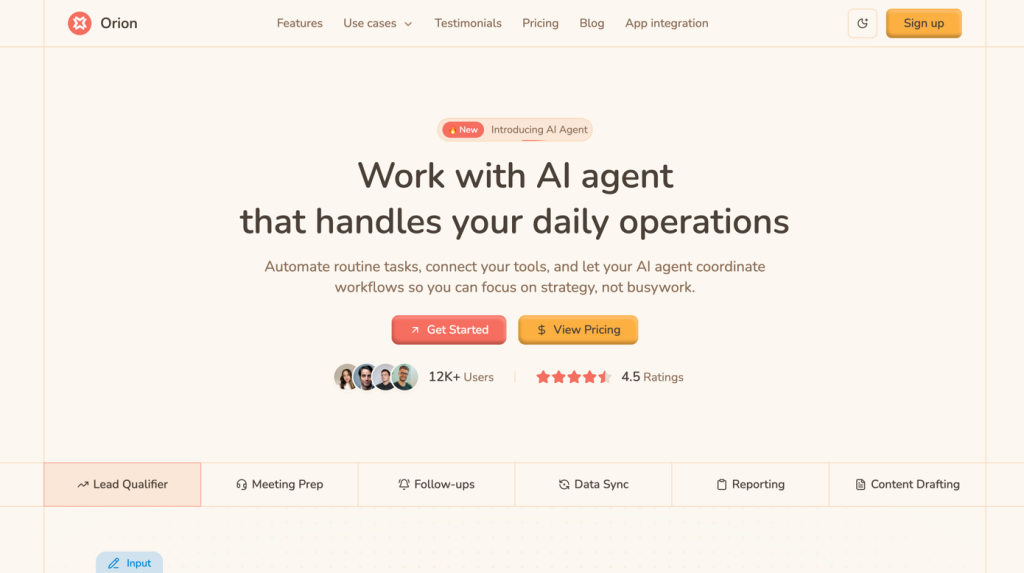
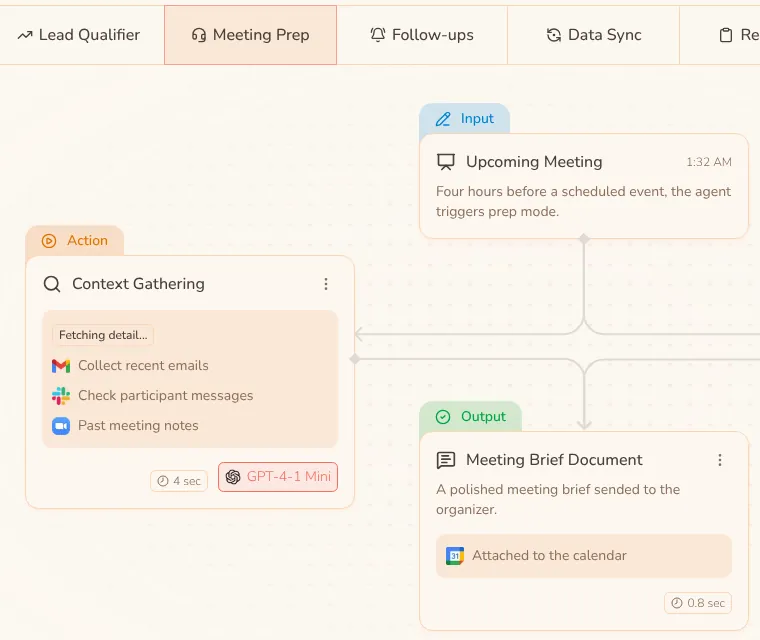
The hero has six tabs, Lead Qualifier, Meeting Prep, Follow-ups, Data Sync, Reporting and Content Drafting, and moves through them on its own. Each tab draws a small workflow: an input card, one or two agent actions with timings and a model label, and an output. Meeting Prep, for example, starts from an upcoming meeting, gathers context from email, Slack and past notes, and ends with a meeting brief attached to the calendar. It is an animation rather than a product demo, so there is nothing to type into. The features and how-it-works sections add more mock agent panels, such as a prompt box and step-by-step progress lists, and a use-case block switches between sales, marketing and founder stories.
An integrations page that filters
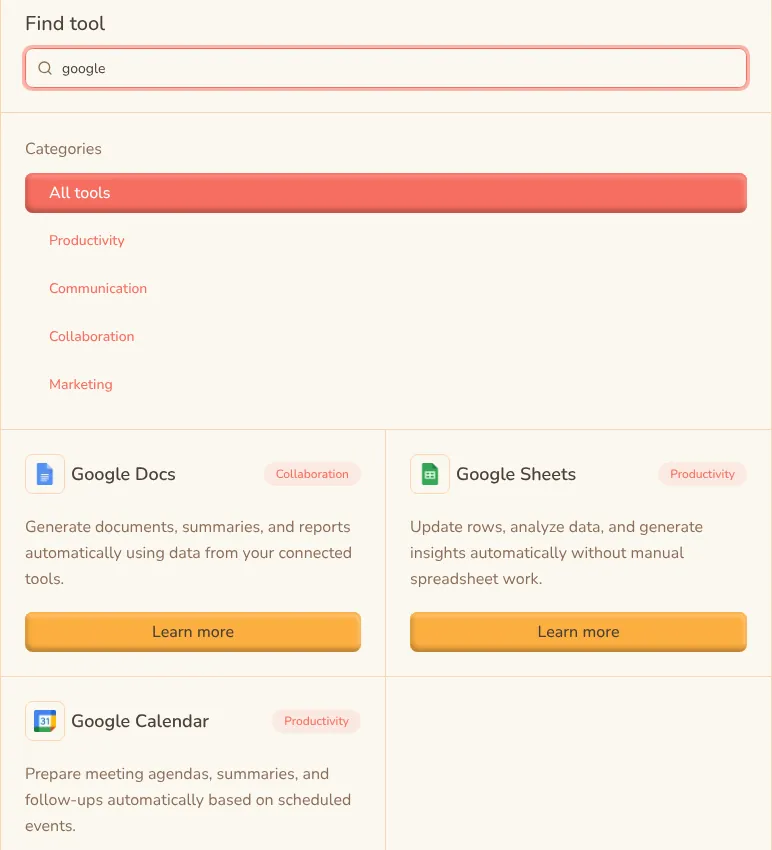
The App integration page lists 18 tools, among them ChatGPT, Google Docs, Sheets and Calendar, Zoom, Slack, Notion and Gmail, with a search box and five categories. Searching "google" left three cards, and the Communication filter showed Zoom, Twilio, Slack and Discord. The Learn more buttons go to "#" or to the LinkedIn and X home pages, so each tool still needs a page of its own.
Sign-in screens with nothing behind them
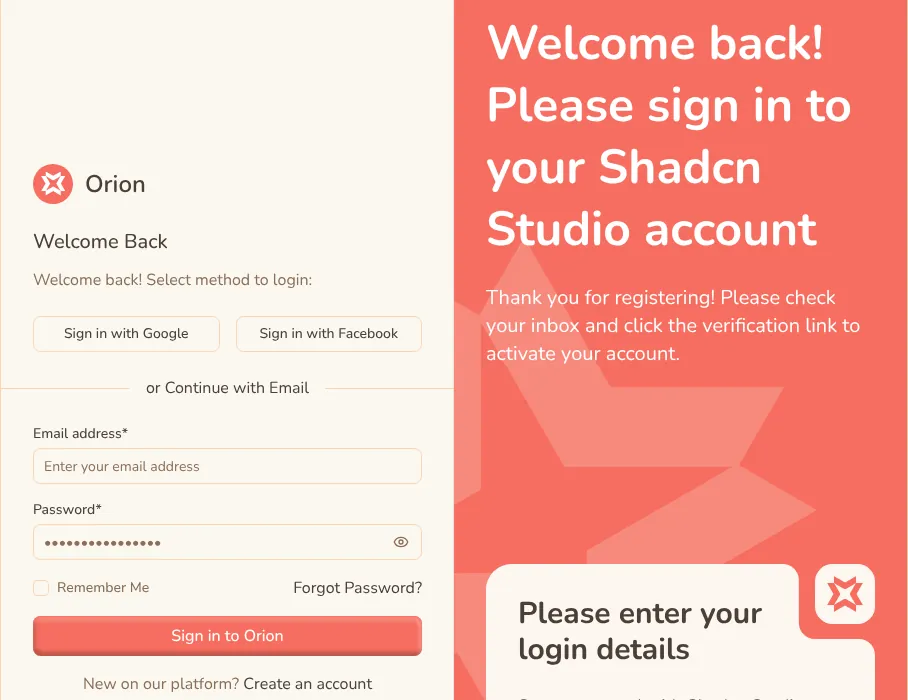
Orion includes sign-in, sign-up, forgot password and set new password screens. Submitting them with a sample address sent no request: sign-in and sign-up simply open the home page, and forgot password opens the set new password screen. The validation is the wrong way round. The sign-in form will not submit until Remember Me is ticked, while sign-up goes through without accepting the terms. The Google and Facebook buttons link to "#", and the side panel of the sign-in screen asks visitors to sign in to their "Shadcn Studio account" and thanks them for registering.
Pricing, FAQ and leftover copy
The pricing toggle works: Starter, Pro and Enterprise cost $8, $12 and $25 a month, or $5, $7 and $16 a month with the yearly "Save 35%" option, but the three Purchase plan buttons are not links. The FAQ has 10 questions in two groups. The closing section still tells visitors to "scale your output effortlessly with FlowMate", and the blog's newsletter form only writes "Email submitted" and the address to the browser console. The home page has 24 links to "#", Docs and Contact Us among them. On a 390 px screen nothing scrolls sideways, the menu works, and the theme choice is saved in the browser under the key theme.
Next.js or Astro
Both editions have the same routes and behavior. The Astro edition transferred 621 KB against 952 KB for Next.js on our mobile runs, but all 10 of its sections are React islands that hydrate on load, so you work in React either way. The Next.js edition preloads 40 images, including dark-mode testimonial photos that a light-mode visitor never sees, gives the home page as every page's og:url and has no canonical link on the home page. Only the Astro edition has an RSS feed.
Performance and SEO
Lighthouse 12.8.2, 22 November 2026; mobile rows are the median of three runs, desktop rows one run:
| Page | Performance | Accessibility | Best practices | SEO |
|---|---|---|---|---|
| Home, Next.js, mobile | 66 | 95 | 100 | 66 |
| Home, Next.js, desktop | 95 | 95 | 100 | 66 |
| Home, Astro, mobile | 76 | 95 | 100 | 69 |
| Home, Astro, desktop | 93 | 95 | 100 | 69 |
| Integrations, Next.js, mobile | 76 | 95 | 100 | 61 |
Both demos block search engines with robots.txt and a noindex tag, which caps SEO; the integrations page also lost points for 18 Learn more links without descriptive text. Mobile largest contentful paint was 5.9 s on Next.js and 5.0 s on Astro, with the hero paragraph as the largest element. Both editions load a 231 KB (uncompressed) Google Fonts stylesheet that declares 557 font faces in 44 families, while the page uses Nunito.
Color is the accessibility fix to make. The muted body text (#8b6e57 on #fcf8f1) measures 4.44:1, just under the 4.5:1 minimum, on 56 elements of the home page, and white text on the coral Get Started and Purchase plan buttons measures 2.86:1. Headings also skip a level at the newsletter block. Structured data is limited to WebSite on every page and WebPage and BreadcrumbList on blog posts, with no ratings or prices to clean up.
What you still have to build
Authentication. Connect the four screens to an auth provider, make Remember Me optional and require the terms checkbox.
Forms. A newsletter signup that stores addresses, and a contact page: the footer's Contact link goes to "#".
Pages and links. Pricing, docs and legal pages, a page per integration, and targets for the 24 "#" links and the Purchase plan buttons.
Copy and proof. The FlowMate and Shadcn Studio mentions, the 12K+ users and 4.5 rating badges in the hero, the 1.42 million tasks figure and the testimonials.
Contrast and indexing. Darker muted text and button colors, and a production build without the demo's robots.txt and noindex tag.
Setup. The shadcn/studio docs ask for Node.js 18.17 or later, but Astro 6 needs Node 22.12 and Next.js 16 needs 20.9, per their npm packages.
Pros and cons
Pros
A hero that explains an AI agent through six animated workflows.
An integrations page with working search and category filters.
Auth screens and a 12-post blog included, in Next.js and Astro.
Light and dark modes that persist, and no sideways scrolling on phones.
Cons
Sign-in and the newsletter are front end only, and the checkbox rules are reversed.
No pricing, contact or legal pages, and 24 links to "#" on the home page.
Leftover copy names FlowMate and a Shadcn Studio account.
The coral buttons have 2.86:1 contrast.
The Figma file comes with the $249 plan, not the $59 purchase, per shadcn/studio.
How Orion compares
Devgent ($97, Themefisher) is a dark Astro theme for AI startups with 73 demo URLs, including careers, integrations, a changelog and a blog with authors. It scored 91 on mobile, but much of its sample copy belongs to other themes and it has no sign-in screens. Pick it if you want more pages and work in Astro.
Nodus (Aceternity, $79) is an AI agent landing template on Next.js 15, React 19, Tailwind CSS 4 and Motion, per Aceternity, with no Astro edition. Aceternity's All-Access covers it and 16 other templates. Pick it if you build in Next.js and want Aceternity's animated components.
shadcn/studio Pro ($249 one-time) includes Orion, Grow and the other templates, with Figma files. It pays off from five templates, or as soon as you need the Figma file.
See all landing page templates for more options.
Who should buy Orion
Buy it if you are launching an AI agent or automation product, want a light shadcn/ui landing page whose hero shows the product at work, and will connect sign-in, the newsletter and the missing pages yourself. Look elsewhere if you need working authentication out of the box, a multi-page marketing site, or the Figma file at the $59 price.
FAQ
Does Orion include working sign-in?
No. The four auth screens are front end only: in the demo they send no request and just open the next screen. You connect an auth provider yourself.
Can I buy Orion without a plan?
Yes. Orion sells for $59 one-time through a Polar checkout on its product page, even though the FAQ on the same page says templates are not sold separately. The Pro plan ($249 one-time) includes it with every other template.
Does Orion come with the Figma file?
Only with a plan, per shadcn/studio. Its FAQ says design files come with Pro, Team and Enterprise, and the $59 checkout does not list a Figma file.
Can I use Orion for client projects?
Yes. The paid licenses allow unlimited end products, including sites built for clients, for one person; the Team plan covers 15 people. You can't resell or redistribute the template.
Should I pick the Next.js or the Astro edition?
The Astro edition was lighter in our tests, 621 KB against 952 KB and 76 against 66 for mobile performance, but every section is still a React island, so you work in React either way. We tested both public demos but did not buy the download to confirm its contents.
Get new templates like Orion weekly
Every Monday: the templates, components and tools added to Tailkits that week, each checked by an editor. Free, unsubscribe in one click.
17 new in the last 30 days313 products reviewed so farSee what you get
KEEP EXPLORING
More templates