
Email API with no approval queue, React Email support; $35 for 100,000 emails
SendGrid
Twilio email API and SMTP relay: $34.95 for 100k emails, no free plan
PaidEmail
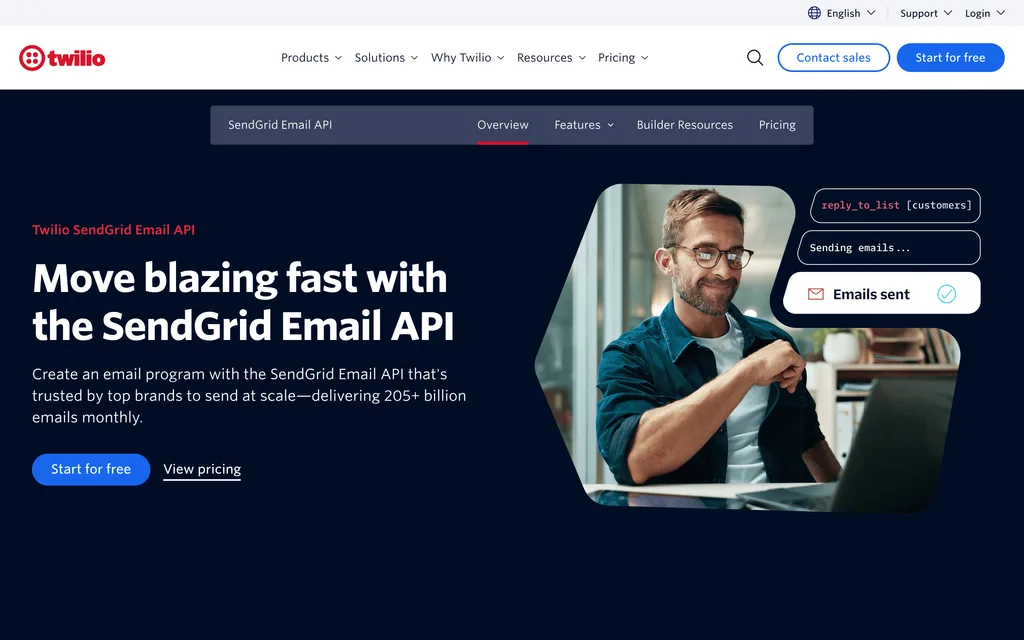
twilio.comExplore the product
AT A GLANCE
- Website
- twilio.com
- Pricing
- Paid
- Categories
- Listed
- Sep 2026
- Updated
- Oct 2026
Details about SendGrid
Short verdict: SendGrid, Twilio's email API and SMTP relay, is priced well at 100,000 emails a month ($34.95) and includes inbound parsing, templates and 30 days of email logs on every plan. The free plan ended in 2025, so even 10,000 emails a month costs $19.95 after a 60-day trial, and dedicated IPs, subusers, SSO and EU data residency all start on Pro at $89.95. Twilio publishes no uptime figure for SendGrid, and a suppression bug in late September 2026 may have lost some customers a small amount of mail and some unsubscribes. It suits US teams sending 50,000 to 100,000 transactional emails a month; side projects, small EU teams and high-volume senders have better options.
How we reviewed it: We did not create an account or send email through SendGrid. On 21 October 2026 we read the pricing pages, set the pricing calculator to each of its eight volumes, and took overage rates from Twilio's pricing PDF (dated December 2025). We read the Node.js quickstart and the docs, installed @sendgrid/mail into an empty folder (Node.js 22.22, npm 10.9) to measure it, and read 90 days of Twilio status history filtered to SendGrid's 13 components. We could not test sign-up approval, delivery speed, inbox placement or support.
What SendGrid costs and requires
| Free tier | None since May 2025. One 60-day trial per account: 100 emails a day, no card |
|---|---|
| 10,000 emails a month | $19.95 (Essentials 50K, the smallest plan) |
| 100,000 emails a month | $34.95 (Essentials 100K), or $89.95 on Pro 100K |
| 1,000,000 emails a month | $733 (Pro 700K at $499 plus 300,000 × $0.00078), or $799 on Pro 1.5M |
| Billing | Monthly, by card only; no annual plan; tax extra |
| Before you send | Email and phone verification, two-factor login and a verified sender; domain authentication and a card to upgrade; in some cases a compliance check of up to 72 hours |
| Regions | Global; EU data residency on Pro and Premier only |
| Inbound | Inbound Parse webhook on every plan, including the trial |
| SDKs | Official C#, Go, Java, Node.js, PHP, Python and Ruby libraries, plus an OpenAPI spec |
| HIPAA | Not on Twilio's list of HIPAA-eligible services (June 2026) |
Prices from the SendGrid Email API pricing page and Twilio's pricing PDF, 21 October 2026.
What we found
The free plan is gone, and the trial ends
Twilio retired the free Email API and Marketing Campaigns plans starting 27 May 2025 (a second changelog entry says 28 May) and paused sending on them 60 days later. New accounts get a one-time trial instead: 60 days at 100 emails a day, about 3,000 a month, with no card. When it ends, "Any active email send integration using your account's API keys will stop sending messages". Twilio's own pages lag: the Email API pricing page calls the trial "our free plan", and the Marketing Campaigns FAQ still offers a free plan with 2,000 contacts.
$34.95 for 100,000, then Pro for the features that matter later
The calculator has eight volume stops. Essentials 50K ($19.95) is the smallest plan and Essentials 100K costs $34.95; from 300,000 it offers only Pro, and Premier at custom prices above 2.5 million.
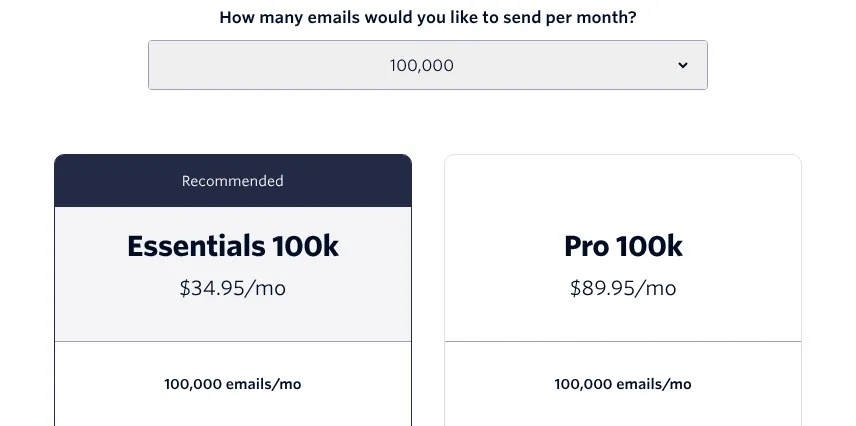
That $55 is the real decision. Essentials sends from shared IP groups that "can change without notice", with daily limits set from your reputation score. Pro adds a dedicated IP, IP pools, automated warm-up, reverse DNS, up to 15 subusers, SSO, 1,000 teammates instead of 1, five event webhooks instead of two, 2,500 address validations and EU data residency.
At 1,000,000 emails, Pro 700K plus 300,000 extra emails at $0.00078 comes to $733; Pro 1.5M is $799 flat. The overage rates appear only in the PDF; the pricing page just says overages "may apply". SendGrid's docs recommend two dedicated IPs from 250,000 emails a month; Pro includes one, and each extra IP is $30 a month. Marketing Campaigns is a separate subscription from $15 a month.
EU data residency needs Pro, a subuser and an EU IP
EU sending goes through api.eu.sendgrid.com from an EU subuser with an EU dedicated IP, on Pro and Premier only; "The parent account itself cannot send emails to the EU". The Email Activity Feed docs add that Twilio stores all Email Activity data in the United States. A small EU team pays at least $89.95 a month, however little it sends.
Several checks before your first customer email
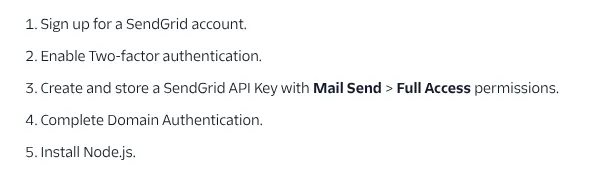
Sign-up runs through a Twilio account that verifies your email address and phone number, and two-factor login is mandatory. The trial can send once a single sender address is verified, which the quickstart calls "recommended for testing only". Upgrading requires domain authentication, two-factor login and a card, and "in some instances" a compliance review that can take up to 72 hours. Domain authentication means four DNS records: three CNAMEs for SPF and DKIM, and a DMARC record whose example value is p=none.
Inbound mail, webhooks and logs on every plan
Inbound Parse works on every plan: point a domain's MX record at mx.sendgrid.net and SendGrid posts each message, up to 30 MB, to your URL. It needs an authenticated domain and drops messages it cannot post after 3 days, without notice. The signed Event Webhook covers delivery events and engagement events (opens, clicks, spam reports, unsubscribes) and retries for 24 hours; Essentials gets two webhooks. Email Logs, available since 4 November 2025, keeps 30 days of events for every customer, while the older activity search shows 3 days on Essentials. Sandbox mode validates requests without sending; there is no test inbox.
Reliability and developer experience
No uptime figure, and a suppression bug reported late
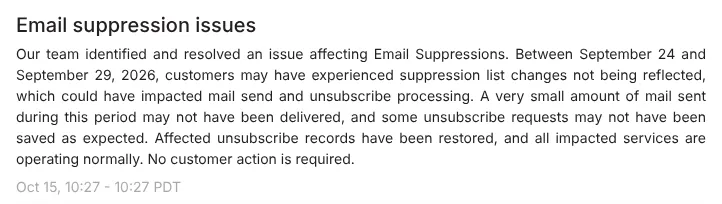
status.sendgrid.com now redirects to Twilio's status page, which shows SendGrid's 13 components with their current status but no uptime percentage; the only figure is the "99.999% uptime" claim on the pricing page. In the 90 days to 21 October 2026 it logged 9 incidents on SendGrid components, none declared as the API or SMTP refusing mail. The serious one was posted on 15 October: between 24 and 29 September, suppression list changes were not applied, and "A very small amount of mail sent during this period may not have been delivered, and some unsubscribe requests may not have been saved as expected." Twilio says the affected unsubscribe records have been restored.
Most of the rest involved Microsoft blocking or deferring mail (14 to 17 August and 4 September), plus about 6 hours of delayed webhook events on 24 September, with "no event data was lost".
A widely used Node SDK that rarely ships
@sendgrid/mail had 5,744,754 npm downloads in the week of 28 September to 4 October 2026, the last week with complete npm data, yet its latest release, 8.1.6, dates from 19 September 2025. A clean install is 31 packages and 5.1 MB, 27 of them pulled in by axios. Types are bundled. EU sending needs setDataResidency('eu'), which exists on @sendgrid/client but not on the mail helper, and the package READMEs don't mention it.
The quickstart is short but dated: it says the SDK supports Node.js 6, 7, 8 and 10 and shows version 7.2.1 installing, while the current package requires Node.js 12 or later. Twilio's official MCP server indexes SendGrid's docs for coding agents but is read-only and cannot send email.
What you still have to set up
Domain authentication. Add the four DNS records, then tighten DMARC once mail passes.
An event webhook. Store bounces, spam reports and unsubscribes yourself, so a bug like September's can be checked against your own records.
Unsubscribe groups. Create one per kind of email and pass its ID with every send.
Templates. Use SendGrid's Handlebars Dynamic Templates, or build HTML with React Email or Maizzle.
IP warm-up on Pro. Automated warm-up starts a new IP at 20 emails an hour and needs a second warm IP for overflow. Pro includes one, so plan a manual warm-up or a second IP.
Pros and cons
Pros
$34.95 for 100,000 emails a month on Essentials.
Inbound Parse, SMTP, Dynamic Templates and 30 days of Email Logs on every plan.
Official libraries in seven languages, with types in the Node package.
Cons
No free plan: a one-time 60-day trial at 100 emails a day.
Dedicated IPs, subusers, SSO and EU data residency require Pro at $89.95.
No published uptime, and the September suppression bug was disclosed 16 days after it ended.
No Node SDK release since 19 September 2025, and a dated quickstart.
Overage rates only in a PDF.
How SendGrid compares
Mailgun costs $15, $75 and $700 at 10,000, 100,000 and 1,000,000 emails, has a free tier of 100 emails a day, and offers US or EU hosting per domain on every plan. Choose it for EU hosting without Pro pricing, but expect SMS verification and a card at sign-up.
Postmark is built for transactional email, with a 100-email-a-month free tier that never expires. It costs $15 at 10,000 but $115 at 100,000, over three times SendGrid's $34.95, and has no EU hosting.
Amazon SES costs $1.64, $16.38 and $163.84 at the same volumes, with 29 regions, five in the EU. You start in a per-region sandbox, wait for a manual review and build event handling yourself.
See all email tools, including template frameworks.
Who should use SendGrid
Use SendGrid if you send 50,000 to 100,000 transactional emails a month from the US, want SMTP, inbound parsing and templates in one account, and can finish domain and phone verification before launch. Look elsewhere if you need a free tier, EU data residency on a small budget, the lowest cost at a million emails, an actively released SDK or HIPAA coverage.
FAQ
Does SendGrid still have a free plan?
No. Twilio retired SendGrid's free plans starting 27 May 2025. New accounts get one 60-day trial with up to 100 emails a day and no card; after that, sending stops until you pick a paid plan, which starts at $19.95 a month for 50,000 emails.
How much does SendGrid cost for 100,000 emails a month?
$34.95 a month on Essentials 100K, before tax. If you need a dedicated IP, subusers, SSO or EU data residency, the Pro 100K plan costs $89.95 for the same volume.
Can SendGrid keep my data in the EU?
Only on Pro or Premier. EU sending uses a separate EU subuser with an EU dedicated IP and the api.eu.sendgrid.com endpoint; the parent account cannot send through the EU region.
Can SendGrid receive email?
Yes, on every plan including the trial. The Inbound Parse webhook receives mail for an authenticated domain whose MX record points to mx.sendgrid.net and posts each message, up to 30 MB, to your URL.
Is SendGrid HIPAA compliant?
No. SendGrid is not on Twilio's list of HIPAA-eligible services (updated 30 June 2026), so Twilio will not cover protected health information sent through it.
KEEP EXPLORING
More email tools