
Free at any volume and tied to Google Ads; 153 KB tag, 2 cookies
Plausible Analytics
Cookieless analytics hosted only in the EU; $19 a month for 100k pageviews
PaidAnalytics

plausible.ioExplore the product
AT A GLANCE
- Website
- plausible.io
- Pricing
- Paid
- Categories
- Analytics
- Listed
- Sep 2026
- Updated
- Oct 2026
Details about Plausible Analytics
Short verdict: Plausible is cookieless web analytics with a 1.3-2.6 KB script, hosted only in the EU by an Estonian company, with an open-source edition you can run yourself. The plan matters more than the traffic: funnels, revenue, custom properties and the Stats API need Business, and the $9 Starter plan covers one site with no team members. One site with 100,000 pageviews a month costs $19 on Starter or $39 on Business, and there is no free hosted plan. It suits sites, blogs and SaaS marketing pages that want simple reports without cookies. Skip it if you need session replay, user-level product analytics or a free plan.
How we reviewed it: We did not create an account or send data to Plausible. On 21 October 2026 we loaded its documented snippet (the older script.js and the per-site script plausible.io uses itself) on a test page in headless Chromium with every outgoing request blocked, so nothing reached Plausible, and recorded what it downloads, stores and tries to send. We also read the pricing slider, the docs, the billing rules in Plausible's open-source code, 90 days of the status page and the public demo dashboard at 1440x900. We did not test the logged-in dashboard, count accuracy, the Google Analytics import, the Search Console connection or support. Prices are monthly in USD.
What Plausible costs and includes
| Free plan | None. A 30-day trial with Business features, no card, and it does not turn into a paid plan |
|---|---|
| 10,000 pageviews a month | $9 (Starter) |
| 100,000 pageviews a month | $19 (Starter); $39 on Business |
| 1,000,000 pageviews a month | $69 (Starter); $139 on Business |
| What is billed | Pageviews plus custom events (outbound clicks, downloads, form submissions, 404s) across a team's sites, in fixed tiers with no overage fees |
| Plans | Starter: 1 site, no team members. Growth (from $14): 3 sites, 3 members, shared links. Business (from $19): 10 sites, 10 members, funnels, revenue, custom properties, Stats API |
| Hosting | EU only, per Plausible: Hetzner in Germany, UpCloud in Finland, Bunny CDN in Slovenia |
| Cookies (our test) | None, and nothing written to web storage |
| Script size (our test) | 1.3 KB (script.js) or 2.6 KB (per-site script), compressed |
| Self-hosting | Community Edition, AGPL-3.0, without several paid features |
| API and MCP | Stats API on Business (600 requests an hour), Events API for server-side tracking, no official MCP server. Plausible pricing |
What we found in Plausible's pricing, script and demo
Traffic sets the tier, the plan sets the features
The slider runs from 10,000 to 10 million pageviews, with custom prices above that. At 100,000 pageviews Starter costs $19, Growth $29 and Business $39; at 1 million, $69, $104 and $139. Yearly billing costs 10 times the monthly price.
Plausible's open-source plan file gives Starter 0 team members and no shared links, so sending a client a private dashboard link takes Growth. Funnels, user journeys, revenue, custom properties, the Stats API and the Data Studio (formerly Looker Studio) connector take Business. SSO, the Sites API, a managed proxy and raw event exports are Enterprise only. Data is kept 3 years on Starter and Growth, 5 on Business.
Going over the limit costs nothing at first
Custom events count: 100,000 pageviews plus 20,000 tracked downloads and outbound clicks is past the 100,000 tier. Plausible promises no extra fees and no gap in tracking. After two consecutive months over the limit, Plausible asks you to upgrade and locks the dashboard a week later; stats keep being collected, and it unlocks at the next billing cycle if usage falls back.
Two details are only in the open-source code: the lock applies only when both months are more than 10% over (11,000 on a 10,000 plan), and the scroll and time-on-page events are not billed. The trial is stricter: if it ends without a subscription, Plausible stops collecting and later deletes the stats after an email warning, with no time frame in its terms.
What the script does on a page
Neither script set a cookie or wrote to web storage. Each sent one POST to plausible.io/api/event with the event name, URL, domain and referrer. A history.pushState route change produced a second pageview plus an engagement event with scroll depth (100%) and engaged time (about 5 seconds). An outbound click sent nothing until that option is on. The script ignores browsers that report navigator.webdriver or run Cypress, so automated tests stay out of your stats (we masked the flag to observe it), and it is off on localhost. It reads one localStorage key, plausible_ignore, for excluding your own browser.
Since October 2025 each site gets its own pa-<id>.js script, configured with plausible.init(), and tracking options are switched on in site settings. The old script.js and its extension URLs still loaded on 21 October 2026; the new script drops data-exclude and sending to several dashboards at once.
The public demo shows the paid reports working
The live demo is plausible.io's own dashboard: 649,000 visitors in 28 days, with the top stats loading in about 2 seconds. Clicking any row filters everything. Filtering by Google swaps Sources for Search Console queries, which Plausible fetches live and does not store.
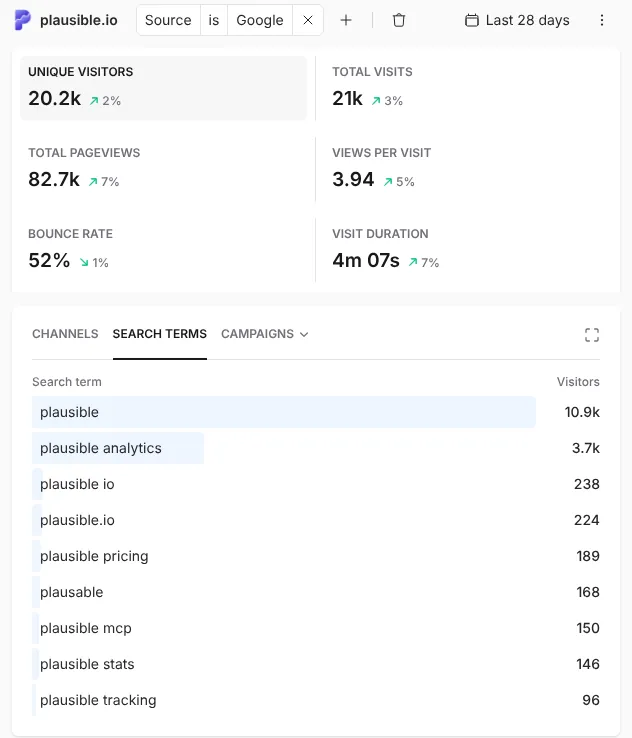
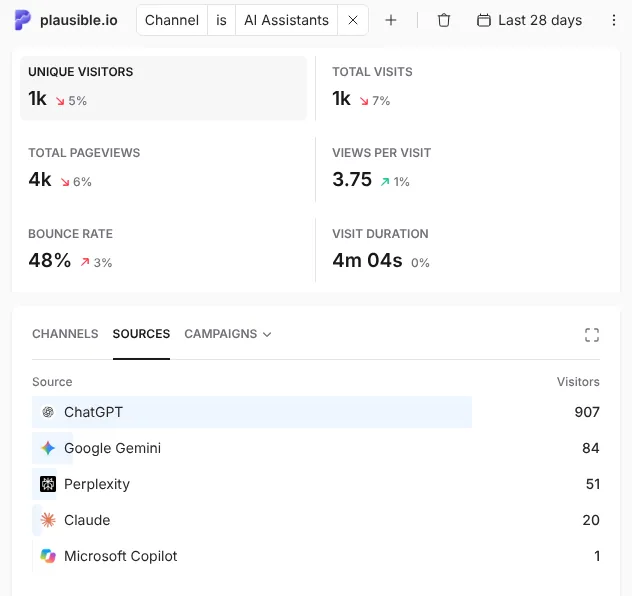
An AI Assistants channel, added in June 2026, groups traffic from chat tools.
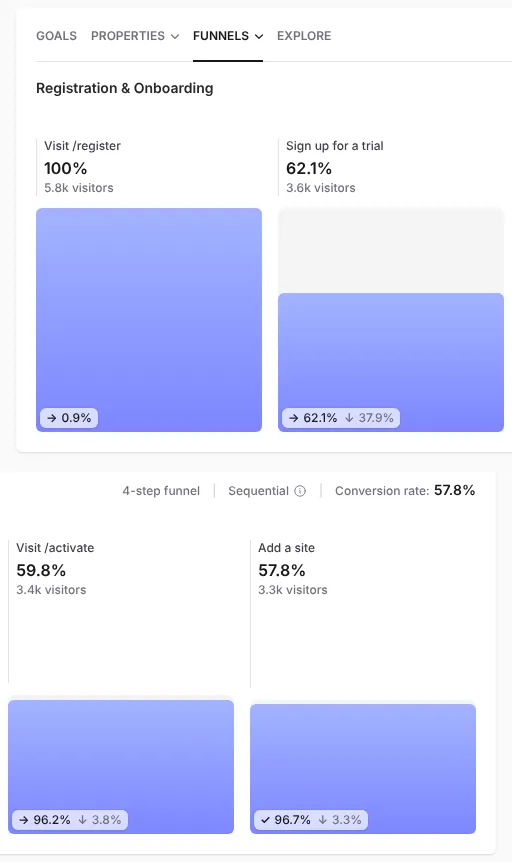
The demo also opens the Business reports: custom properties, user journeys and three funnels. Funnels take 2 to 8 steps in sequential, flexible or strict order.
EU only, and a smaller self-hosted edition
Plausible Insights OÜ is registered in Tartu, Estonia, and Plausible names three companies that touch visitor data: Hetzner (Falkenstein, Germany), UpCloud (Finland) and Bunny (CDN, Slovenia). There is no non-EU option. Visitors are counted with a hash of a daily salt, the domain, IP and user agent; the salt is deleted every 24 hours, so there is no new-versus-returning report. Plausible says it is not HIPAA compliant.
The free Community Edition runs on Docker. Per Plausible it leaves out funnels, user journeys, revenue goals, SSO, the Sites API and the Data Studio connector, filters bots only by user agent and referrer spam, and ships twice a year. The last feature release was v3.2.0 on 26 January 2026; v3.2.1 on 15 May 2026 fixed CVE-2026-8467, a remote code execution flaw in v3.0.0-rc.0 to v3.2.0.
Script weight, privacy and reliability
| Script | Transfer | Uncompressed | Main-thread time (4x CPU) | Cookies / storage | SPA route change |
|---|---|---|---|---|---|
Plausible script.js | 1.3 KB | 2.8 KB | 15 ms | None | Tracked |
| Plausible per-site script | 2.6 KB | 6.0 KB | 14 ms | None | Tracked |
| Umami | 2.4 KB | 4.8 KB | 11 ms | None | Tracked |
| Fathom | 2.2 KB | 7.0 KB | 11 ms | None | Needs data-spa |
| Google Analytics 4 | 153-156 KB | 443 KB | 216 ms | 2 cookies | Not observed |
One machine, one day: treat differences under about 1 KB or 10 ms as noise. Plausible says its analytics need no cookie banner and links a lawyer's assessment; whether that holds for you depends on your jurisdiction and setup, and we are not lawyers.
The status page watches one "API healthcheck": 100% over 90 days, no incident since 6 January 2026. On 6 November 2025 ingestion went down and Plausible wrote that it was restoring "the data that was lost". The npm package @plausible-analytics/tracker 0.4.6 (10 August 2026, MIT) had 114,518 downloads from 28 September to 4 October 2026; the older plausible-tracker is deprecated.
What you still have to set up
Goals and events. Add a
plausible-event-name=SignupCSS class or callplausible(), and switch on outbound, download and form tracking; all of it counts toward your tier.Your own visits. Block up to 30 IP addresses per site, set the localStorage flag, or use the WordPress plugin's role exclusions.
A proxy, if you want one. Plausible estimates blockers hide 5-25% of visitors; it has free guides for Cloudflare, Vercel, Netlify and Nginx.
History. The import takes GA4 only, up to 5 properties per site, on every plan; goals must be recreated.
Team and AI access. Team members need Growth. The only MCP server is a read-only community one built by Sentry's team, and it needs a Business-plan API key.
Pros and cons
Pros
No cookies or storage writes in our test, from a 1.3-2.6 KB script.
EU-only hosting by an EU company, with no setting to get wrong.
No overage fees, and stats are never cut off for going over.
A public demo with funnels, Search Console terms and AI referrals on real traffic.
AGPL source and a self-hosted edition.
Cons
No free hosted plan, and stats stop when the trial ends.
Funnels, revenue, custom properties and the API cost $39 at 100,000 pageviews instead of $19.
Starter has no team members or shared links.
No session replay, heatmaps, returning-visitor report or official MCP server.
Community Edition lacks the paid features and needed a critical security fix in May 2026.
How Plausible compares
Fathom Analytics costs $15 up to 100,000 pageviews and $60 for 1 million, with every feature on every plan but no funnels. Its trial needs a card, and it stores analytics in the US. Choose it for one price with no feature tiers.
Umami Cloud is free up to 100,000 events and costs $20 for 1 million, with US or EU hosting, a free MIT self-hosted version and an official MCP server on Pro. Choose it for a free tier or a lower bill at 1 million.
DataFast charges the same $9, $19 and $69 and includes funnels and payment-provider revenue attribution on its cheapest plan, but its default script sets 4 cookies and data is stored mostly outside the EU. Choose it if revenue attribution matters more than cookieless EU hosting.
See all analytics tools, including PostHog and Google Analytics.
Who should use Plausible
Use Plausible for a site, blog or SaaS marketing page when you want traffic, sources, goals and campaigns without cookies and need the data to stay in the EU: $9 to $19 a month for one site up to 100,000 pageviews, or $39 with funnels and revenue. Look elsewhere for a free plan (Umami), user-level product analytics or session replay (PostHog), or revenue attribution without an upgrade (DataFast).
FAQ
Is Plausible Analytics free?
No hosted plan is free. Every account gets a 30-day trial with Business features and no credit card, and it does not turn into a paid plan; if you do not subscribe, Plausible stops collecting stats and later deletes them after an email warning. The self-hosted Community Edition is free under the AGPL-3.0 license, but it lacks funnels, revenue goals, user journeys, SSO and the Sites API.
How much does Plausible cost for 100,000 pageviews a month?
$19 a month on the Starter plan, or $190 a year, as of 21 October 2026. Starter covers one site with no team members. Growth costs $29 (3 sites, 3 team members, shared links) and Business $39 (funnels, revenue, custom properties, Stats API). Custom events such as outbound clicks and downloads count toward the 100,000.
Do I need a cookie banner with Plausible?
Plausible says you do not, and publishes a lawyer's assessment to back it. In our test its script set no cookies and wrote nothing to browser storage; it counts visitors with a hash that uses a salt deleted every 24 hours. Whether you need consent still depends on your jurisdiction and setup, and this is not legal advice.
Where does Plausible store data, and can I self-host it?
Plausible Cloud keeps visitor data only in the EU, per Plausible: servers from Hetzner in Germany, database and export storage at UpCloud in Finland, and the Bunny CDN in Slovenia, run by an Estonian company. You can also self-host the Community Edition with Docker on your own server; update to v3.2.1 or later, which fixed a remote code execution flaw in May 2026.
Can I import my Google Analytics data into Plausible?
Yes, from GA4, on every plan including Starter. You can import up to 5 GA4 properties into one Plausible site, but goals and conversions are not imported and must be recreated. The importer covers GA4 only, and Plausible notes that GA4's own retention settings limit how much history is left to import.
KEEP EXPLORING
More analytics tools