
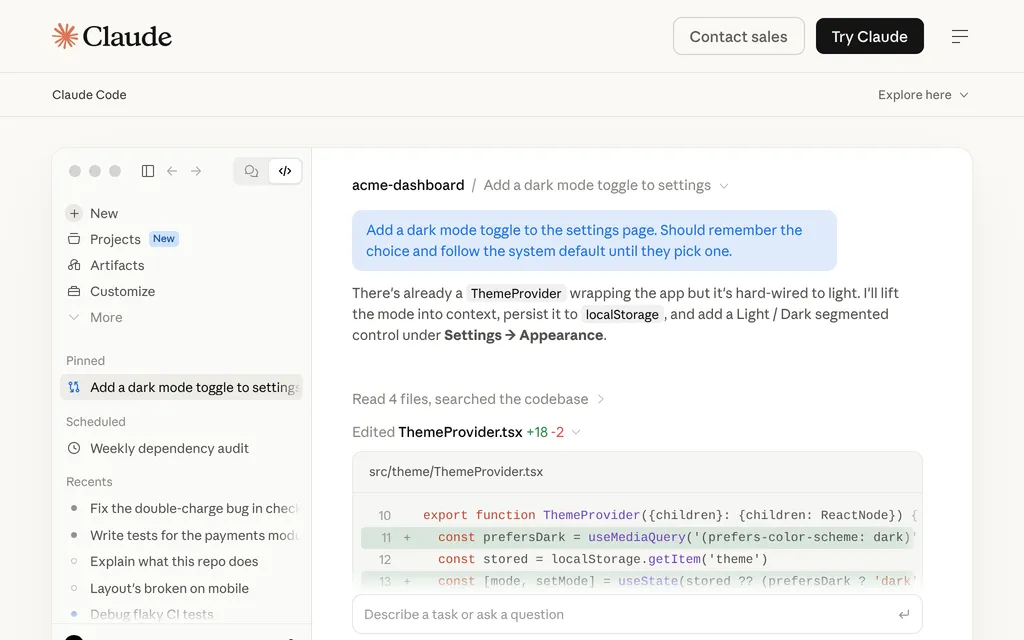
Anthropic's coding agent for terminal, IDE, desktop and web, from $20 a month
Amp
Coding agent with a cloud machine per thread, free on your own compute and keys
FreemiumAI Coding
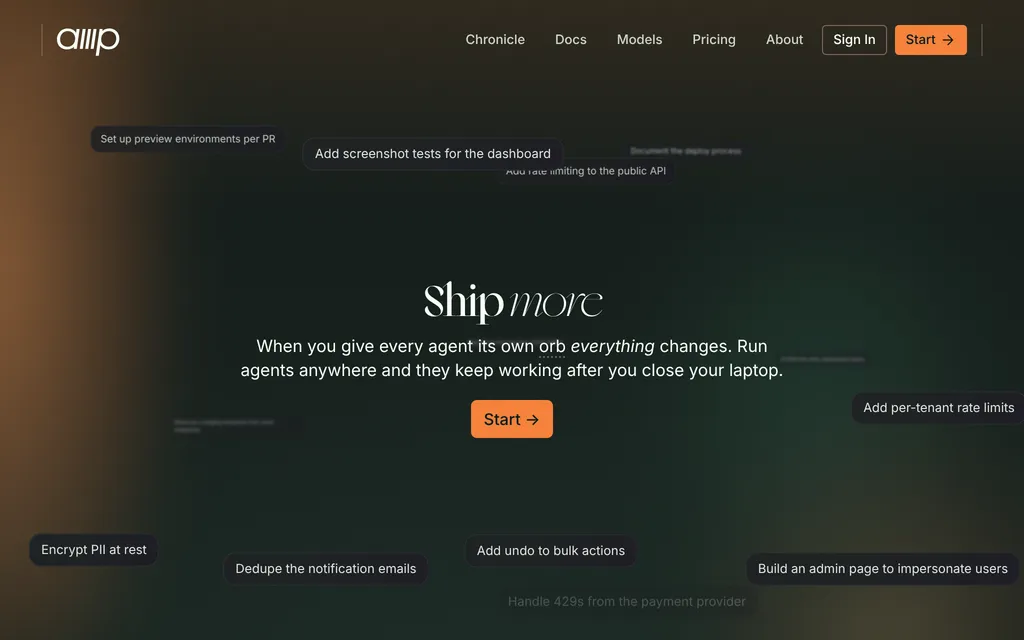
ampcode.comExplore the product
AT A GLANCE
- Website
- ampcode.com
- Pricing
- Freemium
- Categories
- AI Coding
- Listed
- Sep 2026
- Updated
- Oct 2026
Details about Amp
Short verdict: Amp is a coding agent from Amp Frontier Corporation, which spun out of Sourcegraph in December 2025, and it can give each thread its own cloud machine, called an orb, so agents keep working after you close your laptop. Amp is free with your own ChatGPT or Claude subscription or API keys and your own machines; its hosted orbs and model credits cost money, with plans from $20 a month. It also removes features it no longer uses: the VS Code and Cursor extensions were switched off on 5 March 2026, and there is no ad-supported free mode anymore. It suits developers ready to hand whole tasks to remote agents; if you want an agent inside your editor, look elsewhere.
How we reviewed it: We did not sign up for Amp or run it against a model. On 21 October 2026 we read Amp's pricing page and the details behind each plan, its documentation on pricing, orbs, modes, models, the CLI and the Mac and iOS apps, its security reference and terms, and its news posts from 2025 and 2026. We ran npm view @ampcode/cli (a build published that day). Amp changed its pricing in July and again in September 2026; check the pricing page before you pay.
What Amp costs and includes
| Item | Per Amp, 21 October 2026 |
|---|---|
| Type | Coding agent that runs on your machine, on a connected runner or in a per-thread cloud machine Amp calls an orb |
| Where it runs | Web app at ampcode.com; CLI for macOS, Linux and Windows through WSL; Mac app (beta, Apple silicon, macOS 26 or later); iPhone and iPad app (TestFlight beta, iOS 26 or later); Slack and Linear. No editor extension since 5 March 2026 |
| Models | Amp picks the model per mode: low uses GLM-5.3-Flash, medium Claude Opus 5.5, high GPT-6 Astra and ultra Claude Fable 5.1. You can use your ChatGPT, Claude or Grok subscription, or your own keys for OpenAI, Anthropic, xAI, OpenRouter, Amazon Bedrock and others |
| Free tier | Hobby: all features, no Amp fees or limits on tokens from your own subscription or keys, free self-hosted orbs and runners; Amp-hosted orbs and Amp credits are pay-as-you-go. No ad-supported free mode |
| Paid plans | Megawatt $20 a month: $20 of model credits and 45,000 orb minutes (750 hours on the a1.small size). Gigawatt $200 a month: $200 of credits and 480,000 minutes. Teams at no extra charge; Enterprise priced on request; Megawatt is $10 for students and teachers |
| How usage is limited | Credits at provider list price, no markup; orbs billed by the minute from $0.08 to $2.13 an hour by size; included usage resets monthly without rollover |
| Open source | No. The CLI and service are proprietary |
| Data use | Amp does not train on your content unless you opt in; minimal data retention on Amp-managed model connections; SOC 2 Type II |
| Latest notable release | Assign or mention a Linear issue and Amp works it in a thread (19 October 2026); Claude subscriptions in Amp (10 October 2026) |
What orbs change
A cloud machine for every thread
Each thread can get a fresh orb with your repository, tools and plugins set up, so parallel agents don't share a working copy or ports. Sizes run from a1.tiny (1 CPU, 2 GB, $0.08 an hour) to a1.3xlarge (16 CPUs, 44 GB, $2.13 an hour), each with 60 GB of disk. An orb pauses 5 minutes after the agent stops or 20 minutes after your last interaction, whichever is later, and a paused orb costs nothing. A runner on your own Mac or server, or one shared with your workspace, runs threads for free instead.
Previews, terminals and teammates inside the orb
Portals give the app running in an orb a live-reloading URL, so you can try a change from any device without a local checkout. You can open a shell in the orb that shares a tmux session with the agent, see and control the orb's desktop, invite teammates to share control of the same agent and app, and talk with them live inside the thread.
Agents that wake themselves
Orbs can wake on outside events: a new Linear issue, CI failing on main, a webhook or a schedule the agent sets for itself. You can assign or mention an issue in Linear and Amp works it in a thread, and Amp can follow up on your GitHub pull requests.
Modes instead of a model picker
The Dial has four modes, low, medium, high and ultra, and Amp chooses the model, reasoning effort, tools and a second-opinion "oracle" model behind each; a thread keeps the mode it started with. A separate Claude Code mode runs Anthropic's Claude Agent SDK on your Claude subscription inside Amp's orbs and runners.
What Amp costs and what it has removed
Free means bringing your own. Hobby includes no model credits: tokens come from your subscription or keys, or from credits bought at list price, which expire 12 months after purchase. Web search, page reading, voice and image generation use Amp credits even when your subscription covers the model.
Orbs cost money even with your own tokens. Your ChatGPT or Claude plan pays for the model, not for Amp-hosted orbs. Megawatt and Gigawatt minutes are per person, not pooled, and the a1.3xlarge size is limited to Gigawatt and Enterprise.
No ad-supported free tier. Amp added ads to its free tier in October 2025 and removed them on 30 March 2026; from 23 May 2026 it paused or reduced that tier's $10-a-day allowance for more users, and Hobby lists no free credits.
Features disappear. Amp's docs promise "No backward compatibility, no legacy features." Since January 2026 it has also removed Amp Tab, the TODO list, the Fork command, custom commands and public threads.
Pros and cons
Pros
Each thread can run in its own cloud machine and keep working after you close your laptop.
Free with your own model subscription or keys, with no Amp token fees and free runners on your own hardware.
Live previews, a shared terminal and multiplayer threads for reviewing agent work.
Agents wake on Linear issues, CI failures and schedules.
No training on your data unless you opt in, and SOC 2 Type II certification.
Cons
Amp-hosted orbs and some tools cost extra even with your own subscription.
No editor extension since March 2026, and no ad-supported free mode.
Features are removed without backward compatibility.
The Mac and iOS apps are betas and need macOS 26 or iOS 26; Windows needs WSL.
Closed source.
How Amp compares
Devin also runs each cloud session in its own VM, and its $20-a-month Pro plan covers Devin Desktop (formerly Windsurf), an AI code editor, and the Devin CLI too. Choose it if you want an editor and cloud agents on one plan; its Free plan has no cloud sessions.
OpenAI Codex comes with ChatGPT plans (Plus is $20 a month), has an open-source CLI and runs cloud tasks that keep going while your computer sleeps. Choose it if you want OpenAI's own agent; the same ChatGPT subscription can also power Amp's modes.
Cursor runs Cloud Agents in isolated VMs that return pull requests with screenshots or videos, inside an AI code editor, but third-party models such as Claude cost extra at API list price from its $30-a-month Premium plan. Choose it if you want cloud agents and an editor in one product.
See all AI coding tools for editors and other agents, and AI app builders for prompt-to-app tools.
Who should use Amp
Use Amp if you want to hand off whole tasks to agents that run on remote machines, check their work through previews and diffs from a laptop or phone, and pay for compute rather than for another model subscription. Look elsewhere if you want an assistant inside VS Code or JetBrains, need Windows without WSL, want open-source tooling, or need features that stay put from month to month.
FAQ
Is Amp free?
Yes, if you bring your own models and compute. As of 21 October 2026, Amp's Hobby tier is free with your own ChatGPT, Claude or Grok subscription or API keys, with no Amp token fees, and agents run free on your own machines. Amp-hosted cloud machines (orbs) and Amp model credits are pay-as-you-go. Amp no longer has an ad-supported free mode.
How much does Amp cost?
As of 21 October 2026, Megawatt costs $20 a month with $20 of model credits and 45,000 orb minutes, and Gigawatt costs $200 a month with $200 of credits and 480,000 orb minutes. Team workspaces cost nothing extra, Enterprise is priced on request, and students and teachers pay $10 a month for Megawatt. Hosted orbs outside a plan cost $0.08 to $2.13 an hour, depending on size.
Does Amp have a VS Code extension?
No. Amp switched off its VS Code and Cursor extensions on 5 March 2026. You use Amp from the web, the CLI (which also runs in an editor's terminal) or the beta apps for Mac, iPhone and iPad.
Does Amp train on my code?
No, unless you opt in. Amp's terms say it does not use your content to train AI models without your explicit opt-in, and training cannot be enabled on Enterprise. Requests through Amp-managed model connections fall under minimal data retention, and requests made with your own key follow your provider's terms.
KEEP EXPLORING
More AI coding tools Good company for Amp.
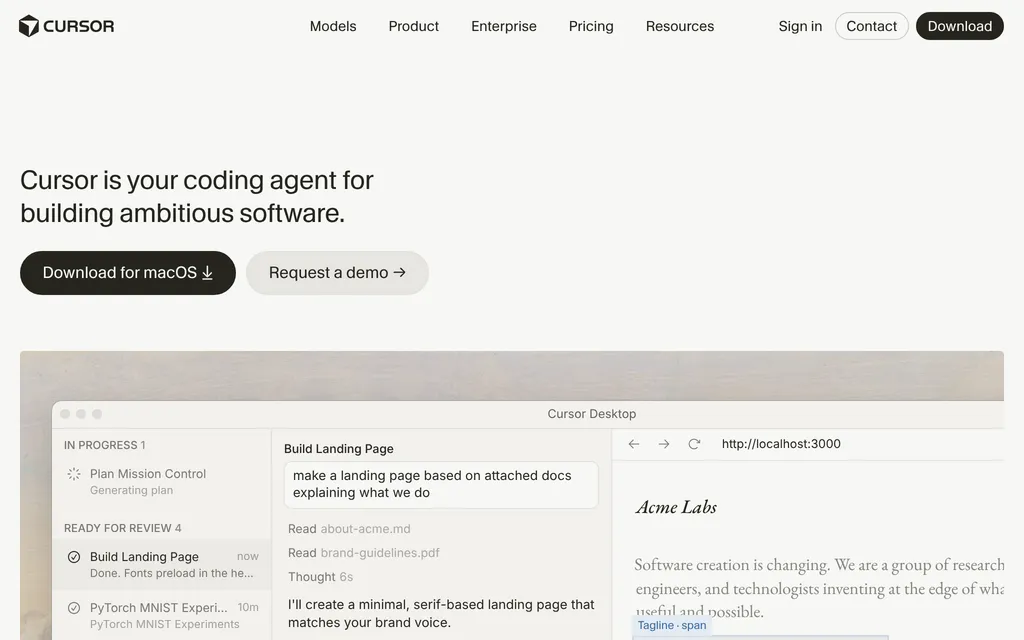
AI code editor with parallel cloud agents, sold in The X Subscription from $8
OpenAI's coding agent for CLI, IDE, ChatGPT app and cloud, from $20 a month