Next.js and Astro single-product store with a model picker and checkout UI
Spaziobianco
Editorial Astro theme for fintech and API products, with a fees page
PaidTemplates
lexingtonthemes.comExplore the product
AT A GLANCE
- Website
- lexingtonthemes.com
- Pricing
- Paid
- Categories
- Templates
- Listed
- Mar 2023
- Updated
- Oct 2026
Details about Spaziobianco
KEY POINTS
- Tailwind CSS v4
Short verdict: Spaziobianco is the most distinctive of Lexington's calm SaaS themes: serif headings on warm paper, a dithered pink and periwinkle shader, and pages written for a banking API, from a per-transaction fees page to a developers page with six SDK samples and a working API code switcher. It is also the cheapest of the three to run: its small, pixelated shader barely registered in our tests, and Lighthouse scored 97 to 100 for performance. The gaps: the forms post to the page itself, which a static host answers with an error, every page carries placeholder SEO tags, and the home page's heading order is broken. It suits fintech, payments and API companies; anyone outside finance will rewrite nearly every sentence.
How we reviewed it: On 30 October 2026 we went through the live Astro demo in headless Chromium at 1280 px and at 390 px phone width, crawled all 51 pages, submitted the contact, chat, newsletter, sign-in and sign-up forms while logging network requests, drove the API tabs with mouse and keyboard, measured what the shader costs the browser and ran Lighthouse 12.8.2 on the home and fees pages. We did not buy the theme, so we could not read the source code or test the Sanity and EmDash editions, which have no demo. Prices, editions and license terms come from Lexington Themes on the same day.
Disclosure: Our links to Lexington Themes carry a referral tag.
What you get for $89
| Price | $89 one-time for the Astro edition; the Sanity or EmDash edition costs $129. Lexington Themes Full Access Personal costs $99 one-time (shown as 50% off $198) and includes all 53 Astro themes, so $10 more buys Spaziobianco and every other theme. |
|---|---|
| Editions | Astro; Astro + Sanity (the same design wired to Sanity with live preview editing); Astro + EmDash (the admin built in, deployed to Cloudflare Workers), per Lexington. |
| Version | Astro 7.4.1 and Tailwind CSS 4.3.3, per Lexington; the demo's stylesheet confirms Tailwind 4.3.3. Released October 2022, rebuilt in March 2025 and redesigned on 15 October 2026 (see the changelog). |
| Size | Ten static pages and seven content collections, per Lexington. The demo's sitemap lists 50 URLs, including 6 integrations, 6 customer stories, 5 job openings, 4 help center topics, 4 blog posts, 3 changelog releases, 2 legal pages and 5 style-guide pages. |
| Stack | Astro and Tailwind CSS v4, Lenis smooth scrolling and a hand-written WebGL shader; the rest is vanilla JavaScript, with no Alpine.js or React in the demo. STIX Two Text and Geist Mono come from Google Fonts, Switzer from Fontshare. |
| Delivery | A private GitHub repository through Polar.sh, to fork or download. Lexington's setup guide still says Node.js 20 or later, but Astro 7.4 requires 22.22 or newer. It builds to static files for Netlify, Vercel or any static host. Comes with AGENTS.md, a design skill for Cursor, Claude Code and Codex, and Cursor rules. No Figma file. |
| License | Unlimited sites for yourself and for clients, including white-label work. No reselling it as a template and no using it as the core UI of a site builder. Refunds only if the theme differs materially from the demo, or if you have not accessed the repository within 14 days. License terms |
What we found in the demo
A banking API's website, start to finish
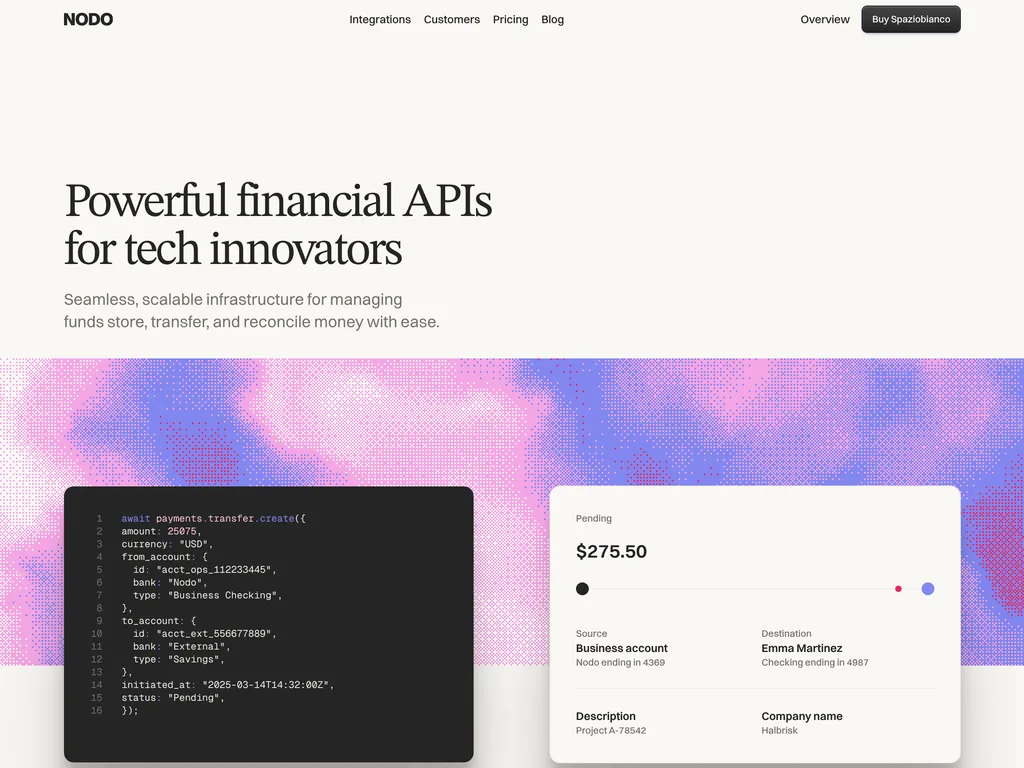
The sample company is Nodo, a fictional US banking API for ACH, wires, FedNow, cards and checks. The home page opens with a code sample next to a transfer card that flips from Pending to Processed after about three seconds, then runs through eight product tiles, a scrolling ticker of Fed transfers, a five-step settlement timeline, compliance tools, a comparison with "others", a customer quote and a fees teaser. Around it sit a security page with eight controls and SOC 2, PCI DSS and Nacha badges, a status page with ten components in operational, degraded and maintenance states, an about page with the leadership team, five job openings with salary ranges, a help center of question lists, a changelog with version numbers and a blog with author bylines. It is the most finance-specific copy of the three themes we tested, which helps a payments company and means a full rewrite for anyone else.
API tabs and a developers page
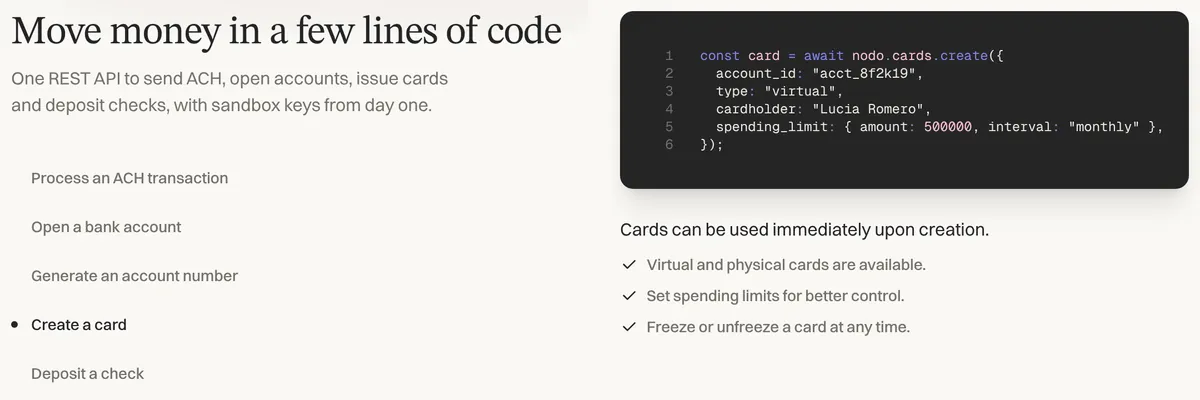
The home and developers pages share a code panel with five tabs, from "Process an ACH transaction" to "Deposit a check". They are real tabs: clicking one, or pressing the arrow keys, swaps the code and the three notes beside it, and the selected state is announced to screen readers. The developers page adds a three-step quick start and six SDKs (Node.js, Python, Ruby, Go, Java and PHP) with version numbers and install commands, all sample values.
Fees instead of plans
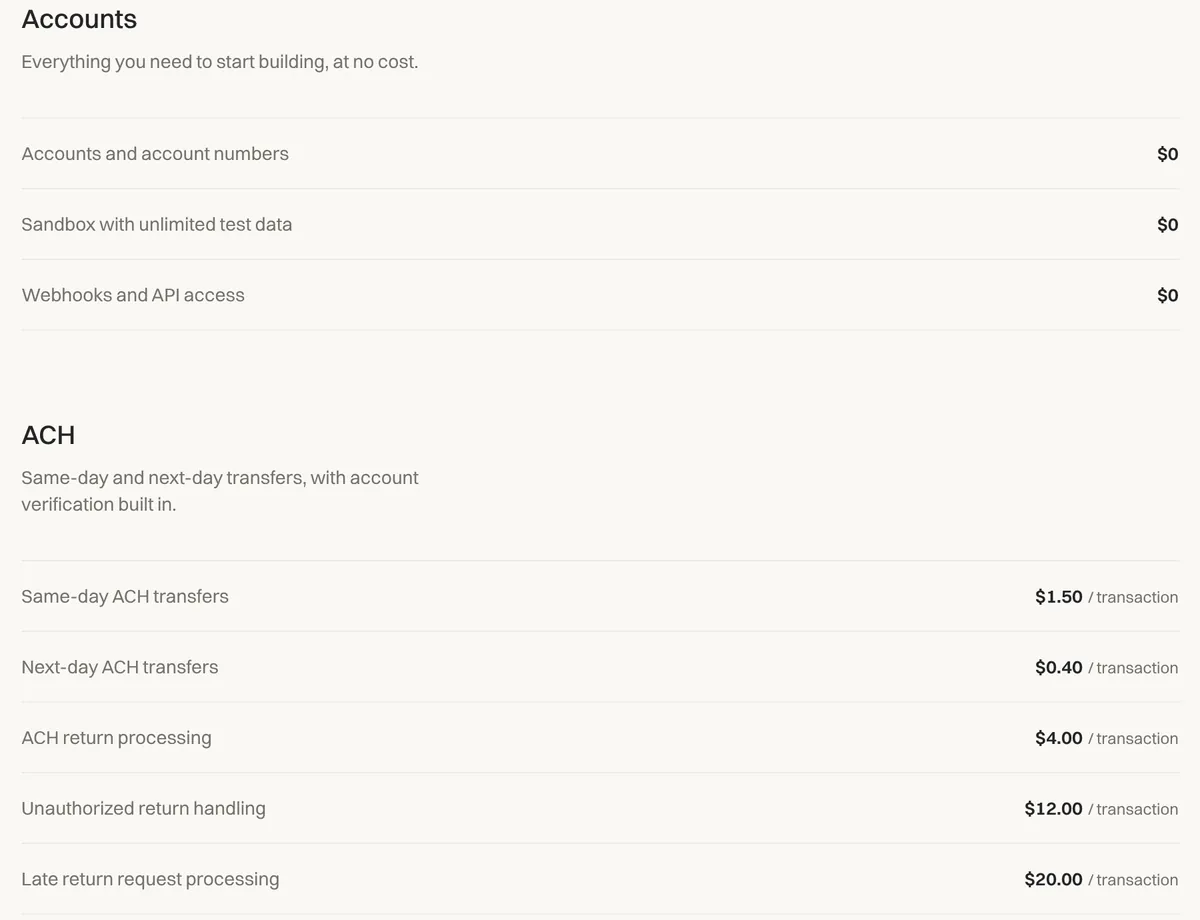
The pricing page lists 17 per-transaction fees in four groups: accounts at $0, ACH from $0.40 to $20, wires from $5 to $25 and checks from $2 to $20, followed by a six-question FAQ and a "Contact sales" button. That fits a usage-based API. If you sell seats or plans, you will design a tier page yourself, as Spaziobianco has none.
Integrations and customer stories
Six integrations, with invented names and .test websites, each get a page with what syncs, setup steps and a connector card that shows the shader, the permissions requested and a Connect button that does nothing. The six customer stories each lead with three numbered results, then the industry, headquarters, team size, products used and a quote.
Forms that end on an error page
The contact, sign-in and sign-up forms use method="POST" with action="#", so they send what you typed to the page's own address. Cloudflare Pages, which hosts the demo, answered each one with 405 Method Not Allowed and a blank page. On sign-up, "Sign up with Google" is also a submit button and posts the email the same way. The blog newsletter field and the chat bubble on the contact page ("Typically replies under 1 hour") have no field names, so they reload the page and send nothing. Sample addresses use the reserved .test domain, but the contact page lists street addresses in Milan, Stockholm and Madrid to replace.
The lightest shader of the three
The dithered shader renders at half resolution with deliberately chunky pixels, caps itself at 30 frames a second, starts only when it nears the screen, pauses offscreen and draws a still frame under reduced motion. Its four colors come from the CSS tokens, so it follows a rebrand. At phone size the hero band is 224 px tall, and in our headless Chromium it kept the main thread busy about a tenth of the time, where Navy's and Brightlight's shaders kept it busy almost all of the time. Without WebGL the band simply disappears and the page still reads well.
Performance and SEO
One Lighthouse 12.8.2 run per page, 30 October 2026:
| Page | Performance | Accessibility | Best practices | SEO |
|---|---|---|---|---|
| Home, mobile | 99 | 99 | 96 | 100 |
| Home, desktop | 98 | 99 | 96 | 100 |
| Fees, mobile | 97 | 100 | 96 | 100 |
| Fees, desktop | 100 | 100 | 96 | 100 |
The home page transferred 167 KiB in 19 requests and painted its largest element, the hero code block, at 1.3 s on mobile. Fonts are 108 KiB of that, loaded from Google Fonts and Fontshare; self-hosting them would remove the third-party requests. Accessibility lost a point for heading order: the transfer card uses h4 headings right after the h1, the section titles are h3, and "Fees" near the bottom is the page's only h2. Best practices lost points for six favicon and manifest files that return 404. Lexington reports 98, 99, 100 and 95.
SEO scores 100 because every page has a title, a description and a canonical link, but they are placeholders: all 51 pages share the title "Your Page Title", the description "A detailed description of your page content." and the canonical URL https://yoursite.com/current-page. The sitemap and RSS feed point at yourdomain.com, and no page outputs structured data.
What you still have to build
Form handling. Point the contact, newsletter and chat forms at a form service or your API, and add field names where they are missing.
Accounts. Sign-in, sign-up and Google sign-in are screens only, and there is no password reset page.
Page metadata. A title, description, canonical URL and social image per page, plus your domain in the Astro config so the sitemap and RSS use it, and a fixed heading order on the home page.
Your own claims. FDIC-insured balances, PCI DSS Level 1, SOC 2 Type II, "$38B moved last year" and the customer results are sample copy, and in finance they have to be true before launch.
Live status and chat. The status page and the chat bubble are static; connect them or remove them.
Clean-up. Remove the "Buy Spaziobianco" and "Overview" menu links and the style-guide pages (they are in the sitemap), and add favicons.
Pros and cons
Pros
Pages and copy written for fintech and API products: fees, developers, security, status and careers.
Keyboard-accessible API tabs and detailed integration and customer pages.
The fastest of the three in our runs (97 to 100 for performance) and a shader that stays cheap and follows the color tokens.
A distinctive editorial look that does not resemble the usual SaaS template.
Cons
Forms post to themselves and end on a 405 error page on static hosts; the newsletter and chat fields send nothing.
The same placeholder title, description and canonical URL on every page.
The copy is tied to US banking (FedACH, Fedwire, FedNow, Nacha), so other products need a full rewrite.
No plan or tier pricing page, and the redesign removed blog tags and search.
How Spaziobianco compares
Navy ($89, same maker, tested the same day) suits monitoring and developer tools: four pricing tiers with a 16-row comparison table and a status page with 90-day uptime bars. Its gradient is heavier to run, and its forms reload the page instead of failing.
Brightlight ($89, same maker) targets invoicing and billing apps, with euro plans behind a monthly and yearly switch, a mega menu and nine shader palettes.
Finzo by Get Astro Themes ($79) is a finance and banking Astro theme with 15 pages, a mega menu and three form integrations; its contact form provider is a setting in
config.toml(FormSubmit by default), per Get Astro Themes. Choose it if working forms matter more than an API-first story.
Browse all templates for more options.
Who should buy Spaziobianco
Buy Spaziobianco if you are building a payments, banking-as-a-service or developer-first fintech product, want a site that looks considered rather than generic, and have a developer to connect forms and fill in real metadata. Look elsewhere if your product is not financial, if you sell plans rather than usage, or if you need a docs section or a dark design.
FAQ
Do Spaziobianco's forms work on a static host?
No. In the demo the contact, sign-in and sign-up forms post to their own page, which Cloudflare Pages answers with a 405 error and a blank page, and the newsletter and chat fields have no names. You connect them to a form service or your own backend.
Should I buy Spaziobianco alone or Lexington Full Access?
Full Access Personal is usually the better buy. Spaziobianco alone costs $89, while Full Access Personal costs $99 one-time (shown as 50% off $198) and includes Spaziobianco plus all 53 Lexington Astro themes and future ones.
Can I use Spaziobianco for client projects?
Yes. Lexington's license allows unlimited websites for yourself and for clients, including commercial and white-label work. You can't resell it as a template or use it as the core UI of a site builder.
Does Spaziobianco include a CMS?
Not the $89 Astro edition, which keeps content in Markdown content collections. The Sanity and EmDash editions cost $129 each; they have no public demo, so we could not test them.
Get new templates like Spaziobianco weekly
Every Monday: the templates, components and tools added to Tailkits that week, each checked by an editor. Free, unsubscribe in one click.
15 new in the last 30 days311 products reviewed so farSee what you get
KEEP EXPLORING
More templates