AI app builder with a built-in backend and two-way Git sync; Pro from $25/month
Rork
AI app builder for native Swift and Kotlin apps, with App Store publishing
FreemiumAI App Builders
rork.comExplore the product
AT A GLANCE
- Website
- rork.com
- Pricing
- Freemium
- Categories
- AI App Builders
- Listed
- Sep 2026
- Updated
- Oct 2026
Details about Rork
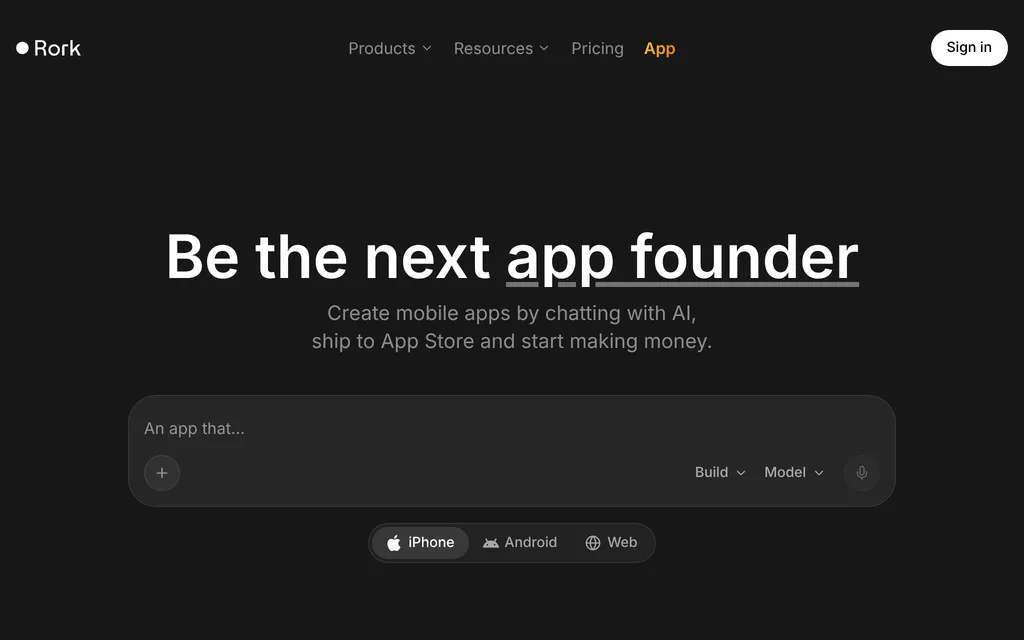
Short verdict: Rork is a chat-based mobile app builder that now writes native iPhone apps in Swift, native Android apps in Kotlin and web apps in React; it used to generate Expo (React Native) apps, and new Expo projects can no longer be created. It runs your app on a cloud iOS simulator or Android emulator in the browser and can send builds to TestFlight, the App Store and Google Play without a Mac. The catches are a free plan that only designs screens, 100 credits a month on the $20 Pro plan that also pay for simulator minutes and iOS builds, and separate iOS and Android codebases that can drift. It suits founders and non-developers shipping a first app to the stores, not teams that want one shared React Native codebase.
How we reviewed it: We did not sign up for Rork or build an app. On 21 October 2026 we read rork.com and its pricing, Max and FAQ pages, Rork's documentation on plans, credits, platforms and backends, the changelog, the privacy policy, the terms and Rork's GitHub organization. Where the FAQ page and the documentation disagree, we follow the documentation; check the Rork plans page before you pay.
What Rork costs and includes
| Item | Rork on 21 October 2026 |
|---|---|
| Type | App builder (prompt to published mobile app) from Rork, Inc. in San Francisco |
| Where it runs | Web app at rork.com with a cloud iOS simulator and Android emulator; the Rork Max iPhone app, installed from a browser over USB rather than from the App Store; two-way GitHub sync on paid plans |
| What it builds | Swift and SwiftUI for iPhone (plus iPad, Apple Watch and Vision Pro on Max), Kotlin and Jetpack Compose for Android, React and Vite for the web; existing Expo projects still build and publish |
| Models | A model picker that includes GPT-6.1 Sol, GPT-6 Astra, Claude Opus 5.5 and Claude Sonnet 5.5 on Pro and Max; no bring-your-own-key option documented |
| Free tier | $0, Design mode only (screens, not a working app): 5 credits a day and up to 35 a month in major markets, 5 a month elsewhere |
| Paid plans | Pro $20 a month: Build mode, 100 credits, iPhone, Android and web apps, email support. Max from $200 a month for 1,000 credits up to $1,800 for 10,000: adds iPad, Apple Watch, Vision Pro, native games, iOS widgets and priority chat support |
| How usage is limited | Credits, roughly one request each, reset monthly on your purchase date; the iOS simulator costs 0.2 credits a minute and the Android emulator 0.1; your live app's AI features use separate Cloud credits in dollars |
| Open source | No; you own the generated code, and Rork open-sources developer tools such as an App Store Connect CLI (MIT, about 8,000 GitHub stars) |
| Data use | The privacy policy says prompts and code are used to generate, host, preview and publish your projects and are not sold or shared; it does not mention model training either way |
| Latest notable release | The move from Expo to native Swift and Kotlin (no date given); newest model, GPT-6.1 Sol, added on 29 September 2026 |
From Expo to native: what Rork builds now
Swift for iPhone, Kotlin for Android
Rork's documentation says its agent wrote better Swift apps than React Native apps in internal benchmarks, so it switched. One project can hold all three: you start with one platform and add another from a menu above the preview, and the agent recreates the screens, navigation, data flows and design. The apps share one backend and one chat, but they are two codebases, and Rork's own page warns that "the two apps can still drift". Existing Expo projects keep working, and Rork offers to rebuild them in SwiftUI.
A real simulator and store submission without a Mac
Swift apps run on a cloud iOS simulator streamed to the browser. When an app is ready, Rork builds it on its own machines and submits it to TestFlight and the App Store; for Android it signs the App Bundle and sends the release to Google Play. You still need your own Apple and Google Play developer accounts, and Google requires new personal accounts to run a closed test with 12 testers for 14 days first. To test on your own iPhone, Rork offers a browser installer and a free companion app.
Backend, payments and store tools
Rork Cloud, a hosted database with authentication and server-side functions, is in beta and free while it is. You can connect your own Supabase or Firebase project instead, add in-app purchases through a built-in RevenueCat integration, and add hosted AI features such as chat, voice and image generation without API keys on paid plans. Store tools include an AI App Store Reviewer that checks a build against Apple's review guidelines, a Screenshot Studio and drafted replies to App Store reviews.
Credits and caveats
Free only designs. Design mode proposes screens; building, testing and publishing an app need Pro or Max.
Credits cover machines too. Pro's 100 credits a month also pay for iOS builds and simulator time at 0.2 credits a minute; Max scales from 1,000 credits for $200 to 10,000 for $1,800.
A second meter for live apps. AI features such as chat, images and voice, plus web search and media generation, in your finished app spend Cloud credits, a dollar balance with $1 free and top-ups of $5 to $200.
The FAQ page is out of date. rork.com/faq still says Pro uses React Native and Expo, quotes plans "ranging from $25 to $200+" and says extra credits cannot be bought; the documentation and pricing page say Pro costs $20, builds Swift, Kotlin and web apps, and that Max users can top up credits.
A sideloaded phone app. The Rork Max iPhone app is not on the App Store: it is installed over USB from a browser with your Apple ID and Developer Mode turned on.
Little on data handling. The privacy policy, updated 19 October 2026, neither lists model training as a use of your code nor promises not to train, and we found no zero data retention or SOC 2 statement.
Pros and cons
Pros
Native Swift and Kotlin output rather than web views.
Cloud iOS simulator, Android emulator and store submission without a Mac or Xcode.
One project for iPhone, Android and web, with a shared backend and chat.
Built-in RevenueCat payments and App Store review tools.
Cons
The free plan cannot build a working app.
Pro's 100 credits a month also pay for builds and simulator minutes.
iOS and Android are separate codebases that can drift.
Public FAQ, docs and pricing disagree, and the privacy policy is silent on training.
How Rork compares
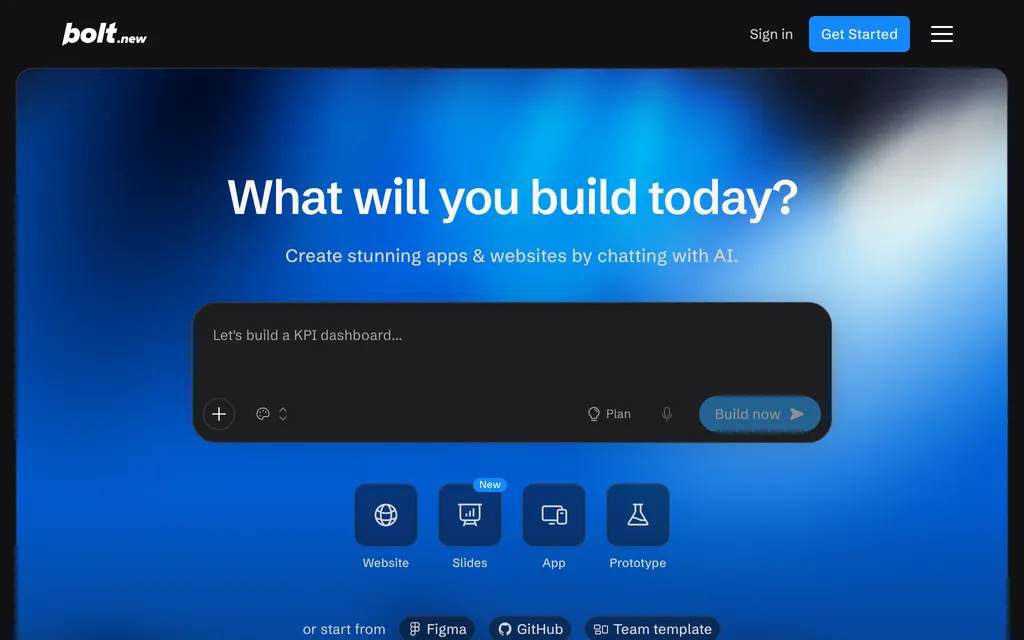
Bolt.new still builds mobile apps with Expo, one React Native codebase for iPhone and Android, with App Store and Google Play releases through EAS; its free plan includes 1 million tokens a month. Choose it for one shared codebase and a free plan that builds.
Replit is a cloud development environment for many languages that also builds native iOS apps and uploads them to TestFlight; Core costs $20 a month with $20 of credits. Choose it if your app needs a backend beyond JavaScript or you want one tool for web and mobile work.
Google AI Studio builds native Android apps in Kotlin and Jetpack Compose for free within Gemini's limits, with a browser emulator and Play test-track publishing, but no iOS apps. Choose it to try an Android idea before paying for Rork.
Compare more vibe coding platforms in all AI app builders.
Who should use Rork
Rork suits founders, marketers and other non-developers who want a native iPhone or Android app in the stores and are willing to pay $20 a month or more to get there, along with indie developers who want Swift or Kotlin code they can sync to GitHub and finish in Xcode. Look elsewhere if you want one shared React Native codebase, need a working app on a free plan, or must document how your code is used for model training.
FAQ
Is Rork free?
Only for designing. The Free plan's Design mode proposes screens with 5 credits a day (up to 35 a month in major markets), but building, testing and publishing a working app needs Rork Pro at $20 a month or Rork Max from $200 a month, as of 21 October 2026.
Does Rork still use React Native and Expo?
Not for new projects. Rork's documentation says you can no longer create Expo projects: new iPhone apps are Swift, new Android apps are Kotlin and new web apps are React. Existing Expo projects still build, publish and sync to GitHub, and Rork offers to rebuild them in SwiftUI.
Can Rork publish to the App Store and Google Play?
Yes. Rork builds iPhone apps on its own machines and submits them to TestFlight and the App Store, and for Android it signs the App Bundle and sends the release to Google Play. You need your own Apple Developer and Google Play developer accounts.
Do I own the code Rork generates?
Yes. Rork's terms say you keep all rights to the apps and content you create, and paid plans can sync the code to GitHub in both directions so you can continue in Xcode, Cursor, VS Code or another editor.
KEEP EXPLORING
More AI app builders