AI app builder with a built-in backend and two-way Git sync; Pro from $25/month
Bolt.new
In-browser AI app builder with hosting and a database; Pro from $25 a month
FreemiumAI App Builders
bolt.newExplore the product
AT A GLANCE
- Website
- bolt.new
- Pricing
- Freemium
- Categories
- AI App Builders
- Listed
- Sep 2026
- Updated
- Oct 2026
Details about Bolt.new
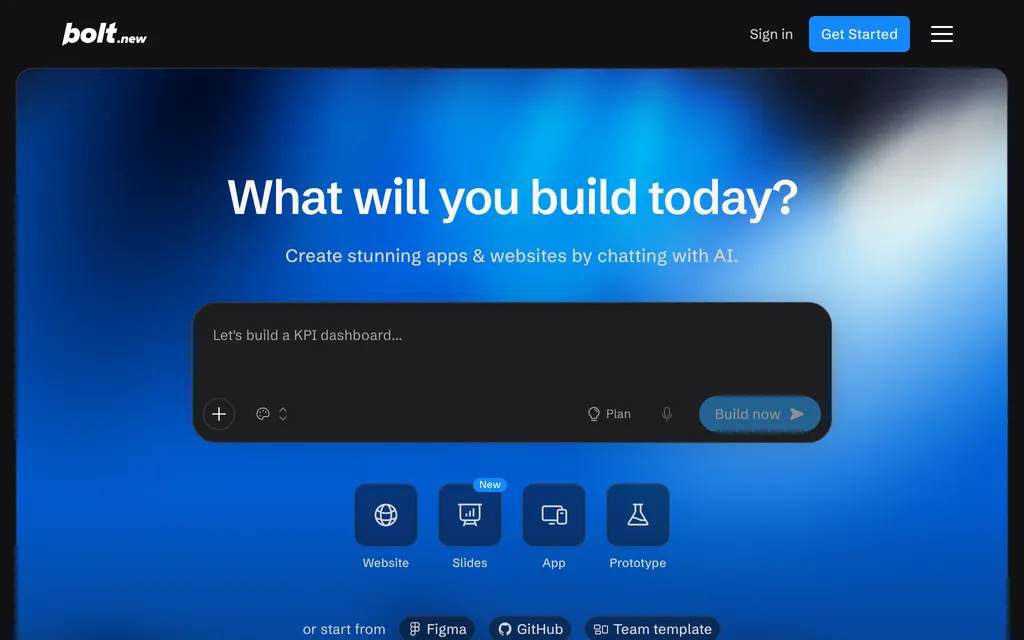
Short verdict: Bolt.new is StackBlitz's prompt-to-app builder: it runs a Node.js development environment inside your browser, writes the code with its Standard and Max agents, and publishes the result to its own hosting with a built-in database, sign-in and custom domains. Nothing needs installing, and you can edit the code by hand without spending tokens. The catch is the cost per message: most tokens go to syncing your project files to the model, so bigger projects burn tokens faster, and since 7 October 2026 your projects and chats are used for model training by default unless you switch it off. It suits founders, marketers and front-end developers building JavaScript web apps, sites and Expo mobile apps; teams that need a Python or PHP backend should look elsewhere.
How we reviewed it: We did not sign up for Bolt.new or send it a prompt. On 21 October 2026 we read the pricing page (monthly and yearly), the help center on tokens, billing, agents, Bolt Cloud, hosting, security and Expo, the release notes and the StackBlitz privacy policy, and looked at the 2024 code on GitHub. Plans and limits change often; check the pricing page before you pay.
What Bolt.new costs and includes
| Item | Bolt.new on 21 October 2026 |
|---|---|
| Type | App builder (prompt to deployed app) by StackBlitz, announced at ViteConf in October 2024 |
| Where it runs | In the browser: Chrome and other Chromium browsers, and Safari with a read-only code view and no terminal. Mobile browsers can prompt, preview, publish and restore versions. No API, CLI or SDK. |
| Models | A Standard agent (all plans) and a Max agent (paid plans); Bolt picks the model behind each. Its release notes list Anthropic's Claude Haiku 4.5, Sonnet 4.6 and Opus 4.6 and 4.7 before the switch to agents in May 2026. No bring-your-own key. |
| Free tier | 1M tokens a month, capped at 300K a day; public and private projects; unlimited databases; hosting on a bolt.host address with a "Made in Bolt" badge; no custom domain |
| Paid plans | Pro $25 a month, or $18 a month billed yearly, for 10M tokens, with bigger tiers on a token slider (for example $50 for 26M and $100 for 55M); Teams $30 per member a month, or $27 billed yearly; Enterprise custom, billed by consumption. Bolt pricing |
| How usage is limited | Tokens, which StackBlitz says mostly go to syncing your files to the model. Paid tokens stay valid for 2 months; extra tokens can only be bought on the top monthly tier or a yearly plan. |
| Open source | Not the current product; the 2024 code is on GitHub under the MIT license (16.6k stars, last commit 17 December 2024) |
| Data use | Used for model training by default from 7 October 2026, except accounts in the EU, UK and Switzerland; a Model training setting turns it off |
| Latest notable release | Week of 12 October 2026: preview, publish, unpublish and restore versions from a phone. Release notes |
Where Bolt.new stands out
A Node.js environment in the browser tab
Bolt runs on WebContainers, StackBlitz's browser-based runtime, so the agent can install npm packages, run a dev server and use a terminal without a remote machine. You can open Code view and edit files yourself; per the help center, direct edits cost no tokens. Two-way GitHub sync commits every change, works with branches and imports existing repositories, with merges done on GitHub.
Hosting, database and sign-in included
Bolt Cloud publishes to a free bolt.host address or your own domain. Bolt creates a database when a project needs one, with no limit on how many: PostgreSQL with row-level security policies, email and Google sign-in, file storage, server functions, secrets and logs. Paid plans add site analytics and the option of Supabase instead, and Stripe handles payments.
Expo for the App Store and Google Play
Saying "mobile app" in the first prompt sets up an Expo project. You test it on a phone with Expo Go, then build and submit it with Expo Application Services to TestFlight, the App Store and Google Play; the Apple and Google developer accounts are paid and separate.
Checks before you publish
Plan Mode discusses a change without touching the code. On paid plans, a security audit in the Publish menu reviews the code and database and fixes most problems; Bolt says neither the audit nor its fixes use tokens, with up to 30 audits a day.
Token burn, training and other limits
Token cost grows with the project. StackBlitz says most token usage comes from syncing the project's file system to the model: "the larger the project, the more tokens used per message".
Rollover has conditions. Cancelling forfeits all allocated tokens, rollover included, when the billing period ends. Subscriptions are non-refundable, and a yearly plan can only be downgraded at its renewal date.
Hosting caps. Free sites get 10 GB of bandwidth and 333,333 requests a month and go offline when they reach either; paid plans raise that to 30 GB and 1M requests, with pay-as-you-go traffic above it up to a spending cap you set.
Training is opt-out. From 7 October 2026 the StackBlitz privacy policy lets it train models on Bolt prompts, outputs and project files and license de-identified datasets to other AI developers, including for payment, unless you opt out. Opting out does not undo models already trained.
JavaScript only. "Bolt only supports JavaScript-based backends, so languages such as PHP or Python aren't compatible," per the help center. An existing Bolt database also cannot be moved to Supabase later.
Pros and cons
Pros
Nothing to install: a Node.js runtime, terminal and editable code run in the browser, and hand edits cost no tokens.
Hosting, unlimited databases, sign-in, file storage and domains come with the plan instead of separate accounts.
An Expo route to TestFlight, the App Store and Google Play.
Token-free security audits on paid plans, plus Plan Mode before code changes.
Two-way GitHub sync, and StackBlitz says the code is yours to use commercially.
Cons
Each message costs more as the project grows, and the free plan stops at 300K tokens a day.
Model training is on by default outside the EU, UK and Switzerland.
Backends must be JavaScript; Python and PHP are not supported.
No refunds, rollover tokens are lost on cancel, and free sites go offline at the hosting cap.
No API, CLI or SDK for automation.
How Bolt.new compares
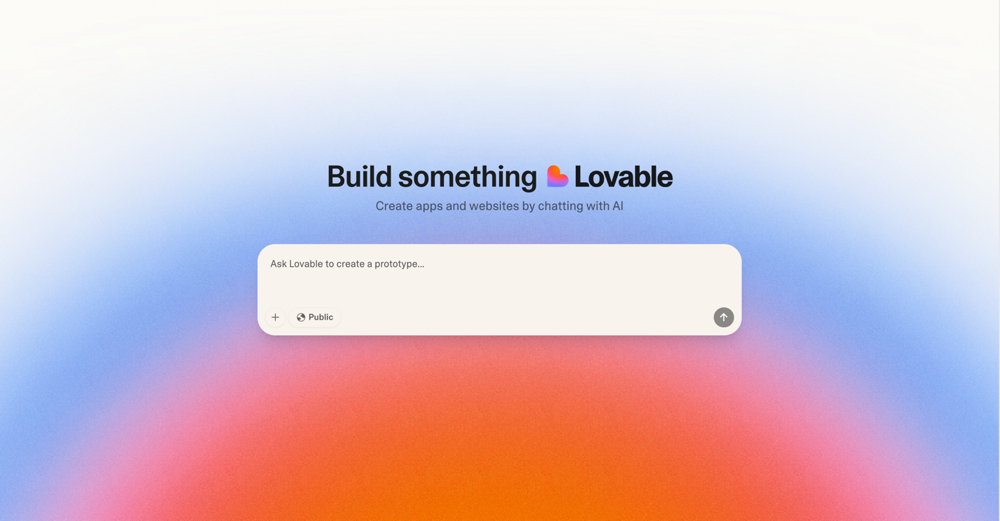
Lovable also hosts your app with a built-in Postgres backend, but it bills credits rather than tokens (Pro is $25 a month for 100 credits), runs a security scan on every publish and offers two-way Git sync on every plan, including Free. Choose it for web apps you want scanned and synced to Git from day one.
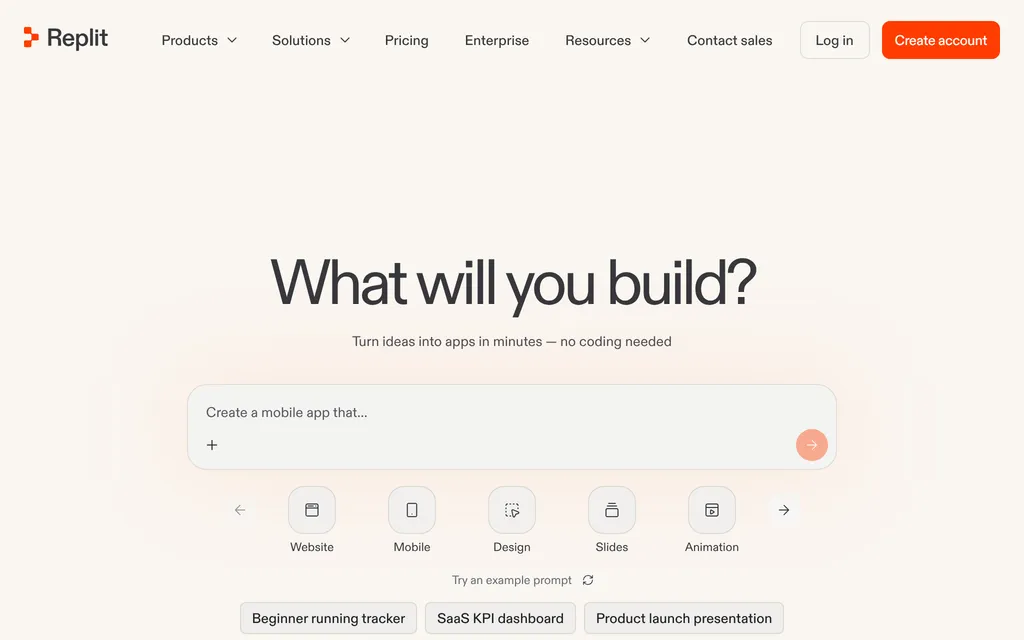
Replit is not limited to JavaScript and runs up to 10 background tasks in parallel on Pro; Core costs $20 a month with $20 of credits, billed by effort. Choose it if your backend needs Python or another language Bolt cannot run.
Rork builds native Swift and Kotlin apps instead of Expo projects and submits to TestFlight and the App Store without a Mac; Rork Pro costs $20 a month for 100 credits, and its free plan only designs screens. Choose it when a native mobile app is the goal.
Compare all AI app builders, or the coding agents in AI coding tools.
Who should use Bolt.new
Use Bolt.new if you want to go from a prompt to a hosted JavaScript app or an Expo mobile app without installing anything or wiring up separate hosting, database and auth accounts. Look elsewhere if your backend must be Python or PHP, if you need predictable costs on a large codebase, or if your company cannot accept model training as an opt-out default.
FAQ
Is Bolt.new free?
Yes. As of 21 October 2026 the Free plan includes 1M tokens a month, capped at 300K a day, public and private projects, unlimited databases and hosting on a bolt.host address with a Made in Bolt badge. Custom domains, removing the badge and the Max agent need Pro at $25 a month, or $18 a month billed yearly.
Does Bolt.new train AI models on my projects?
Yes, by default, for content created on or after 7 October 2026 in accounts outside the EU, UK and Switzerland. You can turn it off with the Model training setting in your account settings; StackBlitz's privacy policy also allows it to license de-identified datasets to other AI developers unless you opt out, and opting out does not undo models already trained.
Is Bolt.new open source?
No, the hosted product is closed source. StackBlitz published Bolt's 2024 code on GitHub under the MIT license, where it has 16.6k stars, but that repository has not changed since 17 December 2024 and is not the current product.
Can Bolt.new build mobile apps?
Yes, through Expo. Put the words mobile app in your first prompt so Bolt sets up an Expo project, test it on your phone with Expo Go, then build and submit it with Expo Application Services to TestFlight, the App Store and Google Play. You need your own paid Apple and Google developer accounts.
KEEP EXPLORING
More AI app builders