Next.js and Astro single-product store with a model picker and checkout UI
Munch
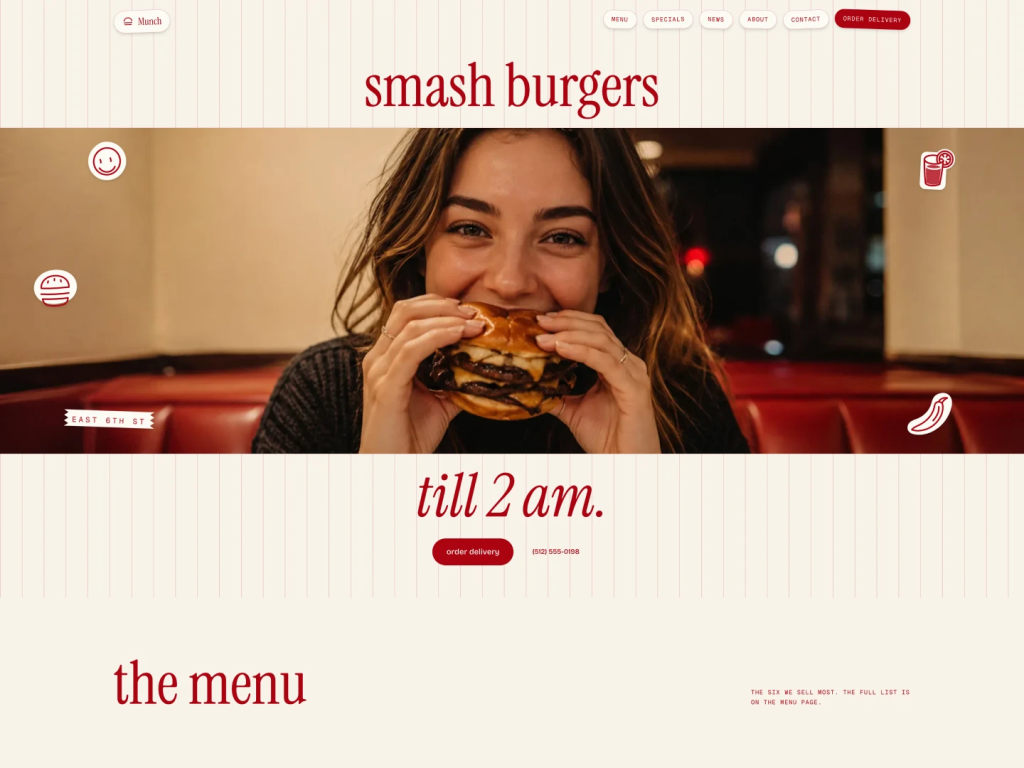
Next.js and Astro restaurant template with a nutrition menu and delivery cart
shadcnblocks.comExplore the product
AT A GLANCE
- Website
- shadcnblocks.com
- Pricing
- Paid
- Categories
- Templates
- Listed
- Aug 2026
- Updated
- Oct 2026
Details about Munch
KEY POINTS
- MDX support
- Copy & paste
- Tailwind CSS v4
Short verdict: Munch is a burger-bar template whose ordering flow already works in the browser: a 12-item menu with calories on the cards, a saved cart, a $12 minimum, a delivery form and a receipt. None of it is connected to anything: placing an order shows an order number and a 25–35 minute drop-off while sending no data. It suits a casual restaurant or takeout spot with a developer who will connect orders to the kitchen, a POS or an ordering service. Skip it if you need orders working on day one, or only a menu and opening hours.
How we reviewed it: On 21 October 2026 we used the live Next.js demo on a desktop (1440 px) and a 390 px phone screen, and repeated the order flow on the public Astro demo. We added items, reloaded, changed pages and placed orders while watching network requests and browser storage, then ran Lighthouse 12.8 on the home and menu pages. We did not buy the source code, so we can't judge code quality, the component count or setup. Prices, specs and license terms come from the Shadcnblocks site on the same day.
Disclosure: Shadcnblocks, the maker of Munch, sponsors Tailkits, and our links to it are affiliate links, so Tailkits may earn a commission if you buy through them.
What you get for $79
| Price | $79 one-time, including the Next.js and Astro editions. Also part of the Shadcnblocks Premium plan ($299 one-time, 21 templates). |
|---|---|
| Version | 1.0.0, released and last updated 26 August 2026 |
| Size | 15 pages and 40+ components, per Shadcnblocks. The demo's sitemap lists 14 URLs: home, menu, a news index with 7 posts, about, contact, privacy and terms. |
| Stack | Next.js 16 or Astro 7 with shadcn/ui, Tailwind CSS 4, TypeScript and MDX, per Shadcnblocks. The Astro edition adds content collections and a sitemap. |
| Demos | Both editions have a public demo; the Astro one matched the Next.js menu, cart and checkout in our test. |
| Deploys to | Vercel, Netlify and Cloudflare Pages, as tested by Shadcnblocks |
| License | Unlimited end products, including client sites, for one user (a Team license covers up to 10). You can't resell the template itself. License terms |
What we found in the demo
A 12-item menu with calories on the cards
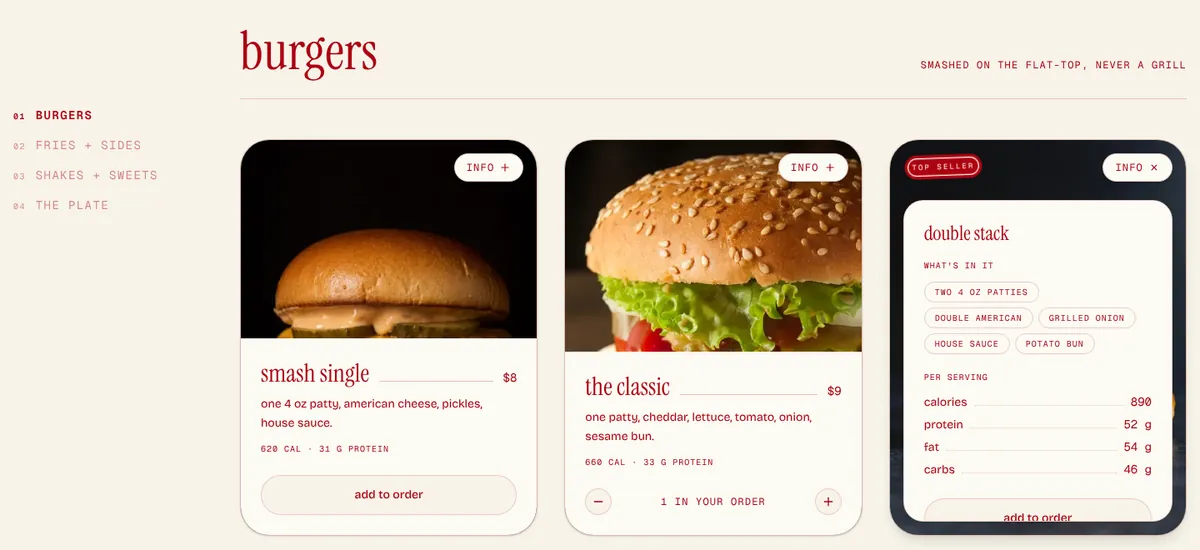
The menu page lists 12 items in four sections (6 burgers, 3 fries and sides, 2 shakes and sweets, 1 combo plate) priced from $4 to $18. Eleven of the 12 cards show calories and protein (the combo plate lists what comes in it instead), and the Info button opens the ingredients plus calories, protein, fat and carbs per serving. The home page previews six items but has no add buttons.
Cart, delivery form and receipt in one drawer
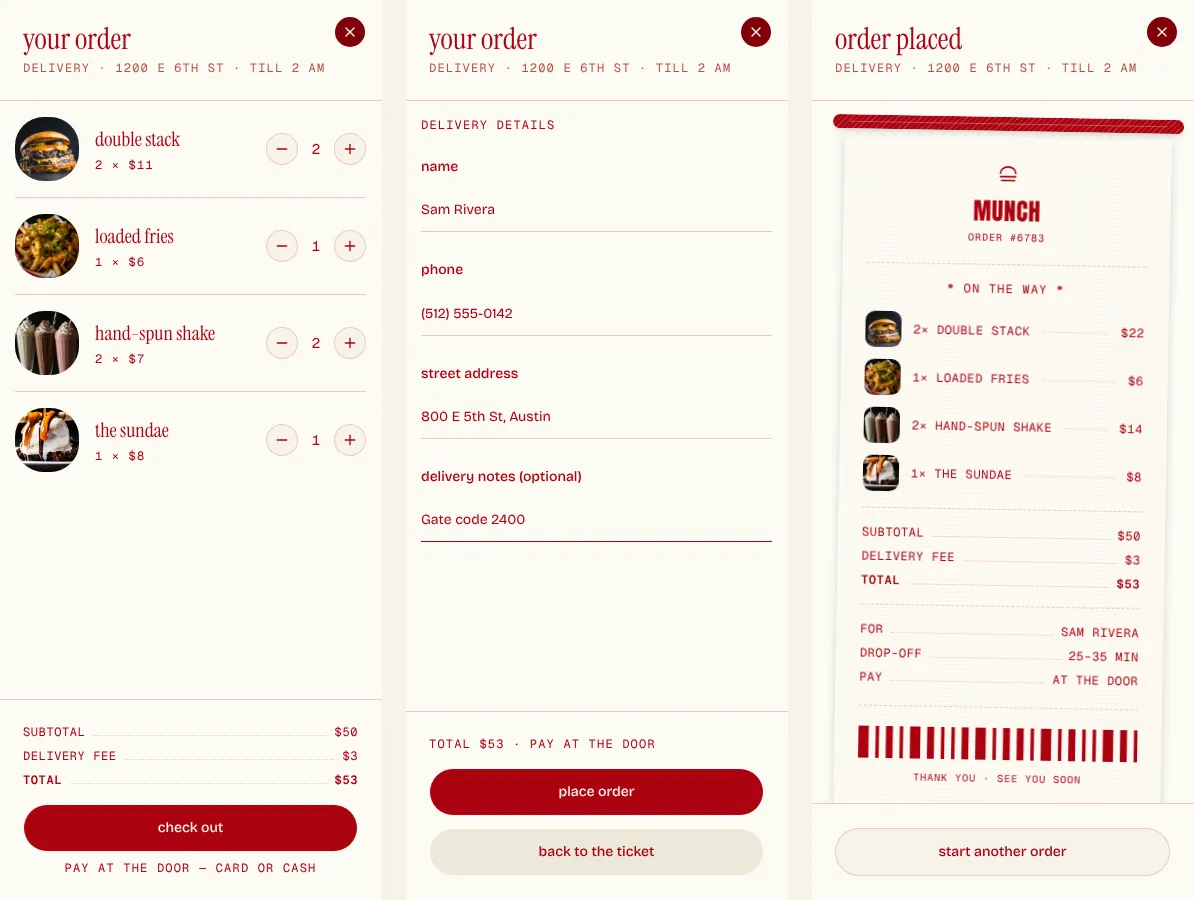
Add to order turns the button into a quantity stepper and the header's Order delivery button into a cart count. The cart is a slide-out drawer, not a page (/cart and /checkout return 404), saved in the browser under munch-cart: it survived a reload and followed us to other pages. It adds a flat $3 delivery fee and disables checkout below a $12 minimum ("add $4 more" for one $8 burger). Checkout asks for name, phone, address and optional notes; payment is "at the door, card or cash", with no card fields.
The receipt confirms an order nobody receives
Place order shows a receipt with an order number, "on the way" and a 25–35 minute drop-off, then empties the cart. In the network log the only request was for a thumbnail image, and the order number changed on every try. The form accepted "not a phone" as a phone number and a London address, despite the 4-mile delivery radius on the menu page. The newsletter form likewise shows "You're on the list" and sends nothing. Deployed as-is, the site would tell customers their food is coming.
A home page built on video
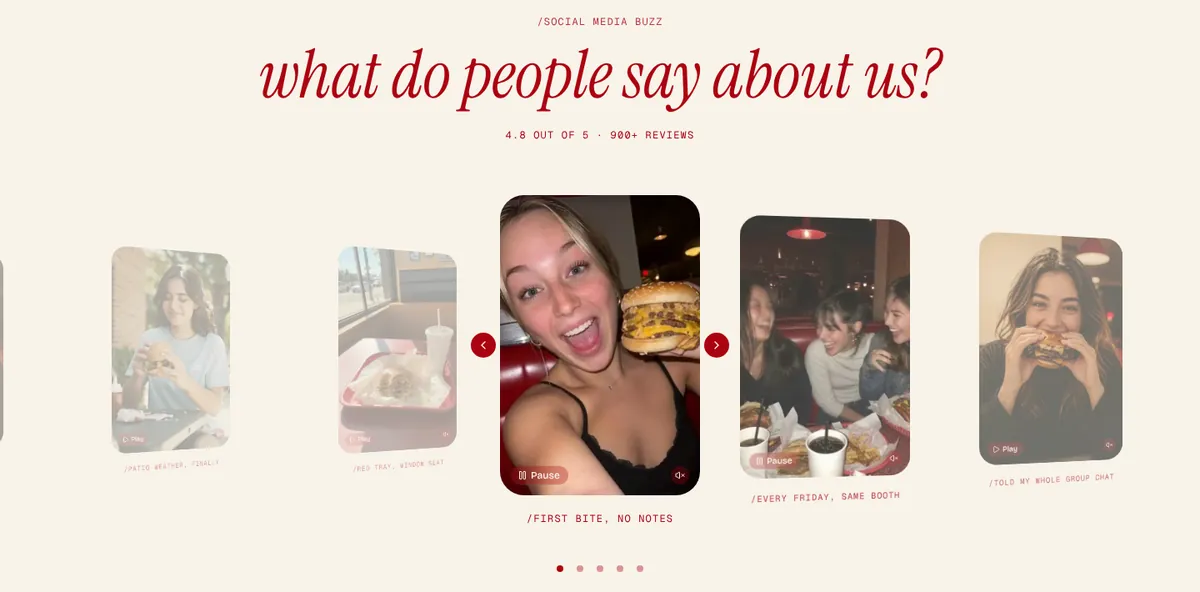
The home page has 12 video elements made from 6 muted, looping clips, 10 of them in a five-reel testimonial carousel under a sample "4.8 out of 5 · 900+ reviews" line. Around it sit a five-step "how it's built" section, a specials strip, an eating challenge ($39 tray, free if finished in 30 minutes), three news posts and opening hours.
Content pages and mobile
Seven news posts come with an index and article layout. About has a team section and a founder note; contact lists hours plus DoorDash, Uber Eats and Grubhub buttons that point at those sites' home pages. The sample copy disagrees with itself on when the beef is ground (at six, at 9 AM, at four, "every afternoon"), so plan to rewrite all of it.
At 390 px no page scrolled sideways, but the header shrinks to the logo and a Menu button, so the cart count only shows after opening the menu, and the drawer cuts item names to "double …".
Performance and SEO
One Lighthouse 12.8 run per page, 21 October 2026, on the Next.js demo:
| Page | Performance | Accessibility | Best practices | SEO |
|---|---|---|---|---|
| Home, mobile | 75 | 97 | 96 | 100 |
| Home, desktop | 98 | 97 | 100 | 100 |
| Menu, mobile | 93 | 96 | 96 | 100 |
| Menu, desktop | 99 | 96 | 100 | 100 |
On mobile the home page transfers about 3.5 MB, 2.8 MB of it video, and largest contentful paint (the hero photo) came in at 4.5 s; the menu page is about 0.6 MB with a 3.0 s LCP. Accessibility points went to contrast: the menu's inactive section links (2.47:1) and footer text (4.47:1, just under 4.5:1). Lighthouse also flagged small text: only 41% of the home page's text is 12 px or larger on mobile.
Each page has its own title, meta description and canonical URL, and there is a sitemap. None of the 8 page types has structured data, so add Restaurant markup with your address and hours before launch.
What you still have to build
Orders and signups. Send placed orders to the kitchen, a POS or an ordering service, and the newsletter form to an email service.
Payments. The demo only offers pay at the door; online payment needs a provider such as Stripe.
Delivery rules. Validate phones and addresses, check the radius, and set your own fee and minimum.
Content and claims. Replace the menu, photos, video testimonials, team and the 4.8 rating, and point the delivery-app and social links at real profiles.
Menu updates. Shadcnblocks lists no CMS for Munch, so price changes need a developer unless you add one.
Pros and cons
Pros
The whole ordering UI works in the browser: saved cart, quantity steppers, minimum order, delivery fee, checkout form and receipt.
Calories and protein on the menu cards, with a full nutrition panel one click away.
One $79 purchase covers two editions that both have public demos, and the license allows client work.
A light menu page: 93 for mobile performance at about 0.6 MB.
Cons
Place order and the newsletter report success without sending anything, which misleads customers if launched unchanged.
The video-heavy home page is slow on mobile in our run.
No structured data for a local business.
On phones the cart count hides in the menu and cart item names are cut off.
How Munch compares
Cuisine is a Themefisher restaurant template for Astro ($97, one project) with 7 pages including a menu. Its product page lists no cart or ordering; pick it for a menu-and-hours site.
Vercel Shop, which replaced Next.js Commerce, is free and takes real payments through Shopify's cart and checkout, but it is a general store with no restaurant menu. Pick it if paid online orders matter more than the design.
Shadcnblocks Premium ($299 one-time) includes Munch and 20 other templates. Worth it if you will use two or more of them.
See all company templates for more options.
Who should buy Munch
Buy it for a burger bar, takeout spot or casual restaurant that wants delivery orders on its own site and likes the bold red-and-cream look, with a developer to connect orders and payment. Look elsewhere if the restaurant takes orders through delivery apps and only needs a menu and hours, or if orders must work without development.
FAQ
Does Munch take real orders and payments?
No. The demo's cart and checkout run only in the browser: placing an order shows a receipt with an order number but sends no data, and payment is "at the door, card or cash". You connect orders to your kitchen, POS or an ordering service, and add a payment provider if you want online payment.
Do I get both the Next.js and Astro versions?
Yes. The $79 purchase includes both editions (Next.js 16 and Astro 7, per Shadcnblocks). Both have public demos, and the menu, cart and checkout worked the same in each when we tested them.
Can I use Munch for client projects?
Yes. The Shadcnblocks license allows unlimited end products, including sites your clients own. A standard license is for one person; the Team license covers up to 10 people. You can't resell the template itself.
Is Munch included in a Shadcnblocks plan?
Yes. The Premium plan ($299 one-time) includes Munch and 20 other premium templates.
Get new templates like Munch weekly
Every Monday: the templates, components and tools added to Tailkits that week, each checked by an editor. Free, unsubscribe in one click.
15 new in the last 30 days311 products reviewed so farSee what you get
KEEP EXPLORING
More templates