Next.js and Astro single-product store with a model picker and checkout UI
Hemingway
Astro magazine and podcast theme with a print-like layout and audio player
PaidTemplates
lexingtonthemes.comExplore the product
AT A GLANCE
- Website
- lexingtonthemes.com
- Pricing
- Paid
- Categories
- Templates
- Listed
- Mar 2023
- Updated
- Oct 2026
Details about Hemingway
KEY POINTS
- Tailwind CSS v4
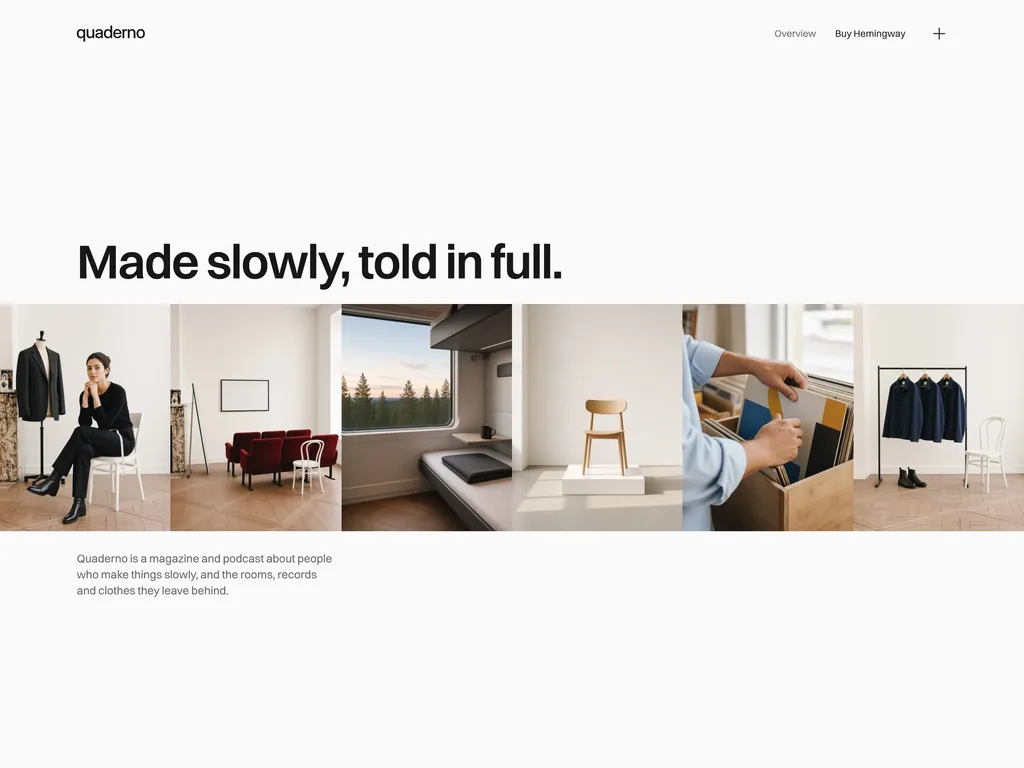
Short verdict: Hemingway gives a culture magazine and its podcast one calm, photo-led design: essays in index rows, episode pages with a working audio player, author and topic pages, and a membership page with three plans. Everything that earns money or keeps readers coming back is layout only: the paywall hides text with CSS, the forms send nothing, the podcast has no feed and there is no newsletter signup. Every page in the demo also shares one placeholder title and canonical link. Buy it if a developer will connect memberships and fix the metadata. Skip it if you need a working paywall, search or a podcast you can list in podcast apps on day one.
How we reviewed it: On 30 October 2026 we used the live Astro demo on a desktop screen and a 390 px phone screen. We crawled all 38 pages, played an episode, submitted every form with the network log running, and read the RSS feed, sitemap and page metadata. We ran Lighthouse 12.8.2 once on the home page and once on an essay. We did not buy the theme, so we can't judge the source code, and the Sanity and EmDash editions have no public demo. Prices and license terms come from Lexington Themes on the same day.
Disclosure: Our links to Lexington Themes carry a referral tag.
What you get for $89
| Price | $89 one-time for the Astro edition, $129 for the Sanity or EmDash edition. Lexington Themes Full Access Personal costs $99 (shown as 50% off $198) and includes all 53 Astro themes, so for $10 more you get Hemingway and every other theme. |
|---|---|
| Editions | Astro, Astro + Sanity ("the same designs wired to Sanity, with live preview editing") and Astro + EmDash (an admin built in, deployed to Cloudflare Workers), per Lexington. Only the Astro edition has a demo. |
| Version | Astro v7.4.1 and Tailwind CSS v4.3.3, per Lexington; the demo's CSS confirms Tailwind v4.3.3. Redesigned on 16 October 2026. |
| Size | Seven static pages and five content collections, per Lexington. The demo's sitemap lists 37 URLs, including 9 essays (3 for members), 4 episodes (1 for members), 3 authors, 5 topics and 5 style guide pages. |
| Stack | Astro, Tailwind CSS v4 with the Forms and Typography plugins, Lenis smooth scrolling, the Switzer font and two small vanilla scripts for the menu and the player. No Alpine.js. |
| Delivery and hosting | A private GitHub repository, bought through Polar.sh. It builds to static files for Netlify, Vercel or any static host. Lexington's setup guide still says Node.js 20 or later, but Astro 7.4 requires 22.22 or newer. No Figma file. |
| License | Unlimited sites for yourself and clients, commercial use without attribution, one seat per person. You can't resell or redistribute it as a template. License terms |
What we found in the demo
One design for essays, episodes and people
The demo is a fictional magazine called Quaderno. The home page opens on a headline over a strip of six photographs, then a full-width lead story, six essay rows, the latest episode with its player and a membership call. Every essay list uses the same index row: photograph, title, standfirst, author, topic and date. A plus button opens a menu with the five topics, the latest episode, the about pages and a featured essay; Escape or a click outside closes it.
Topic pages show tabs with counts (All 9, Fashion 2, Music 1 and so on) but list essays only. Author pages add a portrait, a bio and counts: Erik Lindqvist has 3 essays and 4 episodes hosted. Reading time is calculated from the text; the sample essays run 143 to 182 words, so each one says "1 min read". There is no search (removed in the redesign) and no pagination: the magazine index lists all 9 essays on one page. On a 390 px screen nothing scrolls sideways.
A podcast player with the basics, and no feed
Episode pages carry the number, date, length, host and topic, then show notes and quotes. The player has a play button, Back 15s and Forward 15s buttons, and an elapsed-time counter next to a length typed into the content ("0:00 of 42 min"). There is no progress bar, speed control or download link. Starting one player pauses any other, and the audio is set to preload="none", so nothing downloads until someone presses play.
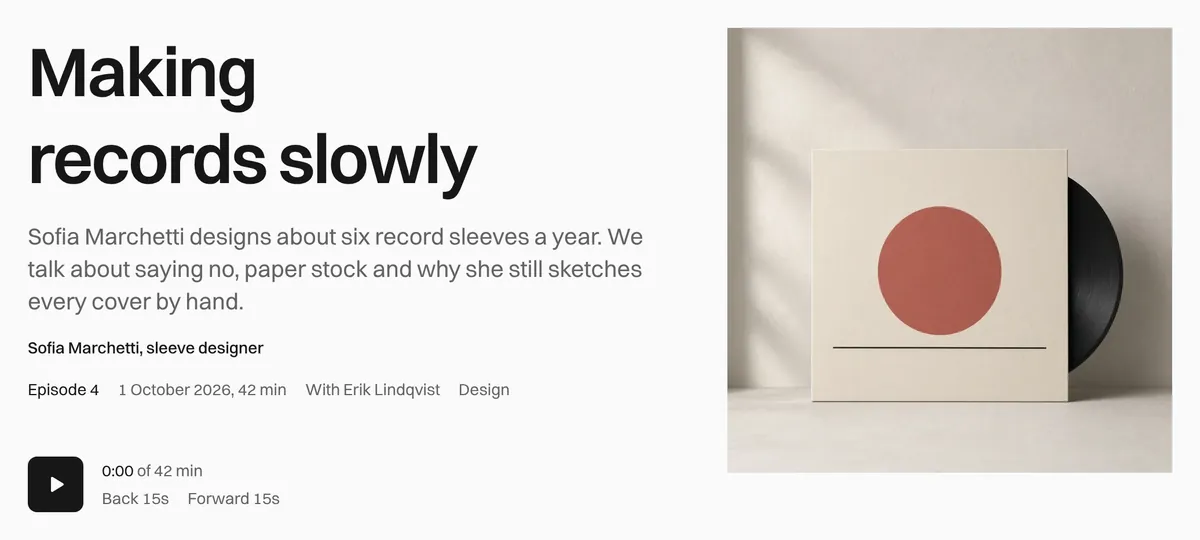
Two problems for a real show. All three public episodes and the home page play the same file, /audios/placeholder.mp3: a 13 MB track of 5 minutes 31 seconds whose ID3 tags identify it as Metallica's "Enter Sandman" (1991), converted with a Spotify downloader. Delete it before you deploy. And the Spotify, Apple Podcasts and "RSS feed" links on the podcast page point to #_, and the site's RSS feed lists the 9 essays with no episodes, audio enclosures or iTunes tags, so podcast apps have nothing to subscribe to.
A members gate that hides text with CSS
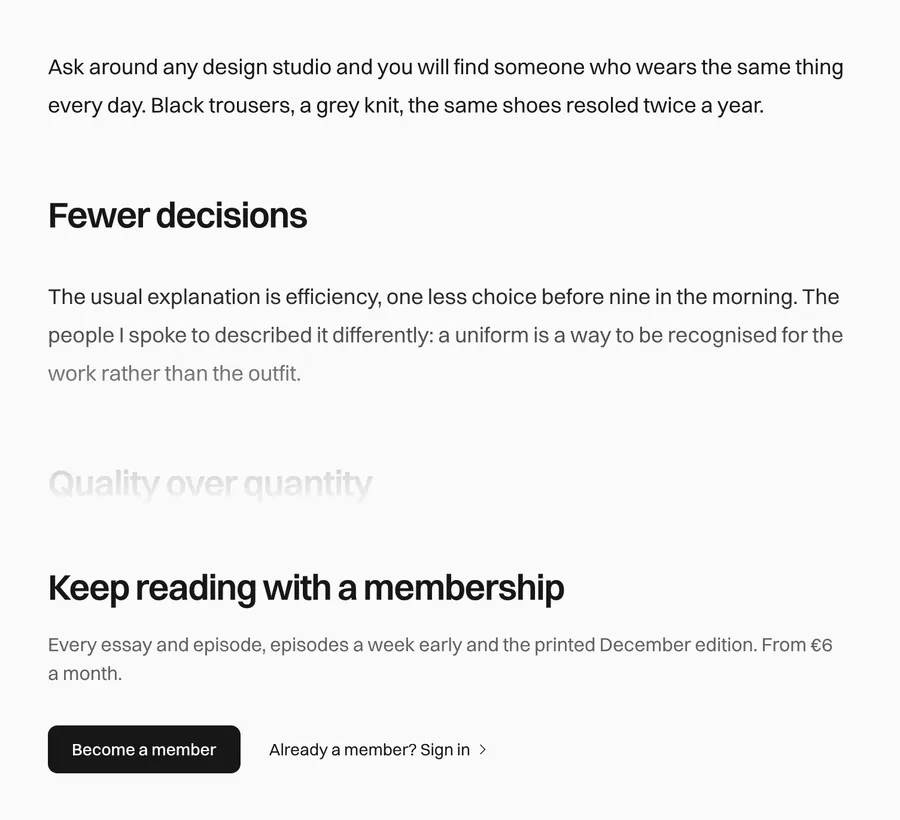
Members-only essays show their first section, which fades into a "Keep reading with a membership" box (from €6 a month). The fade is a fixed-height box with a gradient over it: the whole essay is in the page's HTML, so view-source, reader mode or a search engine sees all of it. The members-only episode does better: the player is left out and a "This conversation is for members" box takes its place, though the show notes stay visible. In both cases nothing checks who the reader is.
Membership, sign-up and contact are layouts
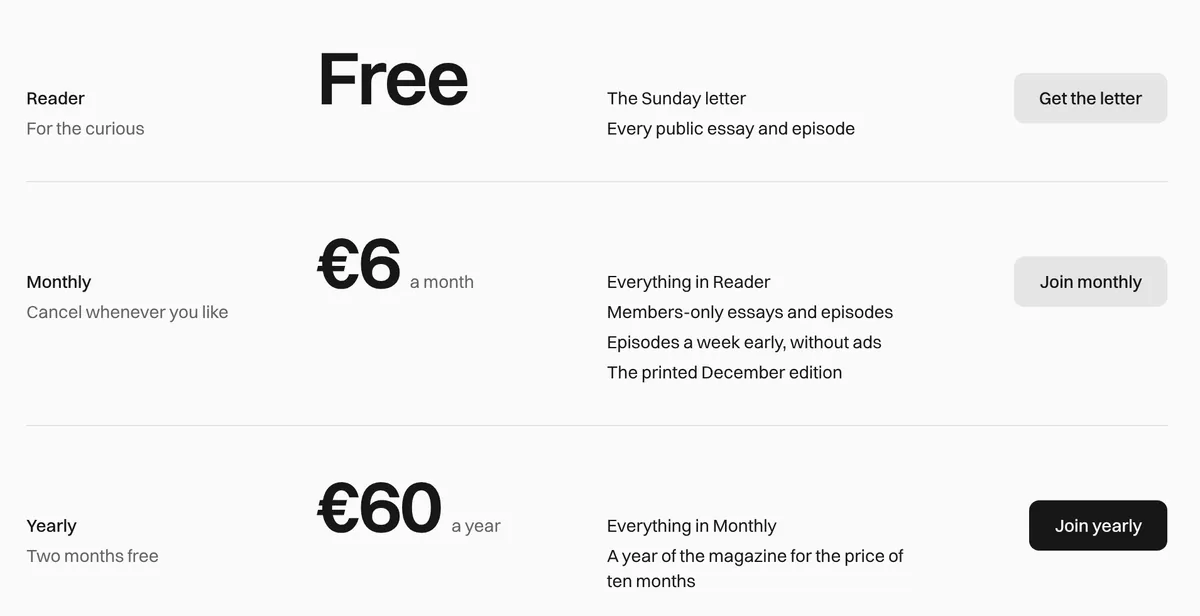
The membership page reads as a letter from the editor, then lists three plans in rows (Reader free with "The Sunday letter", Monthly €6, Yearly €60), four members-only stories and five questions in accordions. Every plan button goes to one sign-up form that repeats the plans as radio buttons.
Sign in, sign up and contact all cancel their own submit, and most of their fields have no name attribute. Pressing the button sends no request and shows no message. "Forgot it?" on the sign-in page links to #_. There is no newsletter form anywhere, even though the free plan promises a Sunday letter. Sample addresses use the reserved .test domain, so nothing can reach a real inbox.
Performance and SEO
One Lighthouse 12.8.2 run per page, 30 October 2026:
| Page | Performance | Accessibility | Best practices | SEO |
|---|---|---|---|---|
| Home, mobile | 98 | 100 | 96 | 100 |
| Home, desktop | 100 | 100 | 96 | 100 |
| Essay, mobile | 98 | 100 | 96 | 100 |
The mobile home page transfers 418 KiB, 303 KiB of it images and 6 KiB of JavaScript. Images are WebP with alt text and lazy loading, but every screen gets the same file (no srcset); Lighthouse estimates 159 KiB of savings on the mobile home page. Best practices lost points for missing favicon and manifest files. Lexington lists scores of 99, 100, 100 and 100.
The SEO score of 100 misses the main problem. All 38 pages share the title "Your Page Title", the description "A detailed description of your page content." and a canonical link to https://yourwebsite.com/current-page, and the Open Graph tags name "Your Site Name". Shipped like this, every page tells search engines that it is a copy of the same placeholder URL. The sitemap and the RSS feed also use the placeholder domain until you set yours. No page has structured data: no Article, BlogPosting, PodcastEpisode or Person markup.
What you still have to build
Page metadata. Pass each page's title, description, canonical URL and social image to the SEO component, set your domain, and add the missing favicons and manifest.
Memberships and payments. Accounts, a payment provider and server-side gating, so members-only text is not sent to everyone.
Forms and newsletter. Endpoints, field names and success states for sign in, sign up and contact, plus a newsletter signup and an email service for the Sunday letter.
Podcast distribution. Real audio files, a podcast feed with enclosures (or your podcast host's feed) and working Spotify and Apple Podcasts links.
Structured data, search and pagination, if you want rich results, a way to find old essays or an archive longer than one page.
Pros and cons
Pros
Essays, episodes, authors, topics and membership share one consistent design, and the home and essay pages scored 100 for accessibility.
Episode pages and a light player are ready, and audio only loads when someone presses play.
Author counts, topic tabs and reading time come from the content, not typed in by hand.
Light pages: 98 for mobile performance on the home page.
Cons
Placeholder titles, descriptions and canonical links on every page, and no structured data.
The members gate hides text with CSS; the full essays are in the HTML.
No working forms, newsletter signup, search or pagination.
No podcast feed, and the sample audio file is a commercial recording that must not ship.
The player has no progress bar or speed control.
How Hemingway compares
Snowpeak ($89, also Lexington) is a design publication with drawn covers instead of photos and no podcast. Its members-only stories leave the text out of the page, and it adds newsletter, advertise and write-for-us pages. Pick it for a design or studio journal.
Phanatik ($89, also Lexington) is built for volume: 30 sample stories, seven sport fronts, a scores strip and ad slots. Pick it for a news site that publishes many short stories a day.
Podcast by Cruip ($49, or in the $79 Classic Bundle of 20 templates) is a three-page podcast site with HTML, Next.js and Vue versions and a Figma file. Its episode player adds a playback-speed control and chapter timestamps, but there are no essays, authors or membership. Pick it for a show without a magazine.
Ghost(Pro) runs memberships, paid subscriptions through Stripe and newsletters out of the box. Its Publisher plan, the first with custom themes, is listed at $29 a month billed yearly for 1,000 members. Pick it if members and email matter more than this design.
See all Tailwind templates for more options.
Who should buy Hemingway
Buy it if you are building a small culture magazine or interview podcast that should feel like print, and someone on the team can wire up accounts, payments, a newsletter and a podcast feed. Look elsewhere if you need memberships, email or podcast-app distribution working without development, or search across a large archive.
FAQ
Does Hemingway's members-only paywall work?
No. It is a design state: on essays the text is faded with CSS while the full essay stays in the page's HTML, and nothing checks who the reader is. You need accounts, a payment provider and server-side gating.
Can I list the Hemingway podcast in Apple Podcasts or Spotify?
Not as shipped. The site's RSS feed contains the essays only, with no episodes or audio enclosures, and the Spotify and Apple Podcasts links are placeholders. Use your podcast host's feed or build a podcast feed.
Should I buy Hemingway alone or Lexington Full Access?
Full Access is better value for most buyers: Hemingway alone costs $89, while Full Access Personal costs $99 (shown as 50% off) and includes all 53 Lexington Astro themes, Hemingway included.
Can I use Hemingway for client sites?
Yes. The license covers unlimited sites for yourself and your clients, with no attribution required. Each seat is one person, and you can't resell or redistribute the theme as a template.
Is there a CMS version of Hemingway?
Yes. Sanity and EmDash editions cost $129 each, and Full Access Studio ($169) includes every Sanity and EmDash edition, per Lexington. We only tested the Astro demo, so we can't say how the CMS editions handle memberships or metadata.
Get new templates like Hemingway weekly
Every Monday: the templates, components and tools added to Tailkits that week, each checked by an editor. Free, unsubscribe in one click.
15 new in the last 30 days311 products reviewed so farSee what you get
KEEP EXPLORING
More templates