
Next.js, Nuxt and TanStack Start SaaS starter with teams, seats and i18n
Makerkit
B2B SaaS kits for Next.js and TanStack Start on Supabase, Drizzle or Prisma
PaidBoilerplates
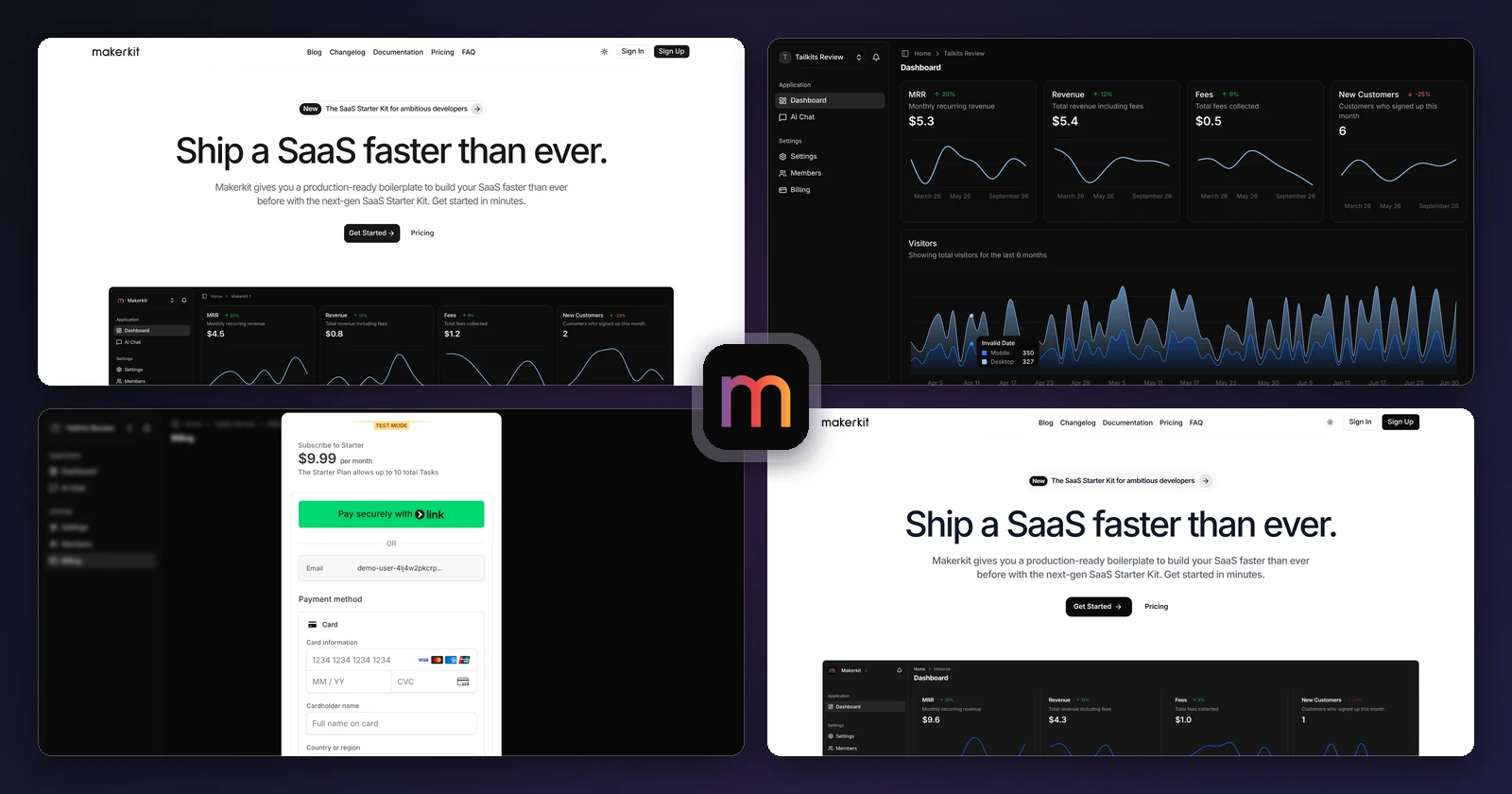
makerkit.lemonsqueezy.comExplore the product
AT A GLANCE
- Website
- makerkit.lemonsqueezy.com
- Pricing
- Paid
- Categories
- Boilerplates
- Listed
- Oct 2023
- Updated
- Oct 2026
Details about Makerkit
KEY POINTS
- Organizations and roles
- Seat-based billing
- Multi-language
- One-time payment
- Lifetime updates
Short verdict: MakerKit sells B2B SaaS starter kits on Supabase, Drizzle or Prisma for Next.js, TanStack Start and React Router, from $299 one-time. Its demo lets you check the product before paying: a demo-account button opens the full app, where we created a team, paid for a plan with Stripe's test card and saw the plan turn active. The core works; the demo's extras don't, with an AI chat that fails silently and a contact form that does nothing on submit. The license is strict and clear: Pro is for one developer, client work needs the $599 Team license plus a license for each client, and each data stack is a separate purchase. Buy it if you build a multi-tenant product in React and want billing and teams already wired; look elsewhere if you need Vue, cheap client work or a refund.
How we reviewed it: On 25 October 2026 we tested the Next.js Supabase demo on a desktop and on a 390 px phone screen, and checked that the other six kit demos load. We signed in with the demo account, created a team, paid for its Starter plan with Stripe's 4242 test card in test mode, went through the team's dashboard, members, billing and settings pages, sent one message to the sample AI chat, submitted the contact form with outgoing requests blocked, followed the Google button to Google's sign-in page, read the SEO tags and ran Lighthouse 12.8.2 on three pages. We could not test a wrong password: in our automated browser, Cloudflare Turnstile kept the sign-in button at "Checking you're not a robot...". We did not buy the code or try the free Lite version. Prices, the license and the changelog come from makerkit.dev that day.
Disclosure: Our links to MakerKit carry a referral tag.
What $299 or $599 gets you
| Plans | Pro, $299 one-time (regularly $349): one developer. Teams, $599 one-time (regularly $649): up to 5 collaborators and a private Discord channel. Both are lifetime licenses with unlimited projects, and you can upgrade from Pro by paying the difference. |
|---|---|
| Kits | Supabase (Supabase Auth, Postgres, storage and row-level security) for Next.js 16, React Router 8 and TanStack Start. Drizzle and Prisma 7, both with Better Auth on any Postgres host, for Next.js 16 and TanStack Start. A license covers one data stack on all its frameworks; another stack is a separate license, discounted if you switch. MakerKit also lists an Expo mobile kit for the Supabase stack. |
| Free version | MakerKit Lite, an open-source Next.js boilerplate with Supabase sign-in and marketing pages but no billing, teams or admin tools, per MakerKit |
| Delivery | An invite to the private GitHub repositories for your kit after purchase |
| Features | Per MakerKit: password, magic link, passkey, OAuth and multi-factor sign-in; personal and team accounts with roles and invitations; a super admin that can impersonate or ban users and teams; flat, per-seat, metered and one-off billing through Stripe, Lemon Squeezy or Paddle on the Supabase kit, or Stripe or Polar on Drizzle and Prisma; React Email with Resend or Nodemailer; i18n; a blog on Keystatic, WordPress or Supabase; Sentry, PostHog or SigNoz; Playwright tests; shadcn/ui and Tailwind CSS 4; a Figma UI kit; agent rules and an MCP server for coding agents. |
| Updates | Recent releases: Next.js 16.4 in all three Next.js kits (7 October 2026), Better Auth 1.7 (8 September), the Expo kit (13 August), a v4 rebuild on Next.js Cache Components (4 August), the TanStack Start kit (9 July) and passkeys (19 June). Giancarlo, the founder, builds and supports it full-time. |
| License | Developer (Pro) is personal: no sharing with contractors and no client work. Team covers employees and contractors up to your seats and allows client work, but each client who receives the code, or gets an instance deployed just for them, needs their own license. No open-sourcing, templates or AI training on the code. License |
| Refunds | "Due to the non-returnable nature of this product, we do not offer refunds." Governed by Singapore law. |
What we found in the demo
A demo account opens the whole app
The Next.js Supabase demo is a marketing site (43 URLs in its sitemap, including three blog posts, sample docs and a changelog) in front of the product app. Its sign-in page offers email and password behind a Cloudflare Turnstile check, Google, and "Sign in with a demo account", which signed us in as a newly generated demo user. The Google button goes through Supabase Auth to Google's sign-in page. The other six kit demos, for TanStack Start, React Router and the Drizzle and Prisma stacks, all loaded.
Billing works end to end in test mode
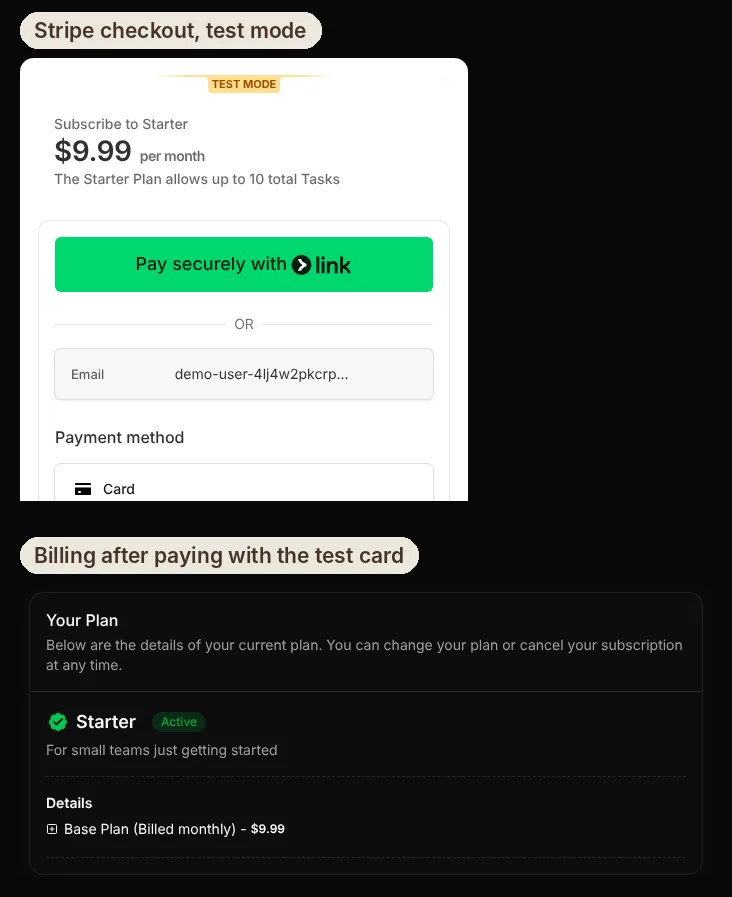
A new team starts without a plan. Its billing page offers Starter ($9.99 a month) and Pro ($19.99 a month), billed monthly or yearly, tells you to pay with Stripe's 4242 test card, and opens Stripe's embedded checkout, marked Test Mode. After we paid, a return page confirmed the subscription, and the billing page then showed Starter as active with a link to Stripe's billing portal, so the subscription had been recorded in the app, not only in Stripe.
Teams, roles and settings
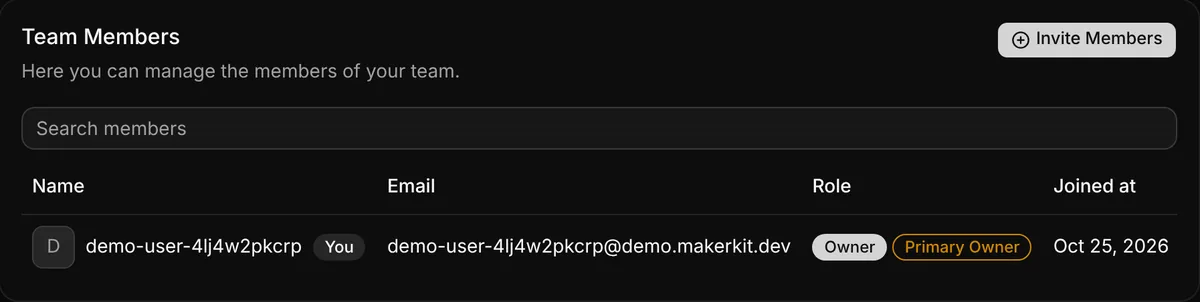
Creating a team gave it its own URL (/home/tailkits-review), dashboard, sample AI chat, members, billing and settings pages. The members page lists each member's role, with us as Owner and Primary Owner, and has an invite button and a pending-invitations table; we didn't send invitations. Personal settings cover the profile picture, name, language, email, password and multi-factor authentication.
The demo's extras are rough
The sample AI chat accepted our message and showed nothing: the server answered "The model gpt-3.5-turbo does not exist or you do not have access to it", and the page displayed no error. The contact form shows raw validator messages on an empty submit ("Too small: expected string to have >=1 characters"), and with valid input, Send Message did nothing visible and sent no request. MakerKit's docs say the form emails the address in CONTACT_EMAIL through your mailer, so test it once yours is set up. Its labels aren't linked to their inputs either, which hurts screen-reader users. Smaller things: the dashboard's sample visitors chart shows "Invalid Date", and the sample docs have no search box.
Performance and SEO
One Lighthouse 12.8.2 run per page and form factor, 25 October 2026. Accessibility, best practices and SEO are from the mobile runs.
| Page | Performance, mobile / desktop | Accessibility | Best practices | SEO |
|---|---|---|---|---|
| Marketing home | 60 / 98 | 96 | 100 | 66 |
| Blog post | 77 / 100 | 100 | 100 | 66 |
| Sign-in | 75 / 98 | 94 | 100 | 66 |
Mobile scores suffer from JavaScript: the home page transfers 903 KiB, 633 KiB of it scripts, with a 5.5 s largest contentful paint, and the sign-in page reaches 1,556 KiB, 748 KiB of it from Cloudflare for the Turnstile check. Desktop is fast. Lighthouse flagged small touch targets on the home page and a button without an accessible name on sign-in. The SEO score of 66 comes from one failed check: this demo sends an x-robots-tag: noindex header, which none of the other six kit demos send.
Pages have titles and descriptions, though pricing and sign-in reuse the site's default description. We found no canonical tags, no structured data, and an empty Open Graph image tag on four of the five pages we checked; the blog post has one. None of the 8 pages we loaded at 390 px scrolled sideways.
What you still have to build
Providers. A Supabase project or Postgres database, a billing provider with your products and webhooks, a mailer and OAuth apps.
Contact and AI features. Configure and test the contact form's mailer, and point any AI feature at a model you have access to.
SEO. Canonical tags, Open Graph images, structured data and page-specific descriptions.
Content. Replace the sample pricing, blog, docs, changelog and dashboard data.
Pros and cons
Pros
Billing, teams and roles work in the demo, from checkout to an active plan.
A demo account and a free Lite version let you check it before paying, which matters with no refunds.
One kit per stack: Supabase, Drizzle or Prisma, on Next.js, TanStack Start or React Router.
A license that spells out what Pro and Team allow, and six dated releases between June and October 2026.
Cons
Client work needs the $599 Team license plus a license for each client.
Each data stack is a separate purchase, and there are no refunds.
The demo's AI chat fails silently and its contact form sends nothing.
Heavy JavaScript on mobile, and no canonical tags or structured data in the demo.
How MakerKit compares
Supastarter costs $349 for one developer, $799 for 5 seats or $1,499 for 10 seats with unlimited client projects, per framework: Next.js, Nuxt or TanStack Start. Pick it if you need Nuxt, or one agency license instead of a license per client.
LaunchFast costs $49 a kit or $99 for Astro, Next.js and SvelteKit, with no organizations or translations. Pick it for a single-user product on a small budget.
ShipFast is Next.js only and costs $199 or $249 one-time during its current $100-off offer, with no organizations or seats in its feature list. Pick it for a simple single-user SaaS.
See all boilerplates.
Who should buy MakerKit
Buy it if you're building a B2B SaaS in React, where customers work in teams and pay through Stripe or another provider, and you want those flows built before you write product code. Pick the Supabase kit for Supabase's auth and row-level security, or Drizzle or Prisma for any Postgres host. Look elsewhere if you build for clients on a budget, since each client needs a license, if you work in Vue or Svelte, or if you need a refund option.
FAQ
Does one license cover Supabase, Drizzle and Prisma?
No. A license covers one data stack, including its TanStack Start version and, for Supabase, React Router. Another stack needs its own license, with a discount if you switch.
Can I use MakerKit for client projects?
Only with the Team license ($599). The Developer license used by Pro forbids client work, and under the Team license each client who receives the code, or gets an instance deployed for them, needs their own MakerKit license.
Can I try MakerKit before buying?
Yes. The demo's sign-in page has a demo-account button that opens the full app, including teams, members and a Stripe test-mode checkout. MakerKit Lite, a free open-source version without billing or teams, lets you read the code structure.
Which payment providers does MakerKit support?
The Supabase kit supports Stripe, Lemon Squeezy and Paddle; the Drizzle and Prisma kits support Stripe and Polar. Plans can be flat, per seat, metered or one-off.
Can I get a refund?
No. MakerKit's license says it does not offer refunds, and its FAQ says refunds generally aren't possible once access is redeemed. Use the demo account and ask questions before buying.
KEEP EXPLORING
More boilerplates Good company for Makerkit.
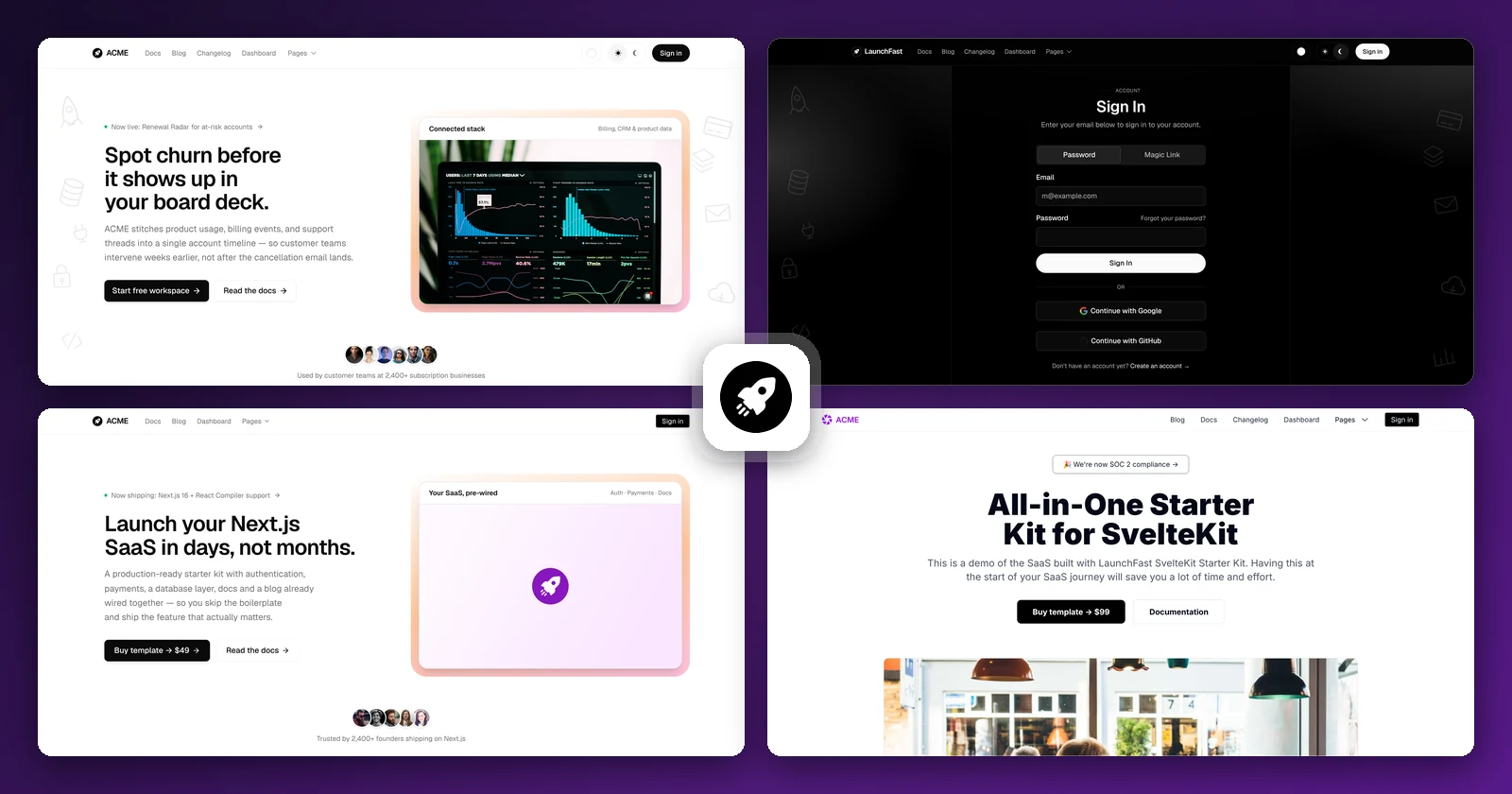
Astro, Next.js and SvelteKit SaaS starter kits with swappable providers
AI-ready Next.js SaaS starter kit overview