Next.js and Astro single-product store with a model picker and checkout UI
Shepherd
Rails property-management kit for short-stay hosts: bookings, calendar, inbox
FreeTemplates
railsui.comExplore the product
AT A GLANCE
- Website
- railsui.com
- Pricing
- Free
- Categories
- Templates
- Listed
- Apr 2025
- Updated
- Oct 2026
Details about Shepherd
KEY POINTS
- Tailwind CSS v4
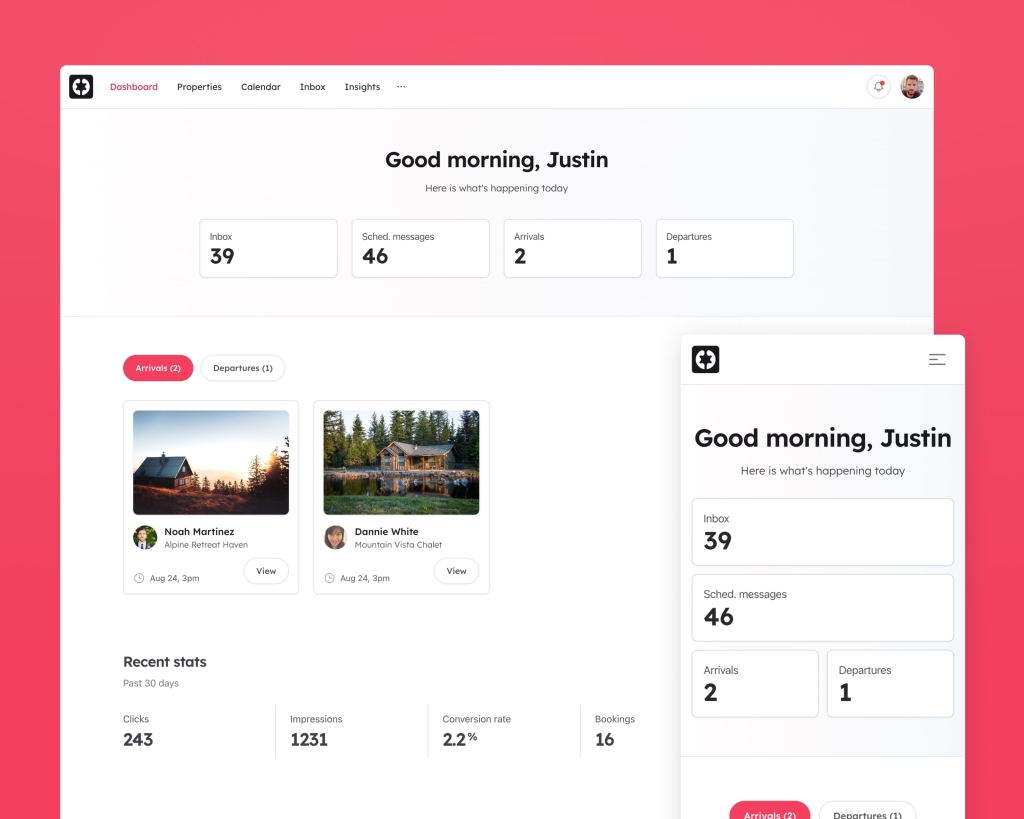
Short verdict: Shepherd is a free Rails UI app kit with the screens of a vacation-rental host tool: a bookings table, a calendar across properties, a guest inbox with payout breakdowns and occupancy charts, plus sign-in screens, emails and dark mode. Every screen is a static ERB page filled with sample data, so the models, availability rules, messaging and payments are yours to build. It suits a Rails developer making software for short-stay hosts who wants matching screens from the first commit. Look elsewhere if you need long-term rental features (leases, rent, maintenance requests), a booking engine that already works, or a framework other than Rails.
How we reviewed it: On 31 October 2026 we went through the public demo, a static build of the screens, on a 1440 px desktop and a 390 px phone screen, in light and dark mode. We opened all 20 pages it links to, submitted its forms with network logging on, and ran Lighthouse 12.8.2 on the about page and the dashboard. We also downloaded the free railsui gem (version 3.4.3) and read Shepherd's views, Stimulus controllers and installer. We added the gem to a new Rails 8.1.4 app but did not run its installer, so we have not seen Shepherd render inside Rails. Prices and license terms come from railsui.com on the same day.
What you get for free
| Price | Free. Rails UI lists Shepherd as one of three free app kits, with Hound and Corgie. The Solo plan ($299 a year, one seat) and Team plan ($799 a year, up to 30 seats) add five premium kits, Charts Pro and private repositories; Shepherd works without them. |
|---|---|
| Version | railsui gem 3.4.3, released 8 June 2026 |
| Size | 21 page templates, 7 sign-in and account screens (each in a Devise and a plain version), 17 component types in 78 partials, 3 email templates plus 5 Devise emails, and 16 Stimulus controllers, by our count in the gem. Rails UI says "23+ pre-designed views". |
| Stack | Rails 7.0 or later (Rails UI lists 8.1.1), ERB, Tailwind CSS 4 through tailwindcss-rails, Stimulus, ApexCharts and PhotoSwipe |
| Install | bundle add railsui, then rails railsui:install; importmap by default, or --build with a JavaScript bundler |
| License | The gem's license file is a "Personal License" for one developer: unlimited end products, including apps for clients, but no redistributing the templates, building a UI kit or website builder from them, or sharing access. RubyGems lists the gem as "Unlicense" and Rails UI calls the free kits open source; we would go by the license file. Rails UI license terms |
What we found
Screens for short-stay hosts, not landlords
Rails UI describes Shepherd as a property-management and tenant-communication kit, and its own product summary promises "tenant portals, and maintenance tracking". The screens are those of a vacation-rental host. The bookings table has Upcoming, Complete and Canceled tabs, guest counts such as "3 adults, 1 child", arrival and departure dates and a payout for each stay. The dashboard greets the host with arrivals, departures and 30-day listing stats (243 clicks, 1,231 impressions, a 2.2% conversion rate), and the help center's articles are about hosting, cleaning and pricing a rental. We found no lease, rent or maintenance-request screen in the demo or among the gem's 21 page templates.
A guest inbox with the booking and payout beside it
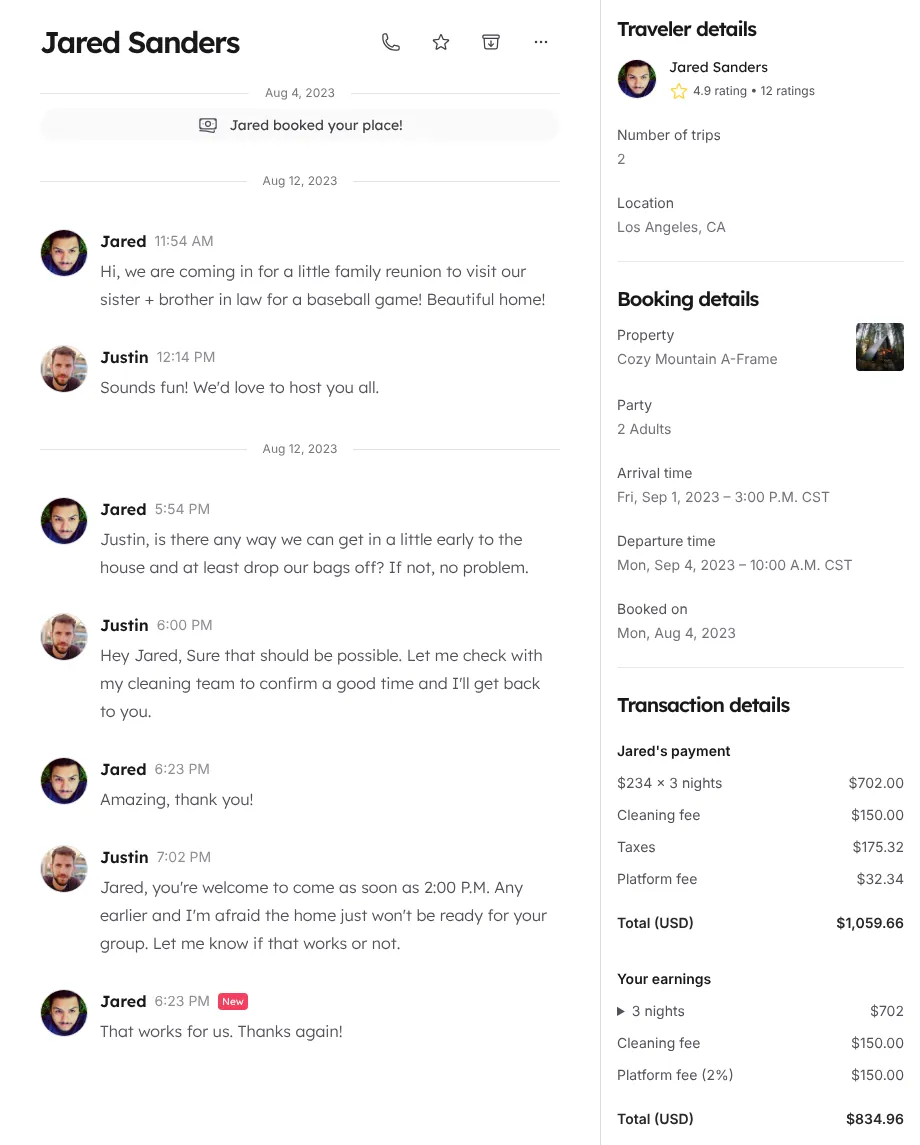
The inbox lists 10 conversations. Opening one shows the thread in the middle and, on the right, the guest's rating and trips, the stay's dates and party size, and two money breakdowns: what the guest pays and what the host earns. The guest side adds up: $702 for three nights, $150 cleaning, $175.32 taxes and a $32.34 platform fee make $1,059.66. The host side does not. It lists a "Platform fee (2%)" of $150.00, while its $834.96 total only works with a $17.04 fee. Sample numbers like these are the first thing to replace.
A calendar and booking form without the logic behind them
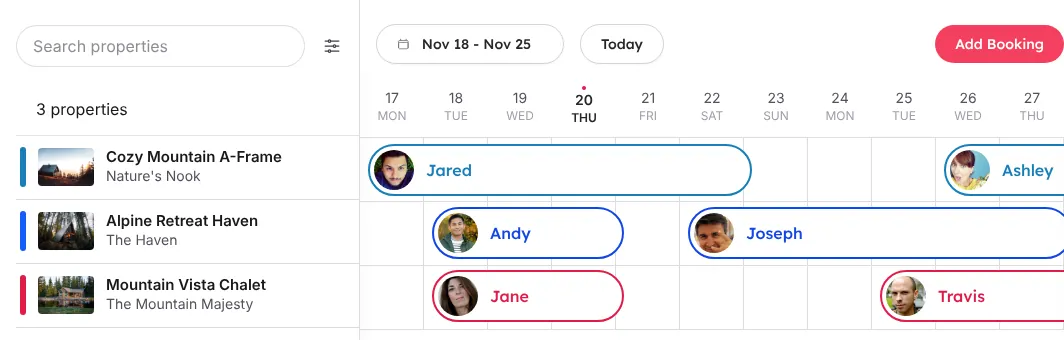
The calendar lines up bookings for all three sample properties on one timeline, with Today and Add Booking buttons. Its day labels are a fixed list typed into calendar.html.erb, not dates worked out from today, and the demo's labels even jump from the 27th to "Sep 29". The new-booking form asks for the property, the guest's name, email and phone, a date range, a language, counts of adults, children, infants and pets, and a total. Pressing Create booking reloads the same page with some of the answers in the URL. Like every form in the demo, it has nowhere to send them: the only other request we saw was Cloudflare's analytics beacon.
Charts and dark mode
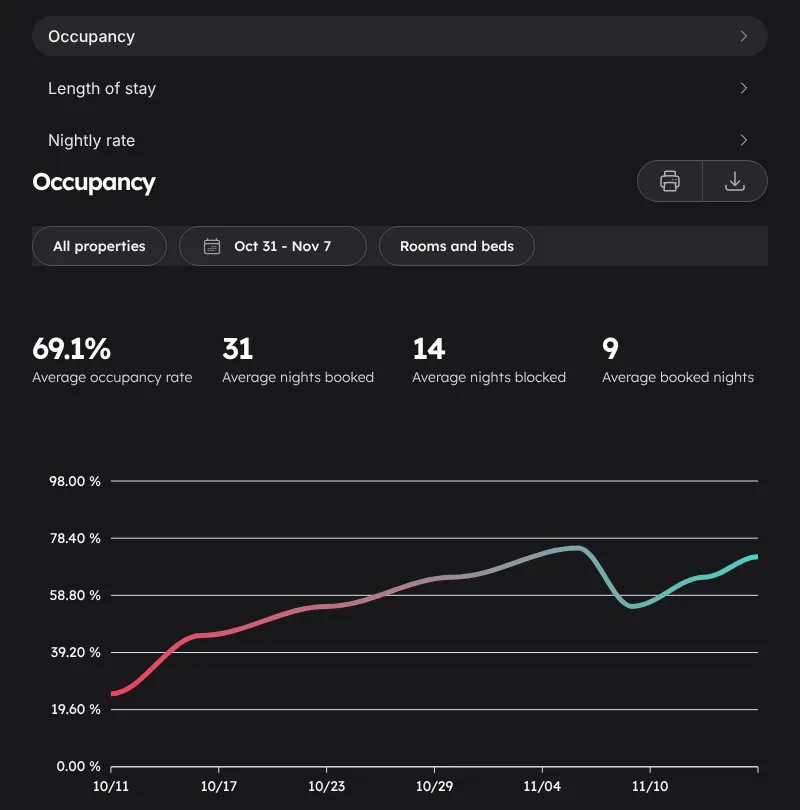
Insights has three tabs drawn with ApexCharts: occupancy (69.1% in the sample), length of stay (3.9 days) and nightly rate ($289). The date filter follows today's date. Rails UI says every page has a dark version, and the bookings and insights pages we checked were fully styled. Dark mode follows the system setting, but the theme script saves the first setting it sees in localStorage: a visit made in light mode stayed light after we switched the system to dark. The app screens have no theme switch; only the API docs page has a Dark, Light and System menu.
What the installer does
We read this in the gem's code rather than running it. rails railsui:install sets up Hound, the default kit, and tells you that you can change it; Rails UI's llms.txt says you choose a kit when prompted, but version 3.4.3 does not ask. You switch to Shepherd on the /railsui settings page, which reruns the update generator. Pages land in app/views/rui under routes such as /rui/bookings, and Rails UI treats them as read-only: changing the configuration overwrites them, so copy a page into your own views before editing it. In the default importmap mode, Shepherd's JavaScript (ApexCharts 3.45.2, flatpickr, PhotoSwipe, tippy.js and others) is pinned to esm.sh and unpkg.com, and its head partial loads three stylesheets from unpkg.com. A production app depends on those CDNs unless you download and serve the files yourself.
Performance and SEO
One Lighthouse 12.8.2 run per page on the demo, 31 October 2026. The demo is a static build made with Tailwind CSS 4.0.9, so a Rails deployment will score differently:
| Page | Performance | Accessibility | Best practices | SEO |
|---|---|---|---|---|
| About, mobile | 71 | 86 | 100 | 83 |
| About, desktop | 78 | 87 | 100 | 83 |
| Dashboard, mobile | 81 | 84 | 100 | 83 |
| Dashboard, desktop | 95 | 75 | 96 | 83 |
The about page, the demo's home, transfers about 6 MB, 98% of it images, and its largest contentful paint took 19.1 s in the mobile run because of the hero photo. Resizing and compressing the sample photos is the first fix. The accessibility points are lost to issues that are also in the gem's current code: the mobile menu button carries role="Mobile navigation toggle", which is not a valid ARIA role; the dashboard's property select has no label; and the primary button's white-on-rose text measures 3.67:1, below the 4.5:1 that WCAG asks for small text. SEO loses points for a missing meta description and the demo host's robots.txt. The kit includes a railsui_meta_tags helper for titles, descriptions and social cards, so filling them in is up to you. No page had structured data.
What you still have to build
Data. Models, migrations and controllers for properties, bookings, guests, messages and payouts. The pages are static views with sample rows written into the templates.
Availability. Real calendar dates, blocked nights, double-booking checks and the Create booking action.
Messaging. Storing and delivering inbox messages, in the app and by email or text.
Payments and payouts. Charging guests for stays, fees and taxes, and paying hosts, with Stripe or another provider.
Calendar sync. The properties page shows a "Syncing" status and a Re-sync action; connecting listings to booking sites is yours.
Sign-in. The Devise screens are ready to drop in, but you install Devise and connect the Google, Facebook, X and GitHub buttons to OmniAuth yourself.
Sample content. The "Shepherd Inc." about page about AI for real estate investors, the 2023 dates, the fees and the photos.
Pros and cons
Pros
Free, under a license that allows unlimited apps, including client work, for one developer.
A consistent set of host screens (bookings, calendar, an inbox with payouts, insights) that you would otherwise design yourself.
Rails-native: ERB partials, a form builder, Devise view snippets, emails and Stimulus controllers, with no front-end framework to maintain.
Dark mode on the pages we checked, and no sideways scrolling on a 390 px screen.
Cons
Static screens: no models, availability logic, messaging or payments.
Nothing for long-term rentals, despite the tenant wording on Rails UI's site.
The default install loads JavaScript and CSS from esm.sh and unpkg.com.
Accessibility gaps in the kit's own code, and heavy sample photos.
Mixed license signals: a one-person license file, "Unlicense" on RubyGems and "open source" on the website.
How Shepherd compares
Hound is Rails UI's free kit for CRM and project management, in the same gem: contacts, deals, messaging and projects. Pick it if your app tracks clients or work rather than stays.
Bullet Train is a free, MIT-licensed Rails framework with teams, roles and billing, and Super Scaffolding that generates views and controllers for your own models. Pick it if pages backed by real data matter more to you than a designed host UI.
Jumpstart Pro ($249 a year for one app) brings payments, accounts, multitenancy, an admin dashboard and an API, but no property screens. Pick it if billing and accounts are the hard part and you will design the host screens yourself.
Rails UI Solo ($299 a year) is only worth it for Shepherd users who also want the five premium kits or Charts Pro.
See all dashboard templates for more options.
Who should use Shepherd
Use it if you are building a vacation-rental or small hospitality tool in Rails, want host screens that match from the first commit, and plan to write the booking logic yourself. Being free, it costs nothing to try. Look elsewhere if you manage long-term tenants, need bookings and payouts that work out of the box, or build on another framework.
FAQ
Is Shepherd free?
Yes. Rails UI lists Shepherd as one of three free app kits, with Hound and Corgie, and it ships in the free railsui gem. The Solo plan ($299 a year) adds five premium kits, Charts Pro and private repositories; you don't need it to use Shepherd.
Can I use Shepherd for client projects?
Yes. The gem's Personal License allows unlimited end products, including apps your clients own. It does not allow redistributing the templates, building a UI kit or website builder from them, or sharing your access with others.
Does Shepherd take real bookings or payments?
No. Every page is a static ERB view with sample data, and the demo's Create booking form saves nothing. You build the models, availability rules, messaging and payments.
Which Rails versions does Shepherd support?
The railsui 3.4.3 gem requires Rails 7.0 or later, and Shepherd's styles are written for Tailwind CSS 4 (adding the gem to a new Rails app pulled in tailwindcss-rails 4.7.0). Rails UI lists Rails 8.1.1. It works with importmap, the default, or with a JavaScript bundler through the --build option.
Does Shepherd cover long-term rentals?
Not as shipped. Its screens deal with guests, stays, nightly rates and host payouts. There are no lease, rent collection or maintenance-request pages.
KEEP EXPLORING
More templates