
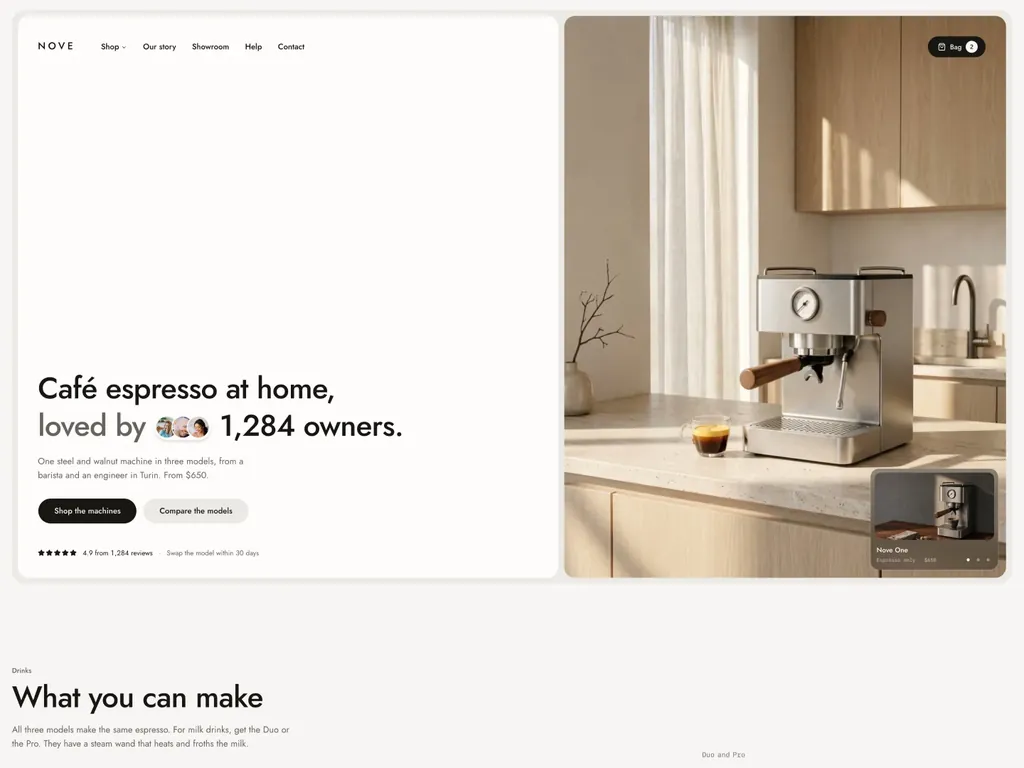
Next.js and Astro single-product store with a model picker and checkout UI
Kotei
Astro growth agency theme with a 12-week pricing planner and case filters
PaidTemplates
lexingtonthemes.comExplore the product
AT A GLANCE
- Website
- lexingtonthemes.com
- Pricing
- Paid
- Categories
- Templates
- Listed
- Sep 2023
- Updated
- Oct 2026
Details about Kotei
KEY POINTS
- Tailwind CSS v4
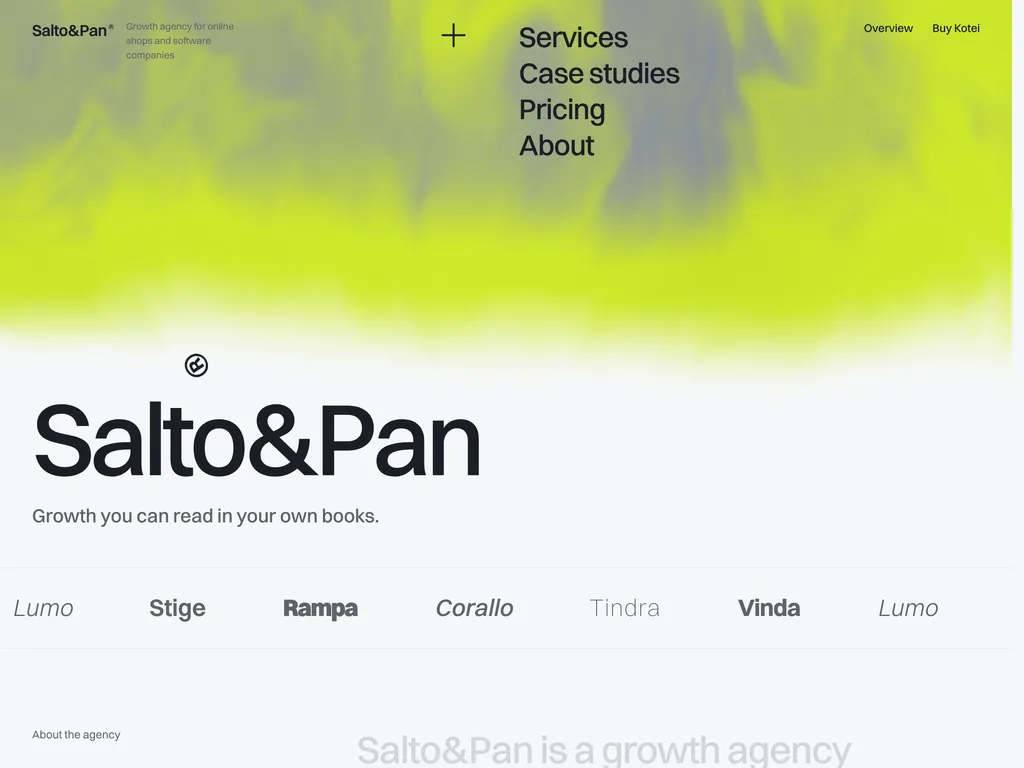
Short verdict: Kotei is now a theme for growth-marketing agencies, rebuilt from scratch in October 2026, and it leads with numbers everywhere: headline metrics, case studies that open with three results, and a pricing planner that maps each plan onto a 12-week timeline. Services and case studies link to each other, and the lime WebGL ink shader behind the hero is built to stay off the main thread. The weak spot is the conversion path: in the demo, both the free audit form and the contact form end on a blank error page, and all 40 pages share one placeholder title and canonical URL. Buy it if you run a performance-marketing agency and have a developer to wire the forms. Look elsewhere if you sell design work, or need forms that work without code.
How we reviewed it: On 30 October 2026 we went through the live Astro demo on a 1440 px desktop screen and a 390 px phone screen. We switched between the three pricing plans, used the case study filters, submitted the audit and contact forms while logging network requests, read the shader's scripts as shipped in the demo and ran Lighthouse 12.8.2 once on the home page and once on the pricing page. We did not buy the source code, so we can't judge code quality, and only the Astro edition has a demo, so the Sanity and EmDash editions are untested. Prices, versions and license terms come from Lexington Themes on the same day.
Disclosure: Our links to Lexington Themes carry a referral tag.
What you get for $89
| Price | $89 one-time for the Astro edition. The Astro + Sanity and Astro + EmDash editions cost $129 each. Lexington Themes Full Access Personal is listed at $99 and includes all 53 Lexington Astro themes, so for $10 more you get Kotei and every other theme. |
|---|---|
| Version | Astro 7.4.1 and Tailwind CSS 4.3.3, per Lexington. Rebuilt from scratch on 19 October 2026: the changelog lists new pages, collections and copy, and says the old work, store and studio pages, dark mode and AOS animations are gone. |
| Size | Lexington lists six static pages plus Services, Case Studies, Blog and Legal collections. The demo has 40 pages: home, about, pricing, free audit, contact, 14 service pages with an index, four case studies with an index, four blog posts with an index, three legal pages, six style-guide pages and a 404. |
| Stack | Astro and Tailwind CSS 4.3.3 (read from the demo's stylesheet), GSAP with ScrollTrigger, Lenis and a WebGL shader. No Alpine.js or other UI framework is loaded. Text is set in Switzer, loaded from Fontshare. |
| Delivery | Access to a private GitHub repository after paying through Polar. It deploys the static build to Netlify, Vercel or any static host. Lexington's setup guide still says Node.js 20 or later, but Astro 7.4 requires 22.22 or newer. |
| License | Unlimited websites for yourself and for clients, including commercial and white-label work, with no attribution. You can't resell or redistribute the theme as a template, and one seat is one named person. License terms |
| Refunds | Only if the theme isn't as described or differs materially from the demo, has a security problem that can't be fixed promptly, promised support isn't given, or you haven't accessed the repository within 14 days, per Lexington's refund policy. Test the demo before buying. |
What we found in the demo
A home page built like a ledger
The home page runs from the shader hero and a client marquee through 14 services, eight "not another agency" contrasts and four headline figures that count up as they scroll into view (€48M of client revenue in 2025, a 4.1x return on ad spend, 40 retainer clients, 92% staying past the first year). Then come case studies, a 90-day plan, testimonials and the three plans. All of these figures are samples, and on a real agency site each one is a claim you need to be able to back up.
A pricing planner instead of a price grid
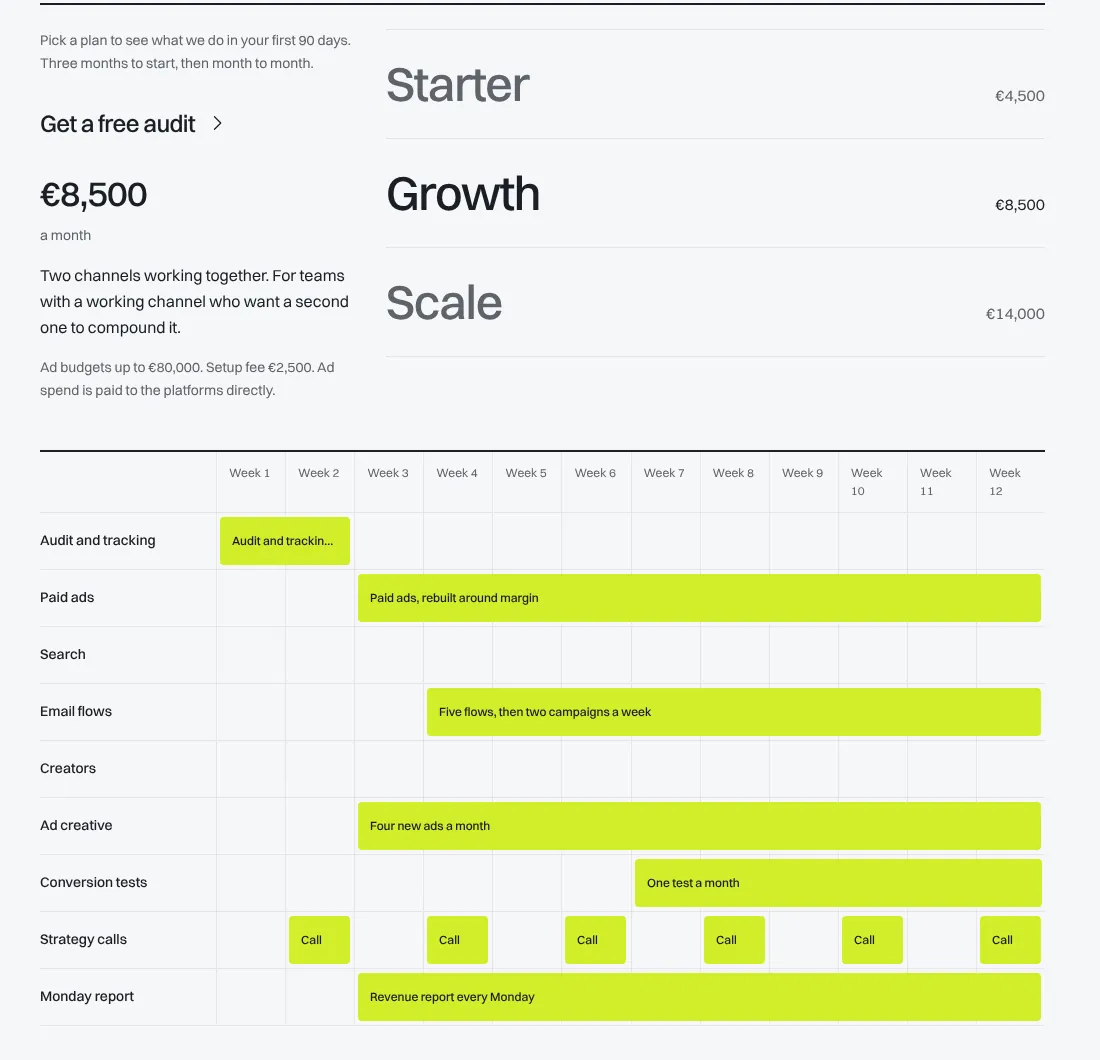
The pricing page has three plans: Starter at €4,500 a month, Growth at €8,500 (selected by default) and Scale from €14,000. Picking one swaps the price, the description and a 12-week timeline. Starter shows the audit, one channel and three monthly calls; Growth adds email flows, four new ads a month, one conversion test a month and six calls; Scale adds search content and creator partnerships, eight ads, three tests and a weekly call. Below sit a seven-row plan comparison and six pricing questions. The plan buttons expose their selected state to screen readers.
Case studies and services that point at each other
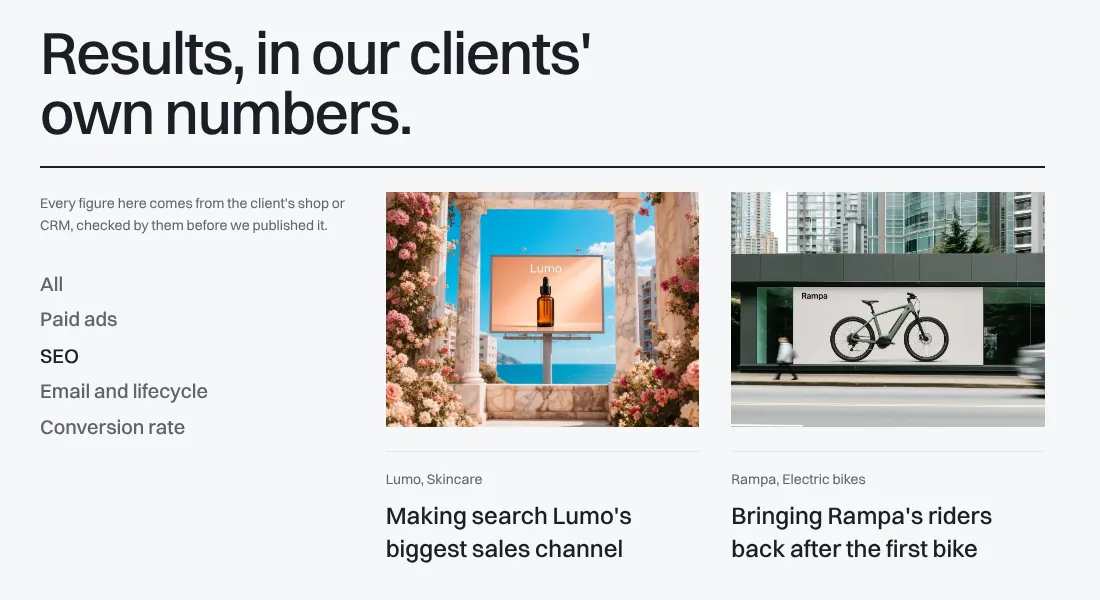
Four case studies (outdoor clothing, skincare, accounting software, electric bikes) open with three results, then the client, industry, duration and services, the problem, what the agency did, the result and a quote. Four channel filters each narrow the list to two; the choice isn't kept in the URL, so you can't link to a filtered view. Each of the 14 service pages has a headline metric (SEO shows +186% organic traffic in a year), the approach, who it's for, deliverables and tools. The four services that match a filter also list their case studies, so the SEO page shows the same two clients as the SEO filter; the other ten have no case study yet.
The audit and contact forms end on an error page
The free audit is the theme's main call to action: name, work email, website, monthly ad spend (five ranges), 14 channel checkboxes and a goals box, with a three-step "what happens next" beside it. Pressing "Request my audit" posts the form to the page's own address; the demo's static host answers 405 Method Not Allowed and the visitor sees a blank white page. The contact form (topic, name, email, company, message) does the same. Nothing reaches a form service. The contact page also routes visitors to four inboxes (new business, press, careers and billing), each with its own contact, and embeds two Google Maps, which load scripts from Google.
The shader, motion and mobile
The ink shader that drifts behind the hero and rises under the footer is drawn with WebGL in a web worker, so the drawing stays off the main thread where the browser supports it. The demo's scripts cap its resolution at 1.5x, pause it when it scrolls out of view and draw a still frame when the visitor asks for reduced motion. On a 390 px screen we found no sideways scrolling, and the menu opens as a dark side panel. There is no dark mode.
Performance and SEO
One Lighthouse 12.8.2 run per page, 30 October 2026:
| Page | Performance | Accessibility | Best practices | SEO |
|---|---|---|---|---|
| Home, mobile | 97 | 91 | 96 | 100 |
| Home, desktop | 97 | 91 | 96 | 100 |
| Pricing, mobile | 88 | 100 | 96 | 100 |
| Pricing, desktop | 98 | 100 | 96 | 100 |
On the home page, with the shader running, total blocking time was 10 ms on mobile, so drawing it in a worker holds up in our run (our test machine has no GPU, so the shader draws in software). Accessibility drops to 91 there, the same score Lexington publishes: the scroll-linked text reveal keeps words at 15% opacity until you scroll, which Lighthouse reads as low contrast, and it puts aria-label on paragraphs, which isn't allowed. The pricing page transfers 130 KiB in 17 requests with no blocking time. On mobile, first and largest paint both came in at 2.8 s, and Lighthouse estimates 1.3 s of savings from render-blocking CSS, mostly the Fontshare stylesheet for Switzer, so self-hosting the font is the first fix.
The SEO score hides the main pre-launch task. All 40 pages have the title "Your Page Title", the same placeholder description and a canonical URL of https://yourwebsite.com/current-page, and the sitemap (39 URLs) and RSS feed point to that placeholder domain. Lighthouse checks that the tags exist, not what they say. The demo outputs no structured data. The best-practices deduction comes from console errors: the page head links a favicon set and a web manifest that the demo doesn't include.
What you still have to build
Form handling. Connect the audit and contact forms to a form service, your CRM or your own endpoint, with confirmation and error states.
Metadata. Your domain in the config (the sitemap and RSS use it), plus a title, description, canonical URL and share image per page, and the missing favicons.
Your own numbers. Revenue figures, case study results, testimonials, team bios and office addresses are samples. Replace them or remove them.
Third-party requests. Switzer loads from Fontshare and the contact page embeds Google Maps. Self-host the font and add consent handling or a static map if your privacy policy requires it.
Pros and cons
Pros
The pricing planner and comparison table show what a retainer buys week by week, which a plain price grid can't.
Case studies, channel filters and service pages are connected, so a service page shows the case studies that used it.
The WebGL shader is built with care: off the main thread, paused off screen and still under reduced motion.
Little main-thread work: 10 ms of blocking time on the home page with the shader running, none on pricing.
Cons
The audit and contact forms end on a blank 405 error page in the demo.
All 40 pages share a placeholder title, description and canonical URL.
Render-blocking Fontshare CSS delays the first paint on mobile (2.8 s on pricing), and the home page scores 91 for accessibility.
Many sample figures read like real claims and must be replaced before launch.
How Kotei compares
Outkast, also $89 from Lexington, is a PR agency theme whose case studies list the press coverage they earned, with services, careers and a brief form. Pick it if you sell coverage rather than performance numbers; its form also needs a backend.
Astromax SP, $89, is Lexington's dark design-studio theme with big type, case studies, services and a journal, per Lexington. Pick it for a studio that sells on visuals.
Northline from Let's Templates costs $10 for the Tailwind CSS version ($20 with Bootstrap 5 too, per its maker). It is a neon-accented agency template with stat cards, case studies, pricing and testimonials, in plain HTML. Pick it for a small budget and a single-page feel; it has no pricing planner or content collections.
See all templates for more options.
Who should buy Kotei
Buy it if you run a growth or performance-marketing agency that sells retainers on results, you want pricing, services and case studies that reinforce each other, and someone can connect the forms to your CRM. Look elsewhere if your work is visual and should lead with images, if you want a dark design, or if the site has to collect audit requests on day one without development work.
FAQ
Does Kotei's free audit form work out of the box?
No. In the demo, Request my audit posts the form to the page itself, the static host answers with a 405 error and the visitor sees a blank page. The contact form behaves the same. Connect both to a form service, CRM or your own endpoint before launch.
Is Kotei cheaper as part of a Lexington bundle?
Yes, if you might use a second theme. Kotei costs $89 on its own, while Full Access Personal is listed at $99 and includes all 53 Lexington Astro themes, Kotei among them, plus future themes and updates.
Is the new Kotei the same theme I bought before?
No. Lexington rebuilt Kotei from scratch on 19 October 2026 as a growth agency theme and removed the old work, store and studio pages and dark mode. Lexington's FAQ says the previous version of a redesigned theme stays available as a tagged GitHub release.
Will the WebGL shader slow down phones?
It is built not to. The demo's scripts draw it in a web worker, cap its resolution, pause it when it is off screen and show a still frame when reduced motion is requested. We measured on a desktop machine without a GPU, not on a real phone.
Can I use Kotei for client websites?
Yes. Lexington's license allows unlimited websites for yourself and for clients, including commercial and white-label work without attribution. You can't resell the theme as a template, and each seat is one named person.
New templates like Kotei, in your inbox
The best developer tools, templates and UI components added to Tailkits, each reviewed by an editor. Free, unsubscribe in one click.
18 new in the last 30 days314 products reviewed so farSee what you get
KEEP EXPLORING
More templates Good company for Kotei.
Do you make Kotei? Get a badge for your site
An optional "Featured on Tailkits" badge that links to this page. Pick light or dark and paste the code into your site, for example in the footer.