Next.js and Astro single-product store with a model picker and checkout UI
Dusk
Astro conference theme with a day-by-day schedule, speakers and ticket tiers
PaidTemplates
lexingtonthemes.comExplore the product
AT A GLANCE
- Website
- lexingtonthemes.com
- Pricing
- Paid
- Categories
- Templates
- Listed
- Sep 2023
- Updated
- Oct 2026
Details about Dusk
KEY POINTS
- Tailwind CSS v4
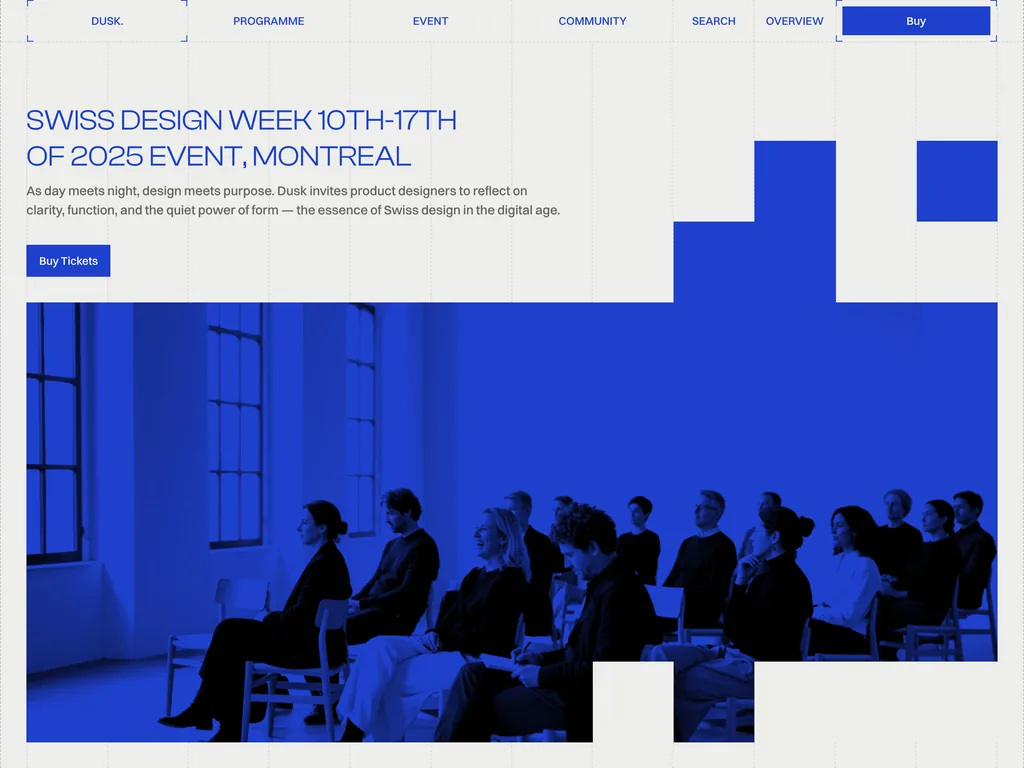
Short verdict: Dusk is no longer an agency theme. Lexington rebuilt it for conferences and festivals, and the demo has the pages an event needs: a day-by-day schedule, linked session and speaker pages, four ticket tiers with a comparison table, venue, FAQ, sponsors, partners, hosts, a recap, a gallery and site-wide search, all on a strict Swiss grid with one blue accent. It is a front end only: the ticket buttons do nothing, registration, sign-in and contact end on an error page, the footer newsletter posts to a third-party form service, and there is no Event structured data. Buy it if you run a multi-day conference or festival and have a developer and a ticketing provider. Skip it if you need to sell tickets next week without writing code.
How we reviewed it: On 30 October 2026 we went through the live Astro demo on a 1440 px desktop screen and a 390 px phone screen. We clicked every ticket button, submitted the registration, sign-in and contact forms while logging network requests, stopped the newsletter request before it left the browser, searched the site, opened the mega menu and the mobile menu, and ran Lighthouse 12.8.2 once on the home page and once on the schedule. We did not buy the source code, so we can't judge code quality, and only the Astro edition has a demo, so the Sanity and EmDash editions are untested. Prices, versions and license terms come from Lexington Themes on the same day.
Disclosure: Our links to Lexington Themes carry a referral tag.
What you get for $89
| Price | $89 one-time for the Astro edition. The Astro + Sanity and Astro + EmDash editions cost $129 each. Lexington Themes Full Access Personal is listed at $99 and includes all 53 Lexington Astro themes, so for $10 more you get Dusk and every other theme. |
|---|---|
| Version | Astro 7.4.1 and Tailwind CSS 4.3.3, per Lexington. The changelog dates the rebuild to 20 April 2025 (the product page says July 2025). Its latest entry, 3 September 2026, expanded the design-rules file for AI coding tools (.cursor/skills/dusk-design/SKILL.md) and changed no pages. |
| Size | Lexington lists 13 static pages plus Journal, Sessions, Speakers, Sponsors and Legal collections. The demo has 64 pages: home, schedule, tickets, venue, FAQ, gallery, recap, hosts, partners, three forms, nine sessions, six speakers and four sponsors with an index each, six journal posts with an index and 14 tag pages, three info pages including a code of conduct, five style-guide pages and a 404. |
| Stack | Astro and Tailwind CSS 4.3.3 (read from the demo's stylesheet) with Lenis smooth scrolling. Search uses Fuse.js 7.1.0, loaded from the jsDelivr CDN. Headings use Clash Display and text Switzer, both from Fontshare. No Alpine.js or other UI framework is loaded. |
| Delivery | Access to a private GitHub repository after paying through Polar. It deploys the static build to Netlify, Vercel or any static host. Lexington's setup guide still says Node.js 20 or later, but Astro 7.4 requires 22.22 or newer. |
| License | Unlimited websites for yourself and for clients, including commercial and white-label work, with no attribution. You can't resell or redistribute the theme as a template, and one seat is one named person. License terms |
| Refunds | Only if the theme isn't as described or differs materially from the demo, has a security problem that can't be fixed promptly, promised support isn't given, or you haven't accessed the repository within 14 days, per Lexington's refund policy. Test the demo before buying. |
What we found in the demo
A schedule built from linked sessions and speakers
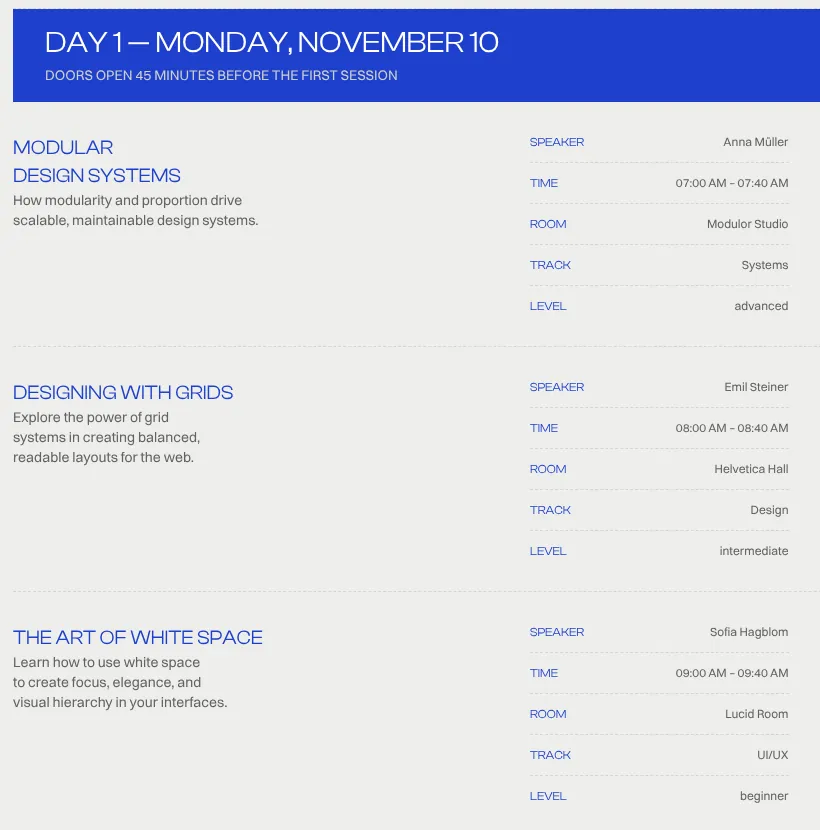
The sample event, Swiss Design Week in Montreal, runs for seven days. The schedule lists each day with its sessions, and every session shows the speaker, time, room, track and level. There are nine 40-minute sessions and six speakers. Session pages add the date, a description, takeaways, resources, the speaker's links and the day's other sessions; speaker pages add role, company, location, focus areas, a bio and every session that speaker gives. What's missing is planning help: no filter by day, track or level, no add-to-calendar link and no personal agenda, although the copy invites visitors to "bookmark" sessions.
Ticket tiers without a checkout
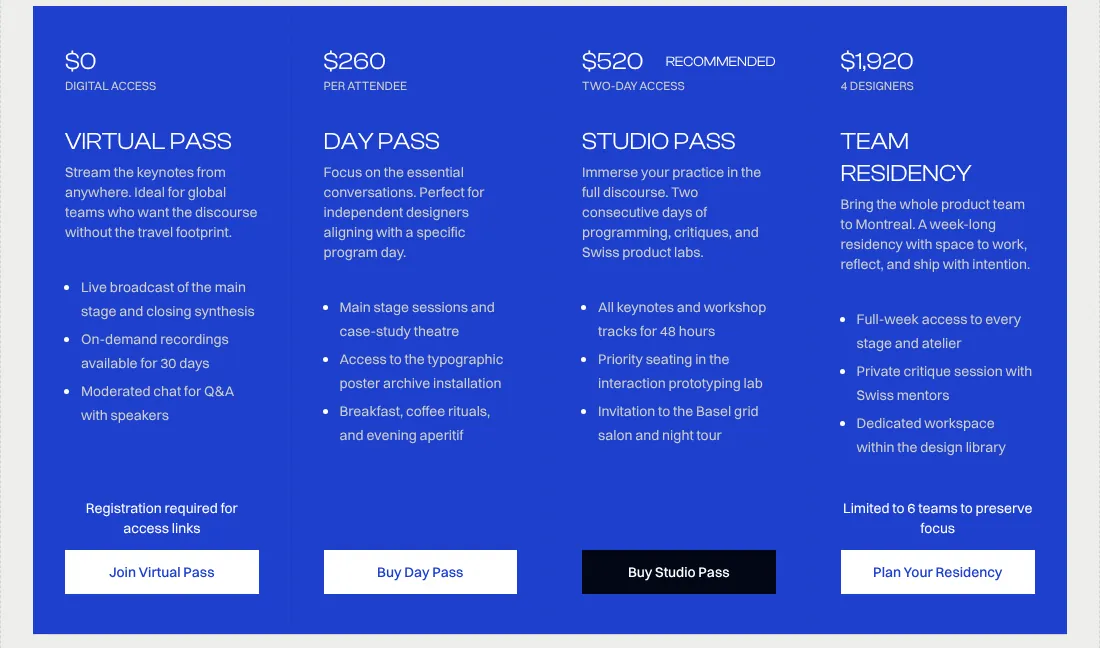
The tickets page offers four passes: a free virtual pass, a $260 day pass, a $520 two-day studio pass marked as recommended, and a $1,920 week-long team residency for four designers. A comparison table covers eight perks, and a "good to know" block explains student and group discounts, upgrades, transfers and refund dates. None of the four pass buttons does anything: they are plain buttons with no link or script behind them. The registration form (name, email, company, role, pass type, notes, consent) posts to the page's own address, the demo's static host answers 405 Method Not Allowed, and the visitor sees a blank page. The pass-holder sign-in and the contact form end the same way.
Venue, FAQ and the community pages
The venue page covers the address, transit, accessibility, nearby hotels and three rooms; its "Venue map" and "Residency handbook" links point to #_, and there is no embedded map. The FAQ answers 12 questions in four groups with native disclosure elements, so it works without JavaScript. Sponsors come in tiers, and the sample sponsors are real companies (Google and Medium as gold, Swissted and Polar.sh below them), each with its own page; one of the two sample hosts is named Anna Wintour. Replace every brand and name before launch. A recap of a 2024 edition, a nine-photo gallery and a six-post journal with tags and an RSS feed round it out.
Search, menus and mobile
Search opens from the top bar and matches sessions, speakers, journal posts and pages in the browser, with no request to a server: "grid" found a session and an essay, "anna" a speaker. The no-results message is white text on a light grey field and hard to read. The mega menu groups the pages into Programme, Event and Community, with a featured session, a ticket link and the latest journal post. On a 390 px screen we found no sideways scrolling and the menu opens, but its button doesn't report whether it is open. There is no dark mode.
A newsletter that posts to a third party, and dates in the past
The newsletter field in every page's footer sends the address to FormSubmit, a third-party form service, with [email protected] as the recipient. We blocked the request, so nothing was sent. Change the address or swap in your mailing list provider. The sample dates also need a pass: the event runs from Monday 10 to Sunday 16 November 2025, the home headline says "10th-17th", and the recap and gallery describe a 2024 edition.
Performance and SEO
One Lighthouse 12.8.2 run per page, 30 October 2026:
| Page | Performance | Accessibility | Best practices | SEO |
|---|---|---|---|---|
| Home, mobile | 97 | 100 | 96 | 92 |
| Home, desktop | 99 | 100 | 96 | 92 |
| Schedule, mobile | 98 | 100 | 96 | 92 |
| Schedule, desktop | 99 | 100 | 96 | 92 |
The home page weighs about 270 KiB on mobile with a 2.2 s largest paint, and the schedule 157 KiB with 2.0 s; neither has any blocking time. About 64 KiB of the schedule's weight comes from third parties: the Fontshare fonts and Fuse.js from jsDelivr.
The SEO deduction comes from the page head. Every page we checked outputs two <title> tags ("Your Page Title" and "Your Website Title") and two canonical URLs on two different placeholder domains, which Lighthouse flags as conflicting. The sitemap (63 URLs) and the RSS feed use a third placeholder domain, and the feed's title is "Lexington Themes" with Lexington's own store description. No page outputs structured data, so there is no Event markup with dates, venue and ticket offers, which is how search engines read an event. Add it yourself. The best-practices deduction comes from a favicon set and web manifest the head links to but the demo doesn't include.
What you still have to build
Ticketing. Point each pass button at a ticketing provider's checkout, or build payments yourself.
Registration and pass holders. The register and sign-in forms need a backend, confirmation emails and the access codes the sign-in page asks for.
Newsletter. Replace the FormSubmit form with your mailing list provider.
Metadata and Event data. Remove the duplicate title and canonical tags, set your domain, write a title and description per page, and add Event structured data for each edition.
Content. Dates, sessions, speakers, sponsors, hosts, the venue map and handbook files, and the speakers' social links (all
#_in the demo). Self-host the fonts and Fuse.js if you want no third-party requests.
Pros and cons
Pros
Covers the full set of event pages, down to a code of conduct, partners, hosts and a recap.
Sessions, speakers and the schedule are linked collections, and search across them works without a server.
The ticket comparison table and pass policies are already thought through.
Light pages: no blocking time on either page we tested, and 100 for accessibility.
Cons
No ticketing or registration: the pass buttons do nothing and the forms end on a 405 error page.
The newsletter posts to a third-party service with a placeholder address.
Two titles and two canonical URLs on every page, and no Event structured data.
Sample content names real companies as sponsors and is dated 2024 and 2025.
How Dusk compares
Tito is a ticketing service rather than a site: 3% per paid ticket (2.5% for charity, non-profit and community organizers), free events at no charge, payment fees on top and no monthly fee, per Tito. It pairs with Dusk: point each pass button at your Tito event.
Luma hosts event pages and tickets: free with a 5% platform fee on paid tickets, or $59 a month billed annually for no platform fee, plus Stripe's card fees, per Luma. For a one-evening meetup its own event page may be all you need; Dusk earns its place when the programme spans days, rooms and speakers.
Dusk is Lexington's only conference theme. The other event theme in its catalog, Northbound, is for weddings.
See all templates for more options.
Who should buy Dusk
Buy it if you organize a conference, festival or design week with several days, rooms and speakers, you want the programme, speaker and sponsor pages designed, and you have a developer and a ticketing provider. Look elsewhere if you need built-in ticket sales or registration, if your event is a single evening, or if you came here for an agency theme: Dusk no longer is one.
FAQ
Can Dusk sell tickets or take registrations?
Not in the demo. The four pass buttons have no link or script, and the registration, sign-in and contact forms post to their own page and end on a 405 error. Link the passes to a ticketing provider such as Tito or Luma, or build checkout and registration yourself.
Does Dusk include Event structured data?
No. None of the 64 demo pages outputs structured data, so there is no Event markup with dates, venue or ticket offers. You add it yourself, along with real titles and canonical URLs.
Is Dusk still an agency theme?
No. Lexington rebuilt Dusk as an event theme for conferences and festivals; the changelog dates the rebuild to April 2025. For an agency site, Lexington's current agency themes include Outkast and Kotei.
Is Dusk cheaper as part of a Lexington bundle?
Yes, if you might use a second theme. Dusk costs $89 on its own, while Full Access Personal is listed at $99 and includes all 53 Lexington Astro themes, Dusk among them, plus future themes and updates.
Can I use Dusk for events I run for clients?
Yes. Lexington's license allows unlimited websites for yourself and for clients, including commercial and white-label work without attribution. You can't resell the theme as a template, and each seat is one named person.
KEEP EXPLORING
More templates