Next.js and Astro single-product store with a model picker and checkout UI
Streamer
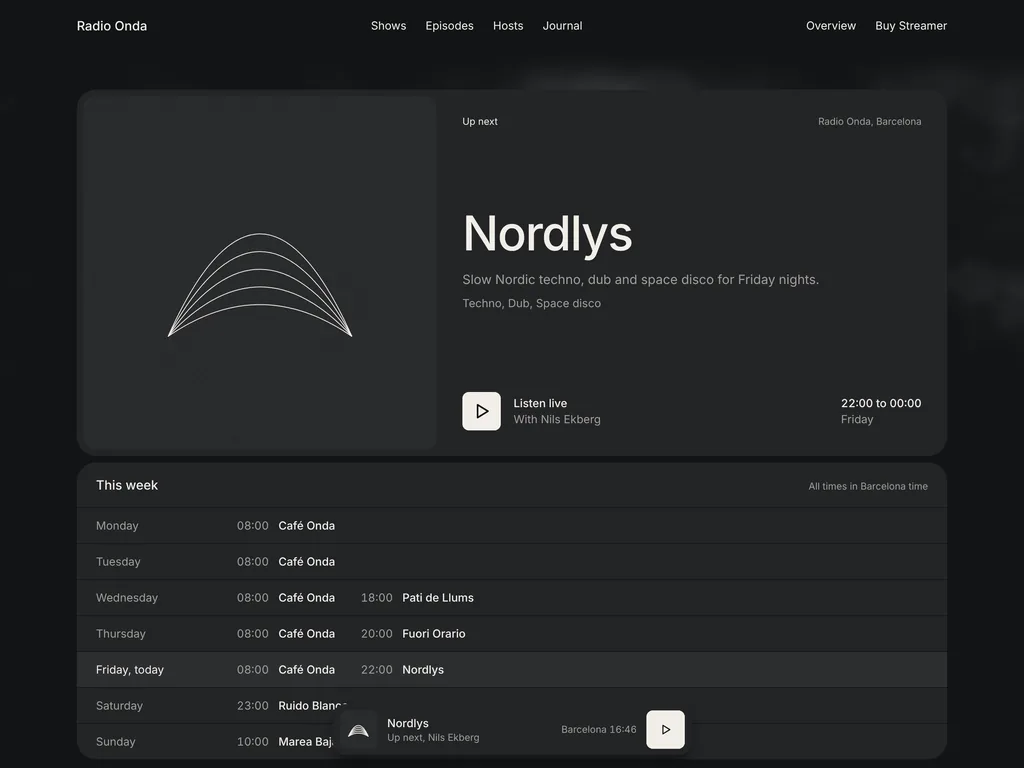
Dark Astro radio theme with a live player, weekly schedule and show archive
PaidTemplates
lexingtonthemes.comExplore the product
AT A GLANCE
- Website
- lexingtonthemes.com
- Pricing
- Paid
- Categories
- Templates
- Listed
- Mar 2023
- Updated
- Oct 2026
Details about Streamer
KEY POINTS
- Tailwind CSS v4
Short verdict: Streamer is a complete layout for an online radio station: a live card that knows which show is on air, a weekly schedule, show pages, an episode archive with tracklists, host profiles and a membership page. The demo plays no stream, though. Every play button uses one 1 minute 56 second MP3 stored with the theme, and connecting a real stream takes more than pasting a URL. It suits a community station or DJ collective that already runs a streaming server and has a developer. It is the wrong buy if you need a station that broadcasts and takes member payments without development work.
How we reviewed it: On 30 October 2026 we used the live Astro demo on a desktop and on a 390 px phone screen. We pressed every kind of play button while logging what the browser loaded, pointed the player at an outside MP3, filtered the archive and submitted the contact, sign-in and sign-up forms with the network recorded. Lighthouse 12.8.2 ran once on the home page and once on the episode archive. We did not buy the source code, so we can't judge code quality, and only the Astro edition has a public demo. Prices and license terms come from Lexington Themes on the same day.
Disclosure: Our links to Lexington Themes carry a referral tag.
What you get for $89
| Price | $89 one-time for the Astro edition; $129 for the Astro + Sanity or Astro + EmDash edition. Lexington Themes Full Access Personal costs $99 and includes all 53 Astro themes, so Streamer plus every other theme costs $10 more than Streamer alone. |
|---|---|
| Version | Astro 7.4.1 and Tailwind CSS 4.3.3, per Lexington. Released July 2024 and redesigned as a radio theme on 16 October 2026, replacing the earlier blog, podcast, jobs, help center and author pages. |
| Size | Lexington lists 7 static pages and 4 collections (shows, episodes, hosts, journal) plus legal pages. The demo's sitemap has 42 URLs: 6 shows, 10 episodes, 3 hosts, 3 journal posts, 5 legal pages and 5 style-guide pages. |
| Stack | Astro and Tailwind CSS 4 (version 4.3.3 in the demo's CSS), Lenis smooth scroll and a WebGL shader. No Alpine.js. Ships with AGENTS.md, a design skill and Cursor rules. |
| Delivery | Access to a private GitHub repository through Polar. It deploys to Netlify, Vercel or any static host. Lexington's setup guide still says Node.js 20 or later, but Astro 7.4 requires 22.22 or newer. |
| License | Unlimited websites for yourself and clients, commercial and white-label, no attribution. You can't resell the theme as a template or use it as the core of a site builder. License terms |
What we found in the demo
A live card that works out what is on air
The home page opens on the current or next show. A small inline script reads the day and time in Barcelona and picks the card before the page first paints. On Friday afternoon it showed Nordlys as up next at 22:00, with Friday highlighted in the "This week" schedule below. The schedule holds 10 weekly slots for the 6 shows; per Lexington it is computed from each show's days and hours. A mini player with the station clock stays pinned to the bottom of the screen as you scroll.
The player plays a 1 minute 56 second sample
The play button on the on-air card and the one in the mini player start the same file, /audios/one.mp3: a 3.7 MB MP3 that ends after 1 minute 56 seconds. The archive works the same way. Of the 10 episodes, only "First light" has a player, and it plays that same sample although the page says 2 hours. Eight episodes show "From the archive" with no play button, including "Monday warm up", which the home page features as episode of the week. One is members-only.
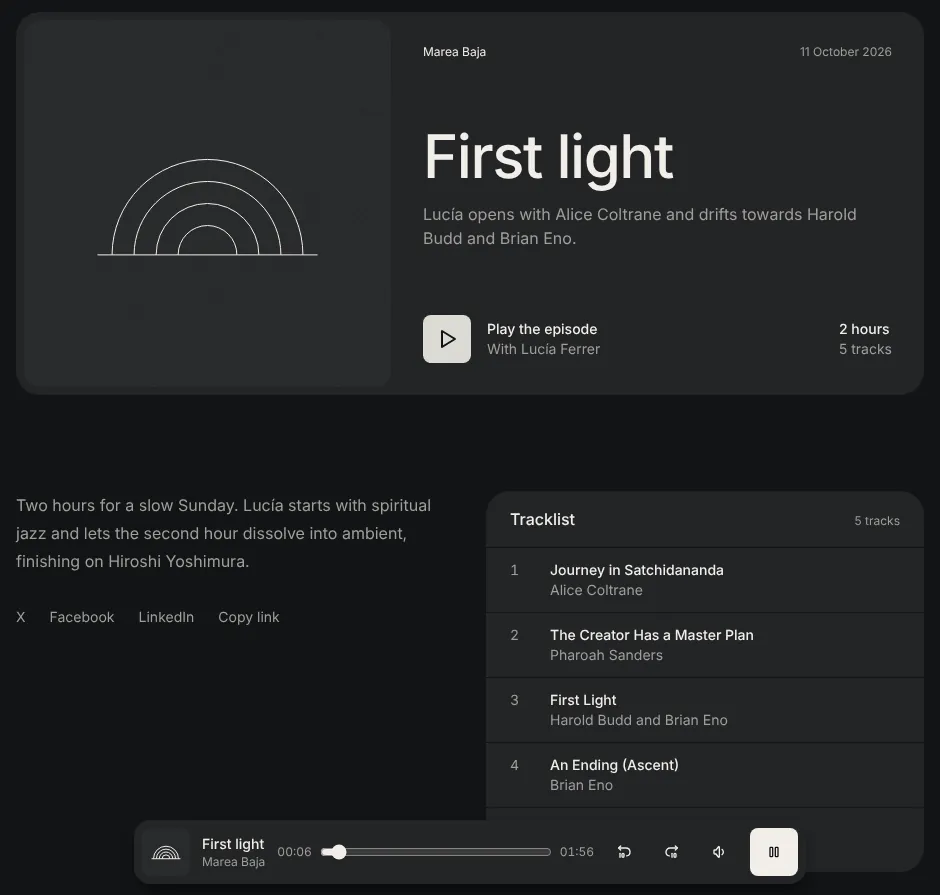
To go live you replace the file with your stream's address, and the shader adds a catch: it reacts to the music by routing the audio through the browser's Web Audio API. When we pointed the player at an MP3 on another domain whose server sends no CORS headers, Chrome reported that the audio source "outputs zeroes due to CORS access restrictions". The player showed as playing, but the shader got nothing and a listener would hear silence. Your streaming server has to send an Access-Control-Allow-Origin header and the audio element needs a crossorigin attribute, or you drop the audio-reactive part.
Playback also stops whenever a listener opens another page. Every link is a full page load, so the stream starts again from a paused player on the new page. Keeping it playing needs client-side navigation, such as Astro's ClientRouter, which the demo does not use.
Archive, tracklists and members-only episodes
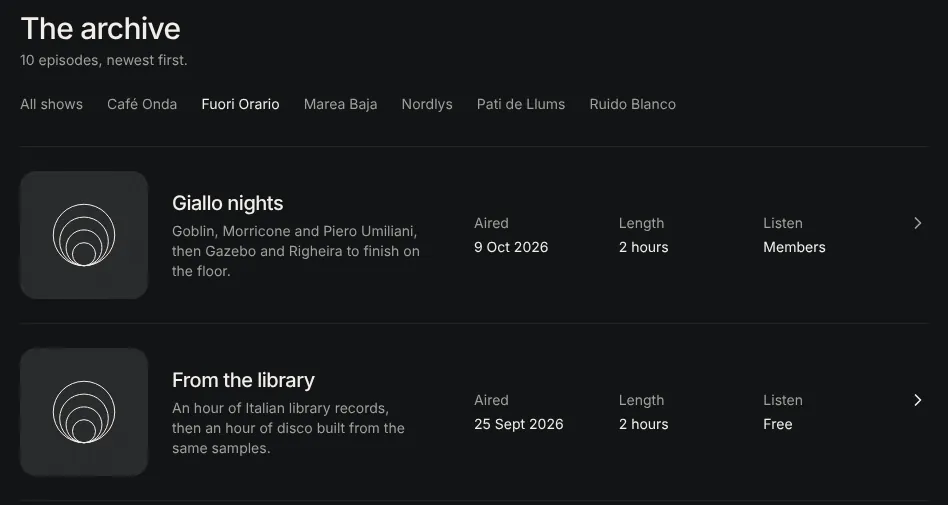
The archive lists 10 episodes as rows with air date, length and a Free or Members label, and a row of buttons filters them by show without reloading. The filter is not saved in the URL, so a listener can't share a filtered view. Episode pages carry a tracklist (5 tracks on the episodes we opened), links to the older and newer episode, share buttons and more episodes of the same show. The members-only episode replaces the play button with "Become a member" and "Sign in to listen".
Membership, sign-in and contact go nowhere
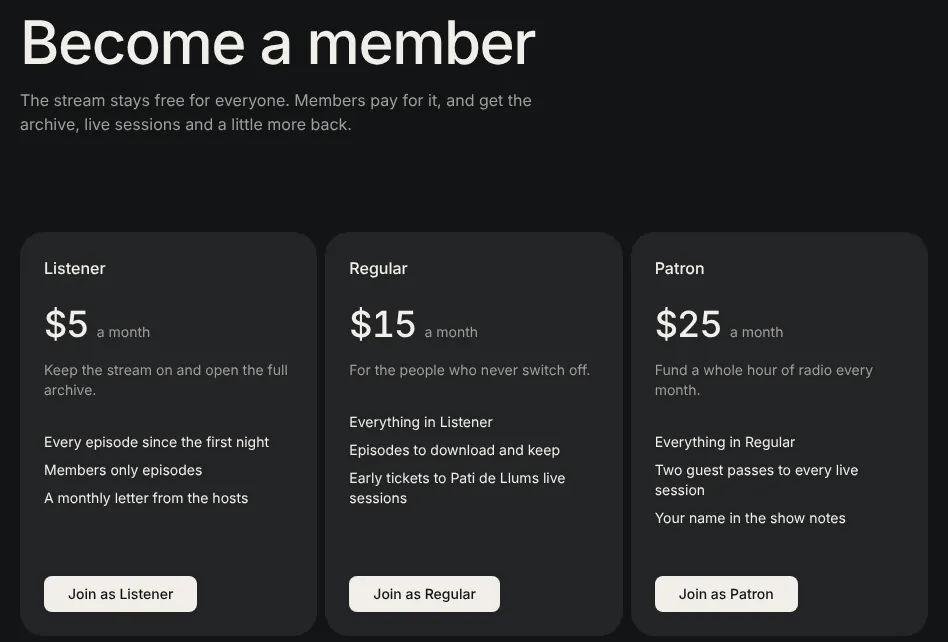
Listener costs $5, Regular $15 and Patron $25 a month, and every "Join" button opens the sign-up page. The sign-up, sign-in and contact forms post to their own page, and the demo host answers with a 405 error and a blank screen. Nothing is stored or sent, as expected from a static theme, and there is no confirmation message to build on.
Leftovers in the legal pages and the feed
The five legal pages were not rewritten in the redesign: they are dated 30 November 2023, the cookie policy names Simplexity (another Lexington theme), the terms print "**streamer **" with raw Markdown asterisks, and the legal FAQ is about a software team. The RSS feed carries the 3 journal posts, not the episodes, so podcast apps get nothing from the archive. On a 390 px screen nothing scrolls sideways, and the mobile menu works without JavaScript.
Performance and SEO
One Lighthouse 12.8.2 run per page, 30 October 2026:
| Page | Performance | Accessibility | Best practices | SEO |
|---|---|---|---|---|
| Home, mobile | 60 | 100 | 96 | 92 |
| Home, desktop | 61 | 100 | 96 | 92 |
| Episode archive, mobile | 100 | 100 | 96 | 92 |
| Episode archive, desktop | 100 | 100 | 96 | 92 |
The home page score comes from the smoke shader, not from heavy code. Our test browser has no graphics chip and draws WebGL in software, so each shader frame took 200 to 290 ms on the main thread and Lighthouse recorded 109 seconds of blocking time on mobile, while script evaluation took only 1.7 of the 154 seconds of main-thread work. With WebGL blocked, or with reduced motion on, the long tasks disappeared. On a phone the shader runs on the GPU, where we could not measure it. It is written with care: it starts when the browser is idle, caps itself at about 30 frames a second, pauses out of view and stays still for visitors who prefer reduced motion. The page itself weighs 140 KB in 12 requests on mobile.
SEO needs work before launch. Every page has the title "Your Page Title" and the same placeholder description, and the head carries two canonical links and two sets of Open Graph tags pointing at example domains. The conflicting canonicals are what cost the 8 SEO points. The sitemap lists the 5 style-guide pages next to the real ones, and none of the pages carries structured data. Best practices lost points for a web manifest and five icon files the demo links but doesn't have.
What you still have to build
The stream. A streaming server or hosted radio service with an HTTPS stream URL, CORS headers for the audio-reactive player, and a way to keep playback running between pages if you want that.
Episode audio. Files or a host for every archive episode; the demo has one sample for all of them.
Memberships. Accounts, recurring payments and server-side gating of members-only episodes. A static site can hide a play button but can't protect a file.
Forms. A form service or backend for contact, sign-in and sign-up, plus success and error states.
SEO and legal. Per-page titles and descriptions, one canonical tag, your domain in the sitemap, an episodes feed if you want podcast apps, and legal pages written for your station.
Pros and cons
Pros
The on-air card and weekly schedule are computed from one list of show times, in the station's time zone.
Shows, episodes with tracklists, hosts, a journal and membership pages are all designed and linked to each other.
Light pages: 100 for accessibility on both pages we tested, and a 140 KB home page.
The shader pauses offscreen and respects reduced motion.
Cons
No real stream in the demo, and a cross-origin stream plays silence until you add CORS headers.
Playback stops on every page change.
Membership, sign-in and contact forms have no backend and end on a blank error page in the demo.
Placeholder SEO tags with conflicting canonicals, and legal pages left over from older themes.
How Streamer compares
Hemingway is Lexington's podcast-and-magazine theme at the same $89. Per Lexington it pairs an essay index with episodes, an audio player and a members-only paywall. Pick it if you publish recorded episodes and articles rather than a live schedule.
Podcast by Cruip costs $49 and comes as HTML (Tailwind CSS 4 and Alpine.js), Next.js and Vue versions with a Figma file, per Cruip. It has an episode list, episode pages with a player and transcript, and a subscribe page, but no live player or schedule. Pick it for an on-demand show on a smaller budget.
Browse all templates for more options.
Who should buy Streamer
Buy it if you run an online or community station with a streaming server in place, want a schedule-led site with an archive and host pages, and have a developer for the stream, memberships and forms. Look elsewhere if you mainly publish recorded episodes, or need a site that takes members and payments without backend work.
FAQ
Does Streamer play a real radio stream?
No. Every play button in the demo plays one 1 minute 56 second MP3 stored with the theme. You replace it with your own stream URL. If the stream comes from another domain, its server must send CORS headers and the audio element needs a crossorigin attribute, or the audio-reactive player plays silence.
Do the memberships and members-only episodes work?
No. The three plans ($5, $15 and $25 a month) link to a sign-up form that posts nowhere, and the members-only episode only hides its play button. You need accounts, recurring payments and a server that protects the audio files.
Should I buy Streamer alone or Full Access?
If you might use a second theme, buy Full Access. Streamer alone costs $89, while Lexington Themes Full Access Personal costs $99 one-time and includes all 53 Astro themes, Streamer among them.
Is there a Sanity or EmDash version?
Yes. Lexington sells Astro + Sanity and Astro + EmDash editions for $129 each. Only the Astro edition has a public demo, so we could not test them. Streamer's changelog describes the October 2026 redesign as a redesign of the Astro + Tailwind CSS variant, so ask Lexington whether the CMS editions already match it.
Can I use Streamer for client projects?
Yes. The Lexington license allows unlimited websites for yourself and for clients, including commercial and white-label work, without attribution. You can't resell or redistribute the theme as a template.
Get new templates like Streamer weekly
Every Monday: the templates, components and tools added to Tailkits that week, each checked by an editor. Free, unsubscribe in one click.
17 new in the last 30 days313 products reviewed so farSee what you get
KEEP EXPLORING
More templates